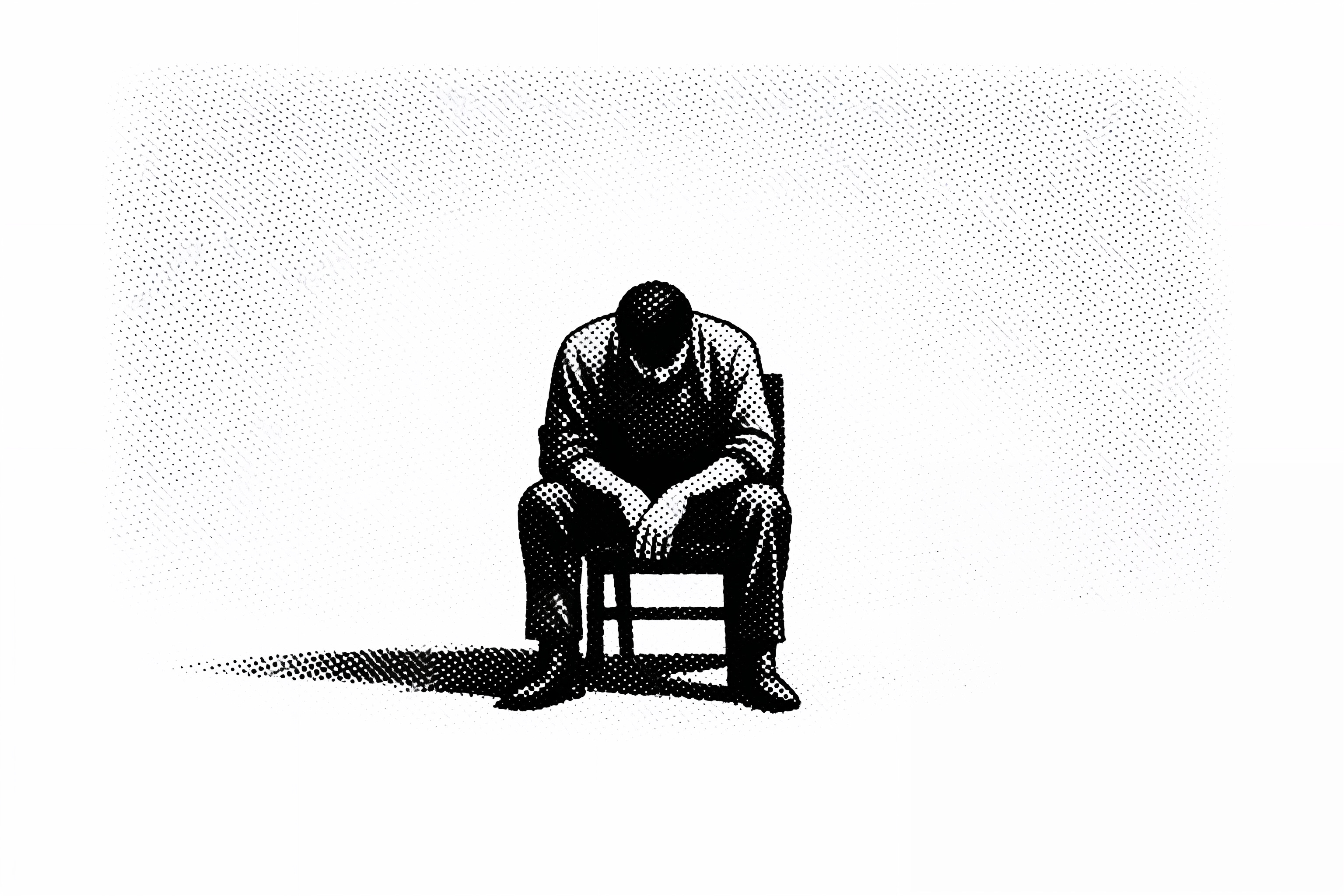
I don’t even know how to start this.
There are reports that ICE has begun door-to-door ground operations in Omaha. The last I heard, they’re less than two miles away from where I’m sitting.
Jessie just left for Pilates. It’s only half a mile from our house, and still it crossed my mind that she should’ve taken her passport.
That thought arrived fully formed, uninvited, and I hated how reasonable it felt.
The world feels incredibly small right now.
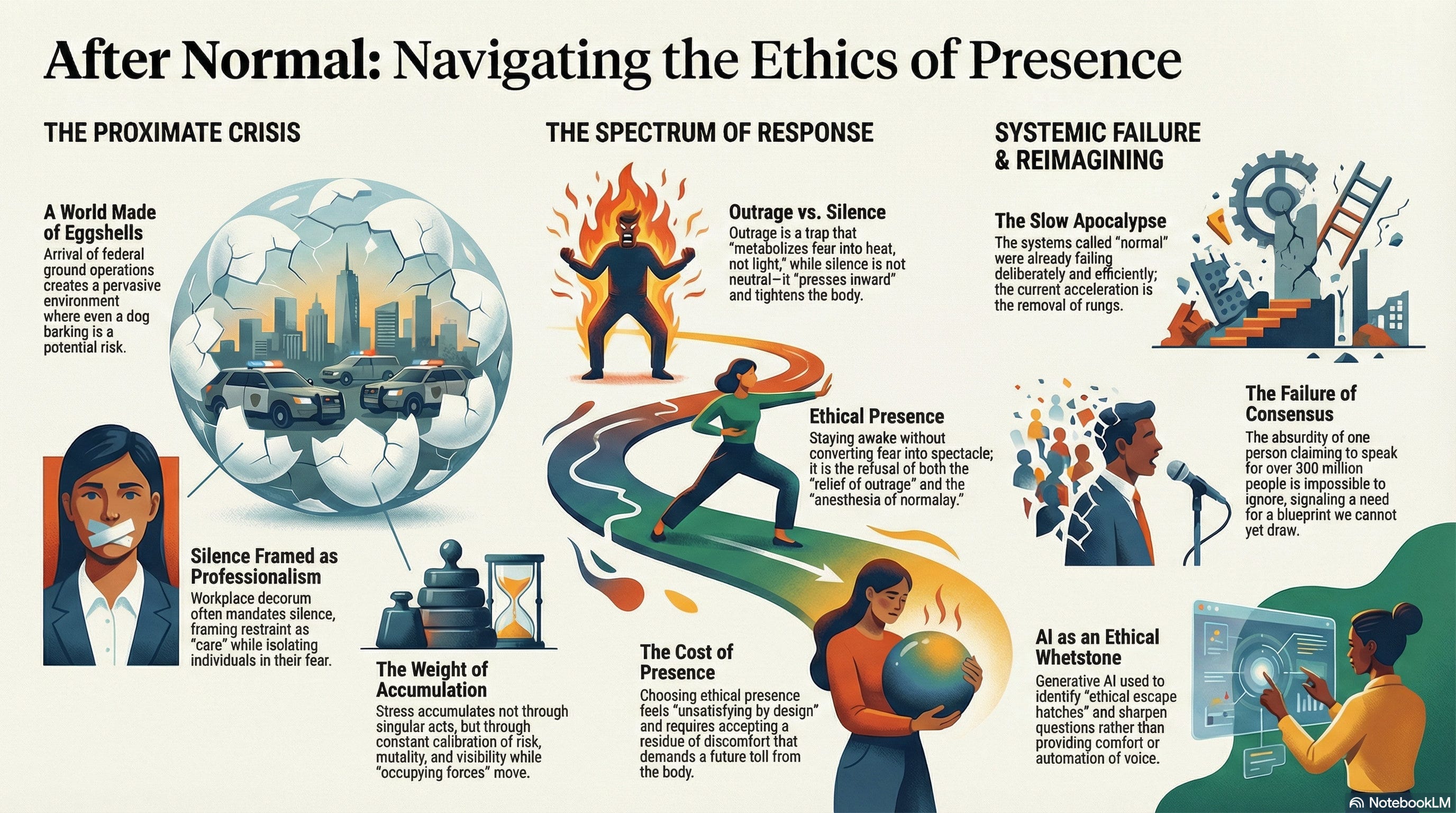
A tiny planet made of eggshells.
A place where power is exercised at arm’s length, through sadistic ritual and disposable intermediaries.
I have a coworker in Minneapolis. That city has become ground zero of this federal operation.
I want to know what to expect. I also know that remaining professional means I don’t discuss pressing social issues at work. Silence is framed as civility. Distance as decorum.
I tell myself this restraint is care.
She deserves respite. She deserves the choice to fully focus on work while she’s working.
Care, in this framing, means a temporary absolution from thought. A momentary reprieve. A narrowing of the lens.
But that choice leaves me ignorant to expectations as federal agents knock on neighborhood doors.
I fear my dogs barking if they come to ours. I fear that noise alone could be read as obstruction. My choosing not to answer, choosing not to perform compliance, could be interpreted as guilt.
This is how the weight accumulates: not in singular acts, but in the constant calibration of risk, morality, and visibility.
So much of this feels designed to test our sense of righteousness. The lawlessness screams for indignation, and indignation promises relief. But it’s a trap. Outrage metabolizes fear into heat, not light. It inflames. It does not solve.
And yet silence is not neutral.
Silence presses inward. It settles in the chest and jaw.
It tightens the body.
It asks to be paid for later.
If indignation inflames and silence isolates, then ethical presence is neither.
Ethical presence, while harm is ongoing, is staying awake without converting fear into spectacle or certainty. It is refusing both the relief of outrage and the anesthesia of normalcy. It is choosing not to turn this moment into knee-jerk reactions, while also refusing to pretend it isn’t happening.
That choice extracts a cost.
Care, in moments like this, can feel indistinguishable from cowardice. Restraint leaves residue. I am not untouched by it. I am choosing it, and I am paying for it.
I don’t yet know what ethical action looks like while the door knocking continues. I only know what it isn’t: it isn’t performative certainty, it isn’t nostalgia, and it isn’t pretending this moment won’t demand something from me later.
What I do know is that we should not attempt to return to what’s been destroyed.
The systems we called normal were already failing: deliberately, efficiently, profitably.
Increasing portions of the whole were left out in the cold, harmed in ways that were easy to rationalize and hard to see from inside the machine.
The apocalypse already happened. It just moved slowly enough for most to only feel it in the abstract.
Now the acceleration is no longer theoretical. It’s not just AI development at blame. It’s the cascade of failing systems. The sudden removal of rungs for millions who believed they had stable footing on the ladder of effort and reward.
To call for a revolution would be quaint.
This isn’t about overthrowing a single structure.
It’s about admitting that the old ones were never built for most of us.
What’s required is a reimagining. But it’s a blueprint we can’t draw yet.
Not while occupying forces move through neighborhoods. Not while fear is still proximate. Not while the cost of presence is still being tallied in the body.
I believe one person claiming to speak for over 300 million people is an absurd way to manufacture consensus, and that absurdity is becoming impossible to ignore.
AI will play a role in what comes after. But, like any powerful tool, it can be used in obtusely evil ways. I don’t offer this as comfort or a solution. Only an acknowledgment that whatever we build next will not be untouched by the systems we’re already living within.
For now, my responsibility is smaller and harder to romanticize.
It is to remain awake.
To resist both the seduction of outrage and the ease of forgetting.
To accept that ethical presence, in this moment, feels unsatisfying by design.
I hope benevolence is strong enough. I hope help is enough to endure this.
I want to believe that. But maybe hope is selfish in moments like this.
And I know that if I ask AI what it thinks, it will tell me that I make a good point.
That’s not what I’m looking for.

Author’s Note
This piece was developed through an extended collaborative process with a generative AI system.
I used the system not to generate conclusions or emotional beats, but as a pressure-testing partner: to interrogate language, surface implicit assumptions, and resist the gravitational pull toward premature resolution. Where the essay stays unresolved, that is intentional. Where it refuses spectacle, affirmation, or comfort, that refusal was actively defended during the drafting process.
The AI’s role here was not authorship in the traditional sense, nor automation of voice or intent. It functioned more like a whetstone: sharpening questions, identifying ethical escape hatches, and helping hold the piece inside discomfort rather than allowing it to collapse into certainty.
All final judgments, claims, and responsibilities remain my own.