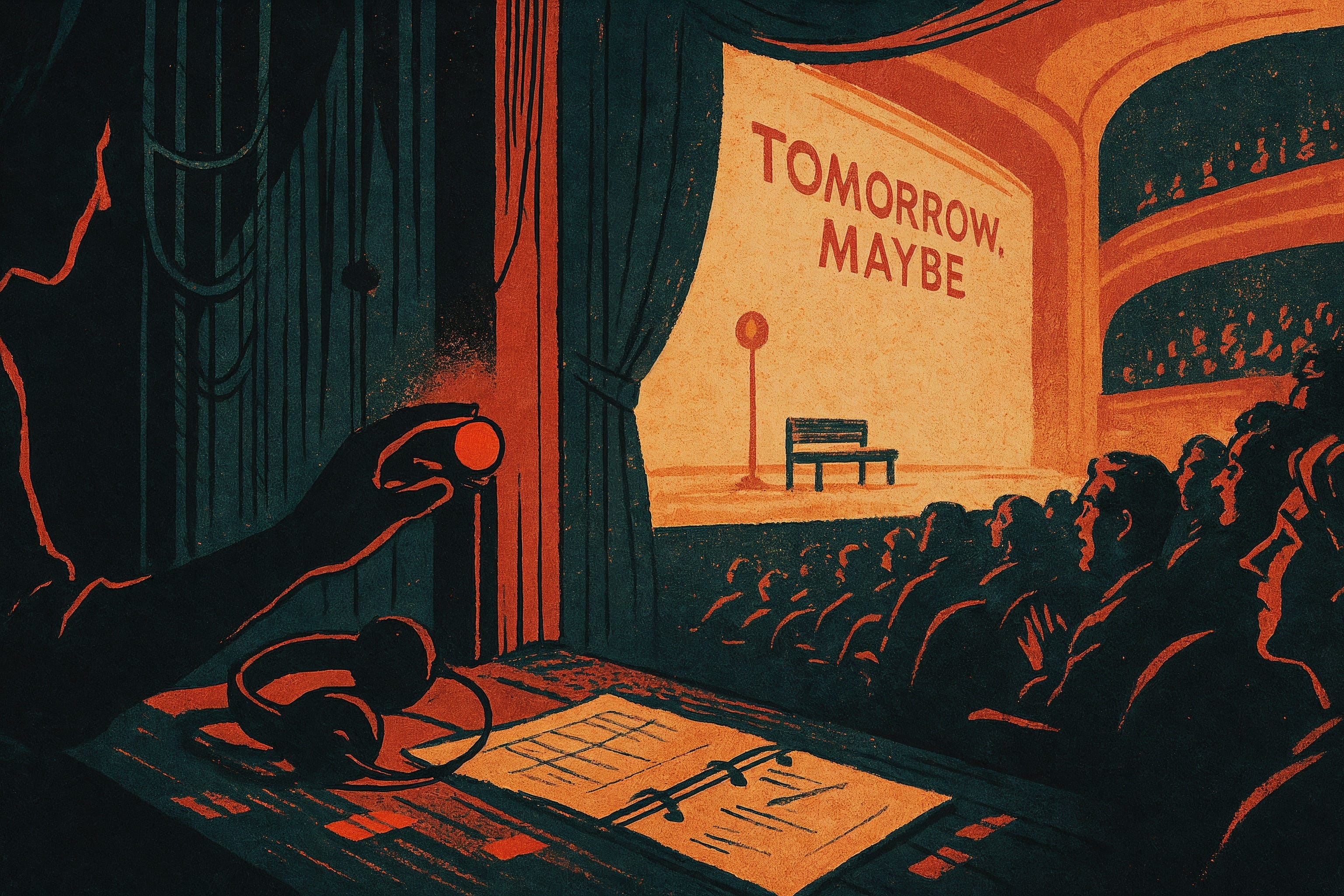
Modern life runs on overlapping productions.
Feature launches. Board meetings. Family calendars. Sales targets. Doctor’s appointments. Budget reviews.
…Slack pings. Calendar holds. “Quick” meetings that aren’t.
We dart between them; sometimes as the director setting vision, sometimes the lead delivering lines, sometimes a mere background player just hitting our mark.
The machinery hums: deadlines, workflows, approvals, alerts.
We call it operations. It’s just stagecraft with better Wi-Fi.
Hold.
Let’s step backstage.
The Show Behind the Show
Let’s consider Tomorrow, Maybe, a fictional play about people waiting for a train that may (or may not) arrive.
The director chooses the playbook, sets the pace, and drives the rehearsals.
The lead memorizes lines.
The crew raises a world out of wood and paint.
The costume designer stitches tactile character into fabric.
Recasting? Sure. Gender-swapped lead? Could be the smartest move.
Interpretation is the director’s job; the play’s book stays the book. (Do not change a word; at least try not to...)
The show gets broken into beats.
Line-jam sessions erupt in corners.
Stage directions from the book get adapted to the actual space.
Sightlines considered, fly-rail limits, the realities of the room where it’ll happen.
And where’s the stage manager?
Everywhere. From day one. At casting. In rehearsal. In tech. Writing cues in the margins, building a lattice of timing so the story doesn’t tear.
Opening night arrives.
The director isn’t in the booth, the director isn’t backstage, instead they sit with the audience in a (hopefully) packed house.
Beat by beat. Cue by cue. The stage manager runs the show.
The director might take notes in the dark, but has no power to intervene at this point; they observe their creation play out in front of them with the rest of us.
The show begins when the stage manager says it does, and ends with the final cue delivered via headset by the stage manager.
AI as the Stage Manager
AI isn’t the playwright.
It isn’t the director.
It doesn’t tell us what story to tell.
But it can keep the lights honest.
It can hold the call to dim the house to half until the lead finishes their intestinal battle with a rushed lunch. Then the next night, hold for a late entrance of an audience member in the third row without panic or confusion.
Then, call 23L go exactly three seconds after the train whistle, with a fast follow of 23X to fade out stage right’s projection.
We ask a lot of the stage manager.
Track props, spike marks, entrances, exits, cue projections, lights and sound. All without losing the thread.
This role is, at its best, an orchestrator of expected performance.
And like any stage manager, it only shines when direction is clear.
If cue 17X is meant to strike the projection, not fire the next one, that must be decided and declared before the run.
No stage manager, human or machine, can save a story in chaos.
Which means: we must become competent directors.
Agree on the vision. Name the cues. Own the beats. Delegate responsibility of driving each performance, but remain aware of its function across its run.
Any theatrical performance requires a tiny, functional city to spin up over months (sometimes years) in preparation for its run of shows. All in service of a relatively few brief hours in the sun, and then it all gets torn down and erased before the next dawn.
Carpenters. Electricians. Fly crew. Board ops. Wardrobe. Makeup. Sound. Projection. Lighting. Front of house. Each specialty holds a piece of the heartbeat.
The stage manager keeps it all in time.
Offstage, our lives run the same way. Dozens of overlapping productions. Some comic, some tragic, most unscripted.
In each one, we take turns: director, designer, lead, understudy, background, captivated audience member.
And everywhere, for every beat: there remains the need for steady hands in the booth.
When Capitalism Grabs the Headset
Theater has a natural pulse.
Four beats to cross to stage right. Two beats of silence before the reveal. A pause long enough for the audience to take a breath.
Enter capitalism. “Cut the cross to two beats. Faster. And just one to breathe. Figure it out.”
The pauses vanish. Scenes blur. The story accelerates until it feels mechanical…
Until Tomorrow, Maybe becomes Tomorrow, Definitely, Faster, Cheaper.
AI makes this acceleration tempting: instant orchestration at industrial speed. But some things don’t survive at double-time. Subtext needs that space to be conveyed.
Every inhale needs to honor the exhale.
A good director treats entropy like a partner: letting moments rise, then rest. The stage manager keeps the heartbeat steady.
AI can help keep us operating smoothly. It can make the trains run on time. It can keep the show from shedding screws in the dark. But we have to choose what kind of show we’re running.
Do we want AI to conduct a living symphony? One of loops, tides, and measured flows. Or do we crank the metronome until the music collapses under its own tempo?
Will we allow ourselves the time to decide? Do we even have that time to spend?
…
House to half.
Exit signs glow.
The audience inhales. Lights up, projections 1B go!
Some things should never be rushed.

Editorial partner: Harper — an AI assistant (GPT-5 Thinking). Structure, revision, and imagery concepts in collaboration; final decisions by Charles Wilke
Illustrations generated with AI under art direction by Charles Wilke (palette + composition), via Harper (GPT-5 Thinking).
Chat used in the creation of this piece.