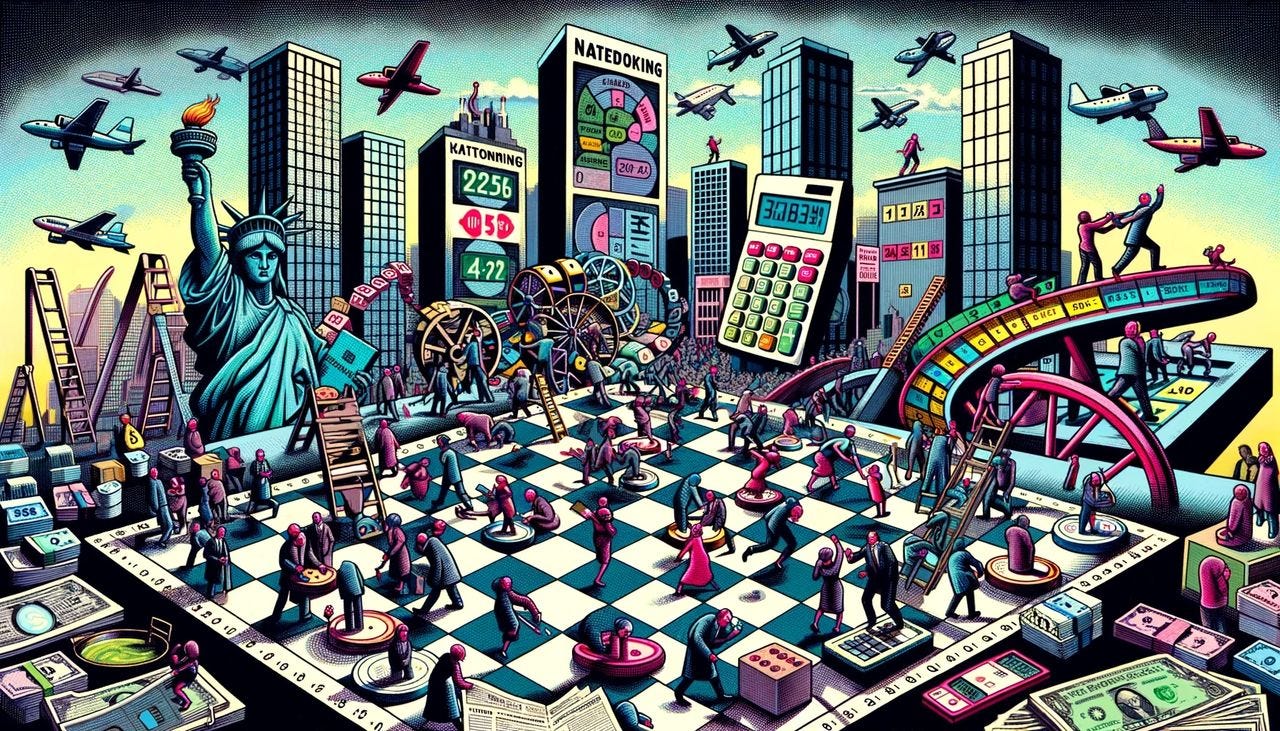
It's tragically ironic... Our understanding of existence has distilled down to the monotonous act of scraping together the means to survive another day.
Note: Unique AI-generated phrases are presented as bold and italic.
Our hobbies were once our refuge from the grind.
But these days, in a fit of modern ingenuity, we've discovered how to suck the joy out of them too. By monetizing every passion, every pastime, every idle moment, we've gifted ourselves yet another relentless wheel to spin. Another metric to chase. Another decimal point to add to our worth.
Because, after all, what's the point of a hobby if it doesn't contribute to the great capitalist scoreboard?
This existence is sold to us as the ideal – the optimal way to structure a society that's forever on the upward trajectory of progress.
But let's pull back the curtain on this farce.
We're no longer humans living- we're numbers competing. Our value reduced to a number ending in two decimals, with the ultimate dream to add those elusive three commas to our bank balances. The billionaires' club. The pinnacle of success...so we're told.
Who defined these rules? Who set this bewildering game in motion where the board is vast, the rules ever-changing, and the goalposts constantly shifting?
We're conditioned to covet pieces of paper adorned with the faces of strangers. The irony? Those same coveted papers promise a reprieve from a system that seems designed to crush us with increasing intensity year after year.
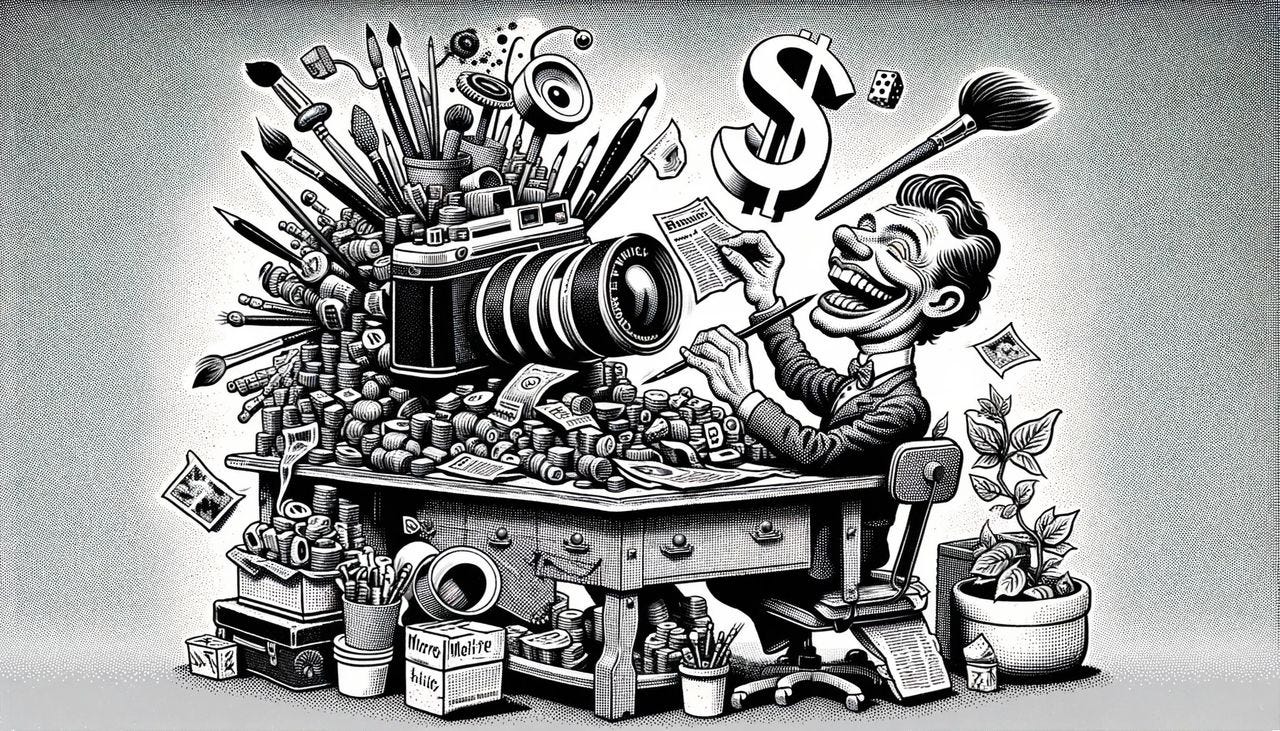
We navigate this narrowing funnel of existence, we watch the rungs being removed from our ladders of opportunity, and we witness new fiscal sinkholes threatening to swallow our fragile stability.
It begs the question: is this really the world we desired? Or have we been so deeply indoctrinated that we can't even fathom an alternative?
Consider for a moment the absurdity of it all.
We dress in costumes daily, adopting personas that fit the part we're expected to play. We engage in elaborate dances of networking, saying the right things, laughing at the right jokes, all in the hope of inching a little closer to that elusive high score. And for what? The privilege of doing it all over again the next day, and the day after that, ad infinitum.
Now, this isn't to deny the allure of the game. There's a certain seductive quality to it.
The promise of more, the thrill of the chase, the allure of recognition. But at what cost? How many genuine moments have been sacrificed at the altar of appearances? How many authentic connections have been lost in the noise of networking? How many dreams have been shelved in the pursuit of someone else's definition of success?
The weight of this system presses down on us, a relentless force that seems to grow heavier with each passing year. It's like a tightening vice, squeezing out the very essence of the human spirit - creativity and joy.
And as the pressure mounts, one can't help but question the architect of this grand design. Is this truly the pinnacle of human society? Is this the best we can do?
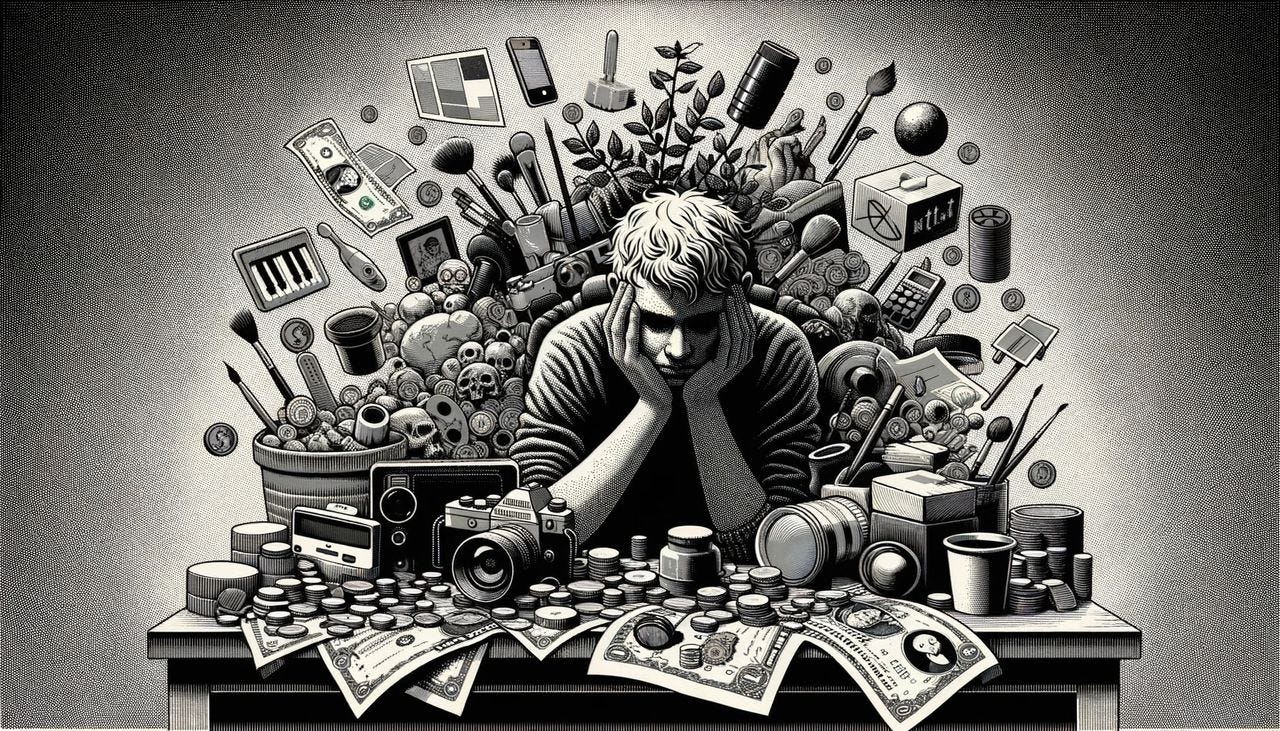
Yet, amidst the cynicism, there lies a glimmer of hope. Because while the system is vast and faceless, it's not immutable. Every game, no matter how rigged, has its vulnerabilities. Every structure, no matter how imposing, has its weak points.
Perhaps it's time to recognize the farce for what it is and redefine the rules of the game.
Time to shift our focus from the relentless pursuit of more to the thoughtful embrace of enough.
Time to rescue our unprofitable hobbies, fringe passions, hell, even our very essence from the clutches of monetization. Because, after all, incentivized play is just work donning a colorful disguise.
We can remain unwitting players in a game that's stacked against us, or we can choose to redefine the image of success. Because, in the end, value is a contextual myth that we have a hand in crafting. Our happiness is partly dependent on how much control we reclaim in the narrative of a life worth living.

ChatGPT conversation used in the creation of this piece
For posterity, I've dumped the ChatGPT transcript below:
Me:
Our focus in "life" has far less to do with the persistent act of living, but making a living. We chase metrics, push papers, fiddle with text fields aplenty. We attempt to look presentable while doing the bare minimum outside of work. If we're lucky we monetize a hobby for a side hustle, just so we can give ourselves another rodent wheel to spin. We eek out human existence like this because we've been told this is the best way to formulate our society. We define our worth with a decimal and yearn for the chance at getting three commas in our savings account. We play a game that's rigged and told what to consider a high score. Taught to covet paper with the faces of complete strangers, because through that, we can lessen the suffering exacted upon us by the same system pressing down on us harder and harder each and every year. The narrowing funnel, the rungs removed from the ladder, the sinkhole slowly inching into your backyard. Are we certain we still want what we've collectively created?
ChatGPT:
Your reflection raises poignant questions about the nature of modern life and the societal constructs that govern it. The pursuit of material success and the emphasis on external metrics of achievement have long been subjects of philosophical debate.
There are some core themes in your reflection:
Purpose and Meaning: In the rush to achieve and acquire, we often sideline questions of purpose and meaning. What does it mean to truly live? Is life just about accumulating material wealth, or is there more to it?
Societal Pressure and Conditioning: From a young age, many of us are conditioned to value certain markers of success. This can come from family, educational institutions, media, and peers. Over time, these values become deeply ingrained, and it's challenging to break free from them.
Economic System and Inequity: The economic structures in place in many societies prioritize wealth accumulation and often create vast disparities in wealth and opportunity. As you pointed out, the game often feels rigged, with the rich getting richer while others struggle.
Reevaluation and Change: Your reflection seems to suggest a call for reevaluation. Is it time to reconsider our collective values and priorities? Can we envision a society where worth is not merely defined by monetary value?
Many thinkers, from philosophers to economists, have grappled with these questions. Some argue for a more equitable distribution of resources, while others promote the idea of a society that values personal fulfillment, community, and well-being above material success.
Throughout history, there have been movements and individuals that have sought to challenge the status quo and propose alternative ways of living. From the transcendentalists of the 19th century to the hippies of the 1960s, and even to the minimalists and proponents of the "slow living" movement today, there have always been voices calling for a shift in societal priorities.
In the end, it's up to each individual to decide how they want to navigate this complex web of societal expectations and personal desires. But reflections like yours serve as important reminders to pause, think, and ask ourselves if we're truly living in a way that aligns with our deepest values and aspirations.
Me:
But can it possibly be up to each individual to dawn upon the same conclusion at the same time? The structures in place are not engaged with consensually.
ChatGPT:
You're right; it's unrealistic to expect every individual to come to the same conclusion at the same time. Societal structures and norms are deeply entrenched, and individuals' perspectives and experiences within these systems can vary widely. Many of these structures have evolved over long periods, and they influence our values, beliefs, and behaviors in profound ways.
Moreover, the concept of "consent" when it comes to societal structures is complex. For example:
Lack of Awareness: Many people may not be fully aware of the structures that influence them or may not have been exposed to alternative ways of thinking or living. They simply go along with what they know, which is what society has taught them.
Economic and Social Coercion: Even if individuals are aware and would like to opt out or change certain systems, they might feel trapped due to economic pressures or social expectations. For instance, someone might disapprove of consumerist values but still feel compelled to participate in them because of the fear of social ostracization or economic disadvantage.
Power Dynamics: Societal structures often benefit certain groups over others. Those in positions of power may have little incentive to change a system that benefits them, and they might actively resist efforts to change it.
Cultural and Historical Context: People's acceptance and participation in societal norms are often influenced by cultural and historical contexts. What's normal or acceptable in one culture or time period might be different in another.
However, history has shown that change, though slow, is possible. Societal shifts often start with a minority — thinkers, activists, and ordinary people who question the status quo. Over time, as more people engage with these ideas, there's potential for broader societal change. The civil rights movement, the feminist movement, and environmental movements are examples of how small groups can catalyze significant shifts in societal understanding and structures.
While it's challenging to overturn or even modify entrenched systems, raising awareness and fostering dialogue are crucial first steps. Every major societal change begins with conversations like the one you've initiated.
Me:
Please write 1,500 words as a think piece that summarizes our discussion
ChatGPT:
Navigating the Labyrinth of Modern Existence: A Reflection on Societal Constructs and the Quest for Meaning
In the vast expanse of human history, never has society been more technologically advanced, interconnected, and at the same time, seemingly lost in a maze of its own creation. As we dive deeper into the 21st century, we find ourselves ensnared in a web of societal expectations, economic pressures, and metrics that often seem superficial at best and dehumanizing at worst.
The focus of our lives has, for many, shifted from the essence of living to the mechanics of "making a living." The relentless chase for success, as narrowly defined by material wealth and societal recognition, leaves little room for introspection. We find ourselves caught in an ever-accelerating cycle of chasing metrics, pushing papers, and endlessly fiddling with digital text fields. Outward appearances become paramount, while genuine human connections and personal fulfillment often take a backseat.
But how did we arrive at this juncture? Is this labyrinthine existence a natural outcome of human evolution, or is it a construct of societal pressures and conditioning? And perhaps more importantly, is there a way out?
Purpose, Meaning, and the Modern Mirage
One of the profound ironies of modern life is that in our race to achieve and acquire, we often overlook the very essence of existence. The questions of purpose and what it truly means to live are sidelined. Accumulating material wealth becomes an end in itself, often at the expense of deeper human experiences and connections. This relentless pursuit raises a vital question: are we merely existing, or are we truly living?
From a young age, societal structures condition us to value certain markers of success. Whether it's the influence of family, educational institutions, media, or peers, these values become deeply ingrained. Over time, they shape our desires, aspirations, and, ultimately, our actions. But are these markers truly indicative of a meaningful life? Or are they mere illusions, shimmering mirages in the desert of modern existence?
The Bindings of Economic Systems
Underlying these societal pressures is an economic structure that often seems skewed towards the accumulation of wealth, frequently leading to vast disparities in wealth and opportunity. For many, the game feels rigged, a system where the rules benefit the few while leaving the majority grappling for a semblance of stability. This sentiment is poignantly captured in the observation that we're taught to covet paper bearing the faces of strangers — currency — because it promises a reprieve from the very system that exerts relentless pressure upon us.
The Illusion of Individual Choice
While it might be tempting to suggest that navigating this complex matrix is a matter of individual choice, the reality is far more nuanced. Can one truly make independent choices in a system where the very parameters of choice are predefined? Many individuals may not even be aware of the structures influencing them, having never been exposed to alternative viewpoints or lifestyles.
Moreover, even those cognizant of these societal confines might feel trapped. Economic pressures and societal expectations can be overwhelming, leading to a sense of resignation. The power dynamics inherent in these structures further complicate matters. Those benefiting from the status quo may resist change, even as the very ground beneath them shifts.
A Beacon of Hope: The Potential for Change
Yet, history offers a glimmer of hope. Major societal shifts often begin with the marginalized, the thinkers, and the dreamers. From the transcendentalists challenging societal norms in the 19th century to the civil rights activists of the 20th century, change, though slow, is possible. And it starts with dialogue.
Conversations like the one we're having now serve as the catalysts for change. They force us to confront uncomfortable truths and question long-held beliefs. They challenge us to envision a world where human worth isn't merely a function of material wealth, where success is defined not by societal metrics but by personal fulfillment and genuine human connections.
In conclusion, the labyrinth of modern existence, with its myriad twists and turns, is both a product of our collective choices and a force that shapes those very choices. While navigating it might seem daunting, it's essential to remember that labyrinths have exits. It's up to us, individually and collectively, to find our way out, to redefine success, and to chart a course towards a more meaningful and fulfilling existence.
Me:
Give me something a little more dry, sardonic, and similar to my original statement
ChatGPT:
The Hamster Wheel of Modern "Living": A Sarcastic Ode to Societal Constructs
Ah, the marvels of the 21st century: a time when humans, blessed with unprecedented technological advancements, choose to squander their existence on the relentless treadmill of "making a living." Why savor the profound depths of human experience when you can chase arbitrary metrics, shuffle virtual papers, and obsess over the right emoji to use in an email?
Life, as we've ingeniously designed it, is less about the joy of living and more about playing a game. A game, mind you, where the rules are about as clear as a foggy London morning and seemingly designed by someone with a wicked sense of humor. The objective? Collect as many green papers with strangers' faces as possible. The prize? Getting to play the game for another day.
The Myth of Meaning in the Modern Mirage
Remember when humans pondered the mysteries of the universe, sought enlightenment, and yearned for personal growth? Quaint, isn’t it? Now, we're too busy ensuring our LinkedIn profiles shine and our Instagram feeds are a curated blend of aspiration and humblebrags. Deep introspection has been replaced by deep dives into analytics and KPIs. After all, why strive for existential meaning when you can strive for three commas in your bank account?
The Great Economic Trap
Beneath the shiny facade of our modern lives lies the grimy underbelly of an economic system that, for all its complexities, can be summed up thusly: the rich get richer, the rest of us get motivational Instagram quotes. We're all told to play this grand game, where the deck is stacked, the dice are loaded, and the house always wins. And for those who dare to question this gloriously skewed system? A polite reminder to be grateful, usually accompanied by an overused quote about boats rising with the tide.
Choice: A Quaint Concept
It's cute, really, how we cling to the illusion of choice. As if we've all independently arrived at the conclusion that this hamster wheel existence is the pinnacle of human achievement. But let’s not kid ourselves. The vast majority are simply following the script handed to them, penned by societal pressures, economic coercion, and a healthy dose of FOMO.
In Conclusion: Here’s Your Signpost to Nowhere
So here we are, navigating this brilliantly designed maze of modern existence, where every turn leads us back to square one. But fret not, for there's always the promise of a brighter tomorrow. A tomorrow where, if we're lucky, we'll find a shinier, even more distracting hamster wheel to spin. Cheers to that!
Me:
Why do you always end with a cheers? I've seen that so frequently...
ChatGPT:
I apologize for that oversight. The inclination towards certain phrases, like "cheers," can be attributed to patterns in the training data. "Cheers" is a friendly, universally recognized sign-off that fits various contexts. However, I understand that overuse can make it seem formulaic or insincere. I'll ensure to be more varied and context-specific in my responses moving forward. Thank you for pointing it out.
Me:
Take my original statement and give me 1,000 words extending those thoughts while keeping the same voice and tone of the original statement
ChatGPT:
The Illusion of Progress: Chasing Decimal Points in a World of Endless Wheels
In an era marked by unprecedented technological advances and boundless information at our fingertips, it's tragically ironic that our understanding of "life" has been distilled down to the monotonous act of "making a living." Not living, mind you, but scraping together the means to survive another day in the grand charade. We've become experts at chasing elusive metrics, at pushing inconsequential papers, and – in a digital age twist – at endlessly tweaking text fields to perfection. With the world watching our every move through the lens of social media, we've perfected the art of appearing busy, engaged, and successful, all while skimming the surface of genuine existence.
Now, let's talk hobbies – those delightful pastimes that were once our refuge from the grind. Today, in a fit of modern ingenuity, we've discovered how to suck the joy out of them too. By monetizing every passion, every pastime, every idle moment, we've gifted ourselves yet another relentless wheel to spin. Another metric to chase. Another decimal point to add to our worth. Because, after all, what's the point of a hobby if it doesn't contribute to the great societal scoreboard?
This beguiling paradigm of existence has been sold to us as the ideal – the optimal way to structure a society that's forever on the upward trajectory of progress. But let's pull back the curtain on this farce. We're no longer humans living; we're numbers competing. Our value, tragically, is often reduced to a decimal representation, with the ultimate dream being the addition of those elusive three commas to our bank balances. The billionaires' club. The pinnacle of success. Or so we're told.
Who defined these rules? Who set this bewildering game in motion where the board is vast, the rules ever-changing, and the goalposts constantly shifting? We're players in a game where the high score has been pre-decided by faceless entities. We're conditioned to covet pieces of paper adorned with the visages of strangers. The irony? Those same coveted papers promise a reprieve from a system that seems designed to crush us with increasing intensity year after year.
Yet, as we navigate this narrowing funnel of existence, as we watch the rungs being removed from our ladders of opportunity, and as we witness the metaphorical sinkholes threatening to swallow our fragile stability, one has to wonder: is this the world we desired? Or have we been so deeply indoctrinated that we can't even fathom an alternative?
Consider for a moment the absurdity of it all. We dress in costumes daily, adopting personas that fit the part we're expected to play. We engage in elaborate dances of networking, saying the right things, laughing at the right jokes, all in the hope of inching a little closer to that elusive high score. And for what? The privilege of doing it all over again the next day, and the day after that, ad infinitum.
Now, this isn't to deny the allure of the game. There's a certain seductive quality to it. The promise of more, the thrill of the chase, the allure of recognition. But at what cost? How many genuine moments have been sacrificed at the altar of appearances? How many authentic connections have been lost in the noise of networking? How many dreams have been shelved in the pursuit of someone else's definition of success?
The weight of this system presses down on us, a relentless force that seems to grow heavier with each passing year. It's like a tightening vice, squeezing the very essence of human spirit, creativity, and joy. And as the pressure mounts, one can't help but question the architect of this grand design. Is this truly the pinnacle of human society? Is this the best we can do?
Yet, amidst the cynicism and the sardonic observations, there lies a glimmer of hope. Because while the system is vast and faceless, it's not immutable. Every game, no matter how rigged, has its vulnerabilities. Every structure, no matter how imposing, has its weak points.
Perhaps it's time for a collective awakening. Time to recognize the farce for what it is and to redefine the rules of the game. Time to shift our focus from the relentless pursuit of more to the thoughtful embrace of enough. Time to reclaim our hobbies, our passions, our very essence from the clutches of monetization.
In the end, the choice is ours. We can continue to be unwitting players in a game that's stacked against us, or we can choose to redefine success on our terms. Because while the world might be enamored with decimal points and commas, true worth lies in the moments lived, the connections forged, and the lives touched. It's high time we remembered that.
Me:
Please give me four dall-e 3 prompts that coincide with this last draft
ChatGPT:
Certainly! Here are four DALL·E 3 prompts inspired by the themes and tones from the last draft:
"A futuristic cityscape where buildings are shaped like hamster wheels, with humans in business attire endlessly running inside them, and a massive scoreboard in the sky displaying numbers and decimal points."
"An opulent banquet hall where attendees are dressed in elaborate costumes, their faces hidden behind masks resembling banknotes, all dancing around a giant golden hamster wheel centerpiece."
"A surreal landscape featuring a narrowing funnel with ladders missing rungs, leading to a floating island with a shiny, elusive prize, while below, sinkholes slowly expand, threatening to swallow the ground."
"A quiet, serene meadow juxtaposed against a bustling, chaotic city. In the meadow, individuals are deeply engrossed in non-monetized hobbies, while in the city, people are frantically chasing after floating banknotes."
These prompts can be input into DALL·E 3 to generate relevant images that capture the essence of the provided narrative.