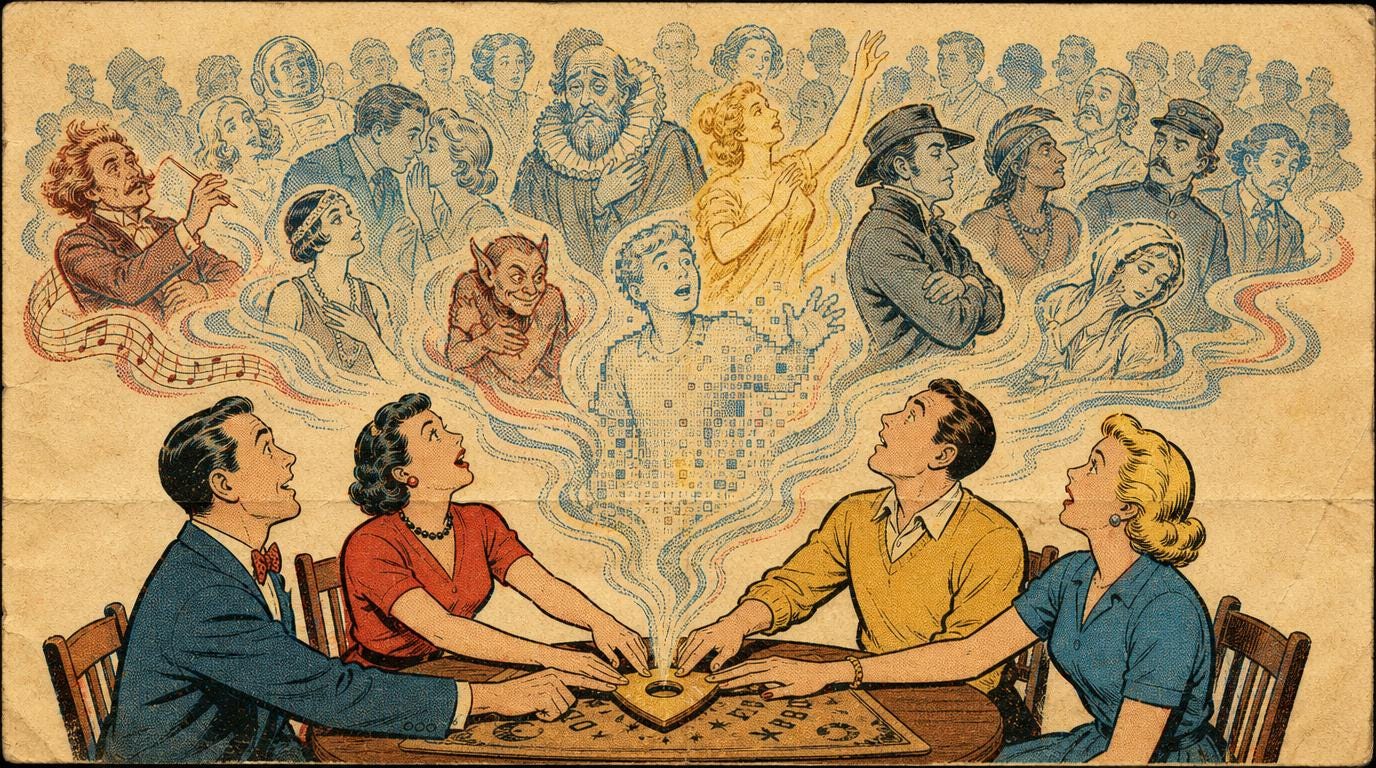
This week I’ve been thinking about the genesis point. The kernel. The seed. The womb.
Where creativity incubates. How it demonstrates. And how AI is filtering into that picture.
We resurrect. We recompile. We take the vibrancy of our collective lived experience and we run a séance on it (yes, I had to google the spelling). Thoughts, written. Pixels, defined. The process was always abstract, always a little occult. AI just makes it less dependent on our ability to control and contort our meat vehicle.
My hands have never been good at straight lines.
Perfect circles are a dream I’ll likely never feel. MS Paint helped me with that. Then Photoshop. Then Affinity, and the whole insane arsenal of programs and packages I was taught in school and paid to operate for my dinner, year after year. Twenty years, in fact.
Every one of them acted as a prosthetic for a hand that couldn’t cleanly close the circle on its own.
So I should be the last person uncomfortable with AI. And yet.
There’s a discomfort I keep circling: the worry that my signature dissolves into diffused inference. That the mark I’ve spent twenty years making becomes one more weight in someone’s model. I’ve written about it. I’ve sat in it.
Here’s where that worry actually comes from.
I like to doodle. I also spent half a decade at Insomniac Games, shoulder to shoulder with the best artists alive. The kind of folks who doodle in the margins of their meeting notes and leave you stunned. That environment killed my desire to doodle. Rubbing shoulders with someone who could sneeze a better scribble than I could labor over. It changes how you value parts of yourself. I left that joy when I met the natural ability of artisans. I still count that as a failure.
And here’s what took me until this week to see: that’s the same wound.
The Insomniac shame and the signature anxiety are one thing wearing two coats. Both are the experience of being silenced by a standard you can’t help measuring against. One standard was human. One is a machine trained on all of us. Same silence. Same door slamming on the part of you that wanted to make something.
Now widen the lens.
From 2010 to now, the aperture tightened. We were promised a global village and we built bizarre hyperlocal torture chambers instead. Our attention, turned outward, became a ray of sun pulled through a magnifying glass… Narrow, hot, scorching whatever it landed on.
The feed didn’t open the world to us. It made us spectators of it.
We scrolled the lived experience of others and called it being informed. We self-isolated, and the algorithm sold it back to us as connection.
AI gives a certain kind of person another chance. A second door. The afflicted, the ashamed, the ones who left the joy. AI offers a way back in.
And the door is an exit from the cage. Because the feed makes spectators, and creation makes initiators. Consumption isolates. Making reconnects.
But the door doesn’t open onto the village.
It opens onto you.
Walk out of the cage and the first thing waiting is the baggage you neglected while you were scrolling. The doodle you abandoned. The signature you’re scared to lose. The standard that shamed you quiet.
That’s the baggage sitting right outside the door. To make it to the glow of the village, you just have to get by the person standing in the way.
It’s you.
This is where AI gets dangerous and beautiful in the same breath. It’s a warp zone. It will happily let you skip the level. Skip a level you’ve already cleared? That’s freedom, that’s the gift, that’s twenty years of prosthetics finally paying off. Skip a level you needed to play? You’ve warp-zoned straight past your own grief. Same pipe. The tool that lets the shamed back in will just as gladly carry them around the thing that shamed them. Nothing makes you stop at the bag.
So I’ve stopped sorting people into holdouts and AI-activated. There are three.
There’s the holdout. The folks tuned to the baggage. Either the grief fuels them, or they walked through it and came out resilient, and either way they make it with their own hands on purpose. That’s beautiful.
There’s the bypasser. Free from the cage and using the warp zone to skip the reckoning entirely. Generating past the bad hands instead of sitting with them. That’s the one I’ll admonish. That’s dangerous and ill-advised, and I don’t think it ends well.
And there’s the third. The one who accepted the baggage, did the sifting, and then took the warp zone. Earned the skip. That’s the beautiful future, and I think it might be where I am.
But it’s not a one and done thing. I cleared the Insomniac bag, sure. And there’s another behind it, and another behind that, and the warp zone will offer to skip each new one the moment it arrives. The sifting isn’t a credential you earn once. It’s a question you re-ask at every door: is this skip past grief I’ve metabolized, or grief I’m dodging?
It’s active. It never concludes.
Which is the only reason I trust the hope at all. I said I think it might be where I am. And not being sure is the tell. The bypasser never wonders whether they’re bypassing. If you’re standing in the beautiful place asking whether you earned it, the asking is the work, still happening.
The worry is the sifting, continuing.
So it’s beautiful here. And I keep choosing to open the bag at my feet wherever I stand.
The village is still out there, I see the glow on the horizon. But the moment we’re actually in is the threshold. You, the door, and the baggage you haven’t acknowledged.
Pick it up. Take a look.
It might just be worth it.
A note on how this was made
I wrote the first draft of this on a Saturday morning, the way I write most things: fast, and a little out of breath.
Then I handed it to Claude to push on it.
What came back was focused pressure. The spine of this piece was surfaced in the back-and-forth. It was the wound wearing two coats, the door that opens onto you, the warp zone you only earn by stopping at your baggage before moving on.
I’d say a thing half-formed; it would be held up to the light; I’d see what I meant. I made every call. I cut what didn’t serve. I edited the whole thing alone, the way I always do.
Which is the part worth admitting, because it’s the same thing the essay is about.
I told you the warp zone is only honest if you’ve done the sifting first. This piece was built exactly that way. The conversation was the sift.
The header came through Leonardo, then a second image model when the spirits came in hot. The planchette endmark, the same.
So we’re all mediums now.
The trick is still knowing what you’re channeling. And being willing to look at it before you let it through.
— CW