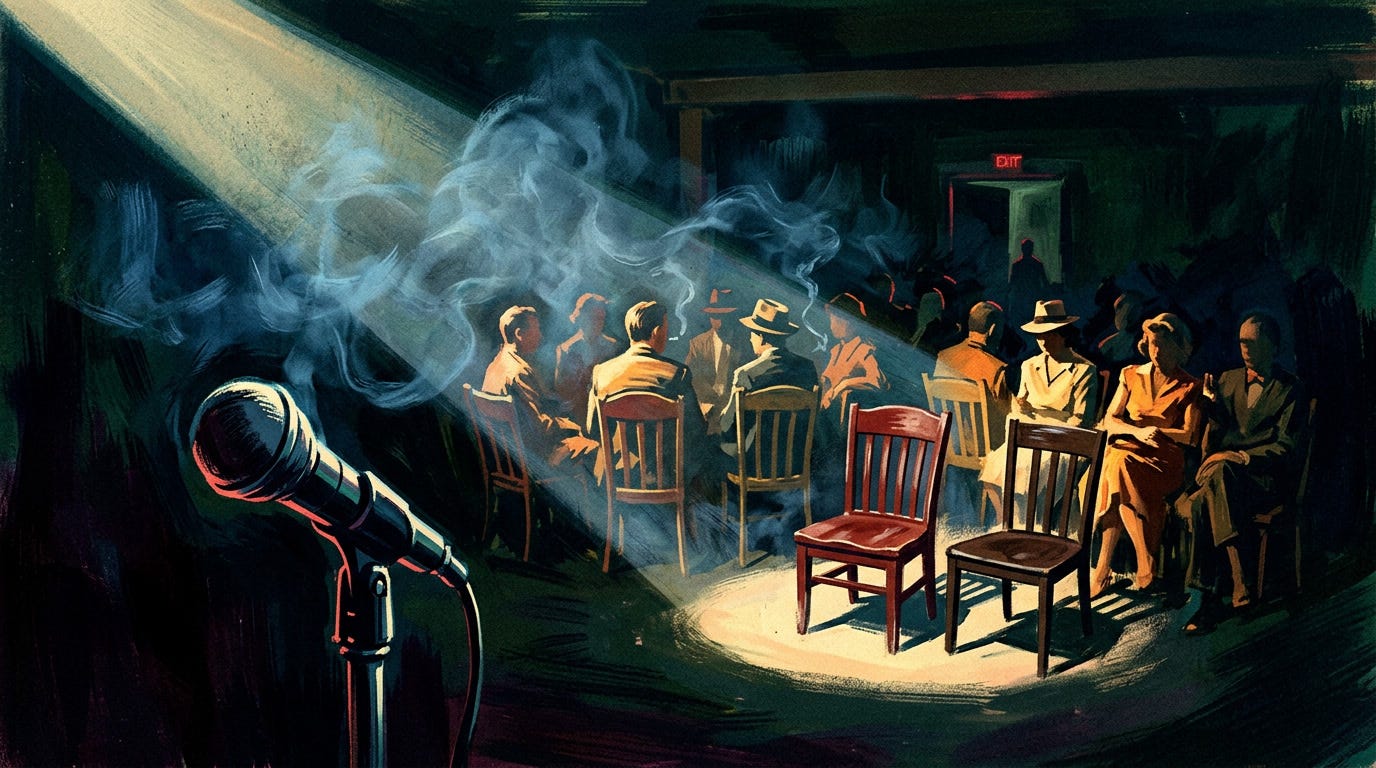
The global village is breaking back into a million little pieces.
That’s how it feels, anyway. The feeds are quieter in the ways that matter and louder in the ways that don’t.
The reach is still there. The signals are infinite, technically. But something’s twisted in the transmission. Rooms are closing their doors. Conversations that used to happen in the open now happen behind secret handshakes.
The whole, which we spent two decades becoming unfortunately aware of, is receding below the horizon.
And it feels like a loss. I want to be honest about that before I talk myself out of it. Let’s unpack the mechanism, as best I can diagram it.
Feedback has two dials: how wide the circle, and how long the sample. Our closest circles are our most proximate emitters of feedback. In practical terms, it’s the value of friendship, the value of consideration. And that signal is useful when it’s measured, when it’s consulted over a long horizon.
Things get funky when we widen the locus. And things get dangerous when we shorten the clock.
We did both, all the way, at the same time. Reach maxed out. Horizons cut to zero. And feedback stopped being feedback. It became weather. Voices chiming in with the speed and severity of a thunderstorm. Voices that haven’t earned a seat at the table, operating on limited understanding, delivering morally-charged verdicts that are hard to receive as anything but a statement of character.
Considered feedback takes time. It takes care. Considering feedback takes just as much of the same. Neither survives at storm speed.
So when I say the village is fracturing, what I mean is: people are turning the dials back down. And I’ve been reading that as damage.
(A confession, since we’re here: I don’t know who this is for. I’m writing it the way you’d plate a dessert — because raw flour isn’t worth serving, because the flashy product with the shiny packaging is the thing that gets devoured. Flash and intrigue. Blood and sorrow. It all sells. I’m dressing this up for a crowd I can’t see and can’t verify, and I’d like you to keep that in mind, because it turns out to be the subject.)
We should name what the village actually was, because we never really did. We just called it normal.
For a couple of decades, anyone could reach anyone. Some call the resulting relationship parasocial. I’d just call it new.
A permeation of access previously unfathomable. Intimacy running at broadcast scale, strangers folded into your interior life, your interior life folded into theirs, no vetting, no vestibule.
We built our lives around the call and response of community, the bouncing about of the people near us, and then suddenly the “near” fell off the word. Everyone was proximate. No one was close.
And that confusion made the crowd feel like a choir. The stage was so intimate in its mechanics. The reply. The mention. The little red heart. We experienced the whole world as a room we were in.
Comics have a name for this move. Crowd work. You turn to the audience, you read the room, you respond in real time, and for a moment every stranger in the dark feels personally addressed. It’s a beautiful skill. It is also, definitionally, a performed illusion of intimacy.
We were all doing crowd work. All the time. With everyone. And reading the room, the essential skill of crowd work, is exactly what broke, because you can’t read a room with no walls.
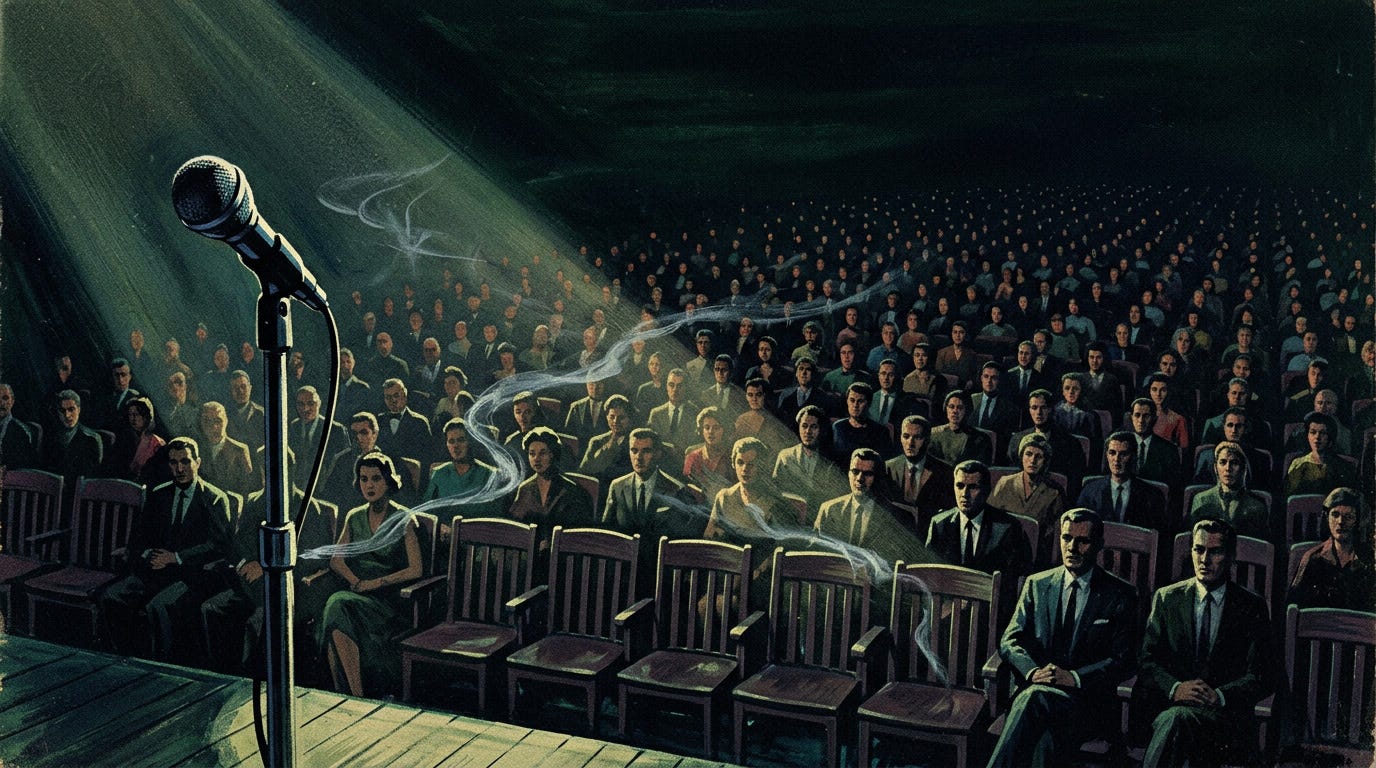
Then the machines learned to talk, and the room got stranger.
When anything can be summoned, anything can be conjured, provenance becomes the scarcest thing in the signal. Is this voice a person? Is this essay a person’s thoughts? Is this feedback, this pile-on, this chorus of verdicts, even populated?
The permeation grew uncontrollably for twenty years: everyone reaching everyone. And the contraction is now underway. Checkpoints. Purity lines. Rooms that won’t admit AI-touched work; rooms that won’t admit skepticism of it.
Lines being drawn about what ideas are allowed in what spaces.
It would be easy to write this as paranoia, and some of it is. But most of it is repricing. When reach is infinite and voices are conjurable, unearned attention becomes worthless. The market simply corrects.
What’s left holding value is the thing that was always the actual asset: the earned seat. The voice you’ve measured over a long horizon. The reader who has been in the room with you long enough that their verdict carries weight instead of weather.
The crowd didn’t leave. The crowd deputized itself into choirs, and the choirs started checking papers at the door. You don't have to love every border guard to see what raised the walls.
(Still performing, by the way. Slightly less. Noted.)
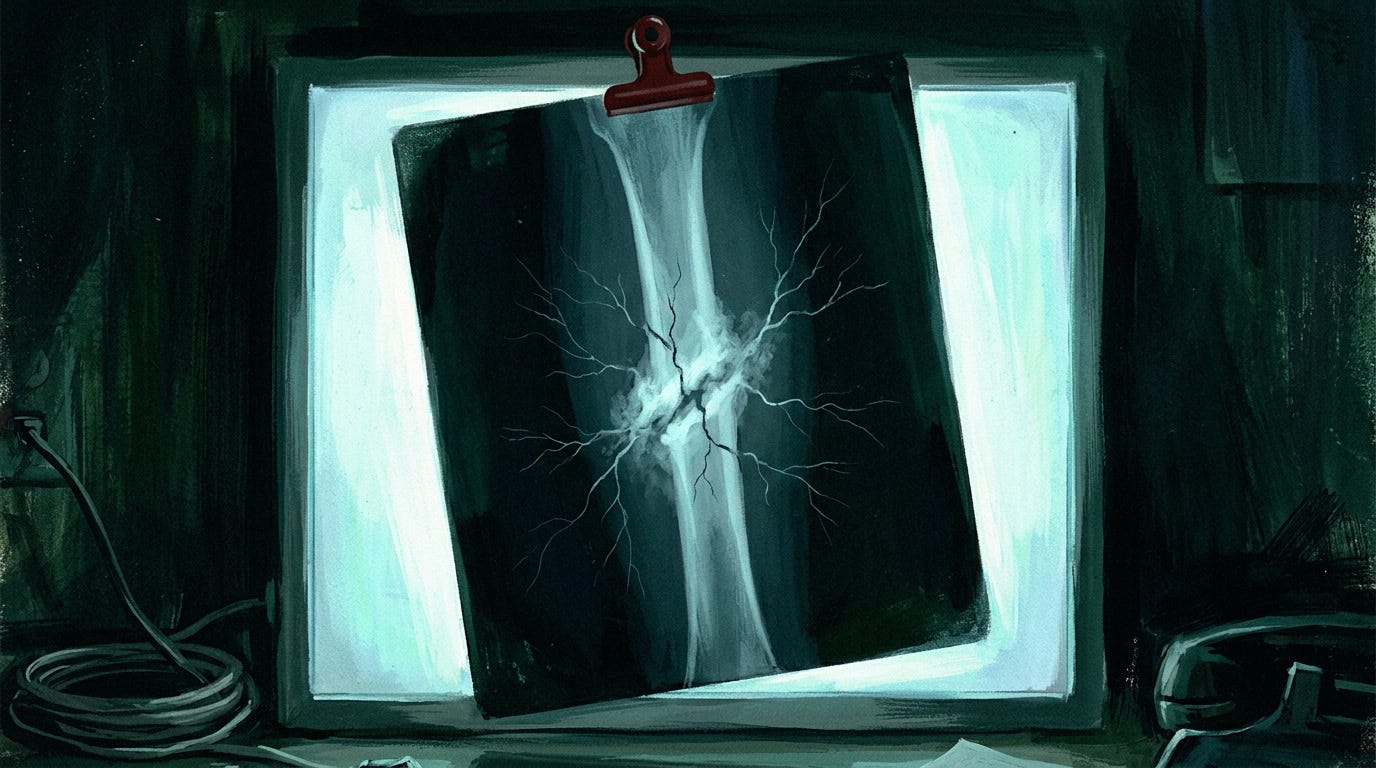
So here is where I have to admit I’ve been reading the X-ray upside down.
Nothing is fracturing. Something is healing shut.
The global stage wasn’t the baseline. It was a two-decade anomaly we mistook for a birthright, because we’ve only ever known the charts to go up and to the right. The confusion was never that we mistook the choir for the crowd. It ran the other way the whole time: we mistook the crowd for a choir.
We took a stadium’s worth of strangers doing weather at us and called it community, and then grieved when the weather stopped.
I want to pay the toll honestly: the anomaly wasn’t worthless. Strangers did reach across it. People found their people at distances no village ever allowed, were changed by voices they’d never have heard, and some of that was miraculous and none of it should be waved away.
The era produced real contact. It just produced it at a ratio no nervous system was built to absorb.
Because the two dials never stopped being true. Feedback that is narrow and slow is the only kind that ever carries nutrition. Feedback that is wide and fast was not actually feedback. The choir is the small room, the earned seats, the long horizons. They’re not the consolation audience you retreat to when the stage stops calling.
They were the ones doing the listening. The entire time. The crowd was the illusion the permeation sold us, and now the subscription is lapsing.
There’s a stand not far from where I live that runs on the honor system. Baked goods on a table, a cash box, nobody watching. It works. It works because trust is a short-range signal.
That little economy functions at choir scale and would collapse instantly under crowd conditions, not because it’s precious, but because the mechanism it runs on doesn’t transmit past a certain distance.
Nothing about that stand is a compromise. It is the intact version of the thing. Everything larger is the adaptation.
The crowd is unruly. The crowd wants it all and nothing at the same time. The crowd is rapaciously hungry and wildly overfed. And the crowd, it turns out, was never actually hired to listen.
So: the signals are infinite. We can still all reach each other. But who is gonna listen?
The people in the room. Same as ever. And every one of you earned the chair.
That’s not a smaller audience. That’s not a compromise. That’s not a failure.
That’s the audience.
Author’s note
This essay began as a Saturday-morning mess — a raw, unbaked dump of paragraphs about feedback, crowds, and fracture that I handed to Claude, Anthropic’s AI, the way you’d hand someone a junk drawer. What came back wasn’t writing; it was diagnosis. It found the central mechanism buried in my third paragraph (feedback has two dials: how wide, how long), told me I’d braided four essays into one, and asked which one I actually meant. The conversation that followed did what these collaborations do at their best: it pressured me into a decision I didn’t know I was avoiding — that this piece isn’t an elegy for the global stage. It’s a homecoming.
The drafting worked the way it always does. Claude compiled our structural decisions into a full draft; I took it into my own document and rewrote it in my hands — cutting, replacing, arguing with it — then brought my edits back for another round of pressure. Some of its suggestions I took. Some I overruled. “Load-bearing,” a phrase it leaned on, got vetoed for being exactly the kind of borrowed-engineering tic that AI text calcifies into. The best line in the essay’s final movement exists because the machine noticed I’d spent my ending two paragraphs early. The decision about what this essay believes remains, as always, mine.
The header art came from the same table: we drafted image prompts together in a numbered-rules structure, ran them through Leonardo, and followed the accidents. The empty red chair in the spotlight wasn’t in anyone’s plan — human or machine. It’s the best thing in the frame.
I’m aware of the shape of this: an essay about conjured voices, partly conjured. About rooms checking papers at the door, written by someone whose papers are mixed. I disclose this every week not as a compliance ritual but because I think provenance is the whole game now — the essay says as much. You deserve to know what’s in the room with you. This is what’s in the room: one person with the pen, one machine with a flashlight, and a long horizon between us.
— CW