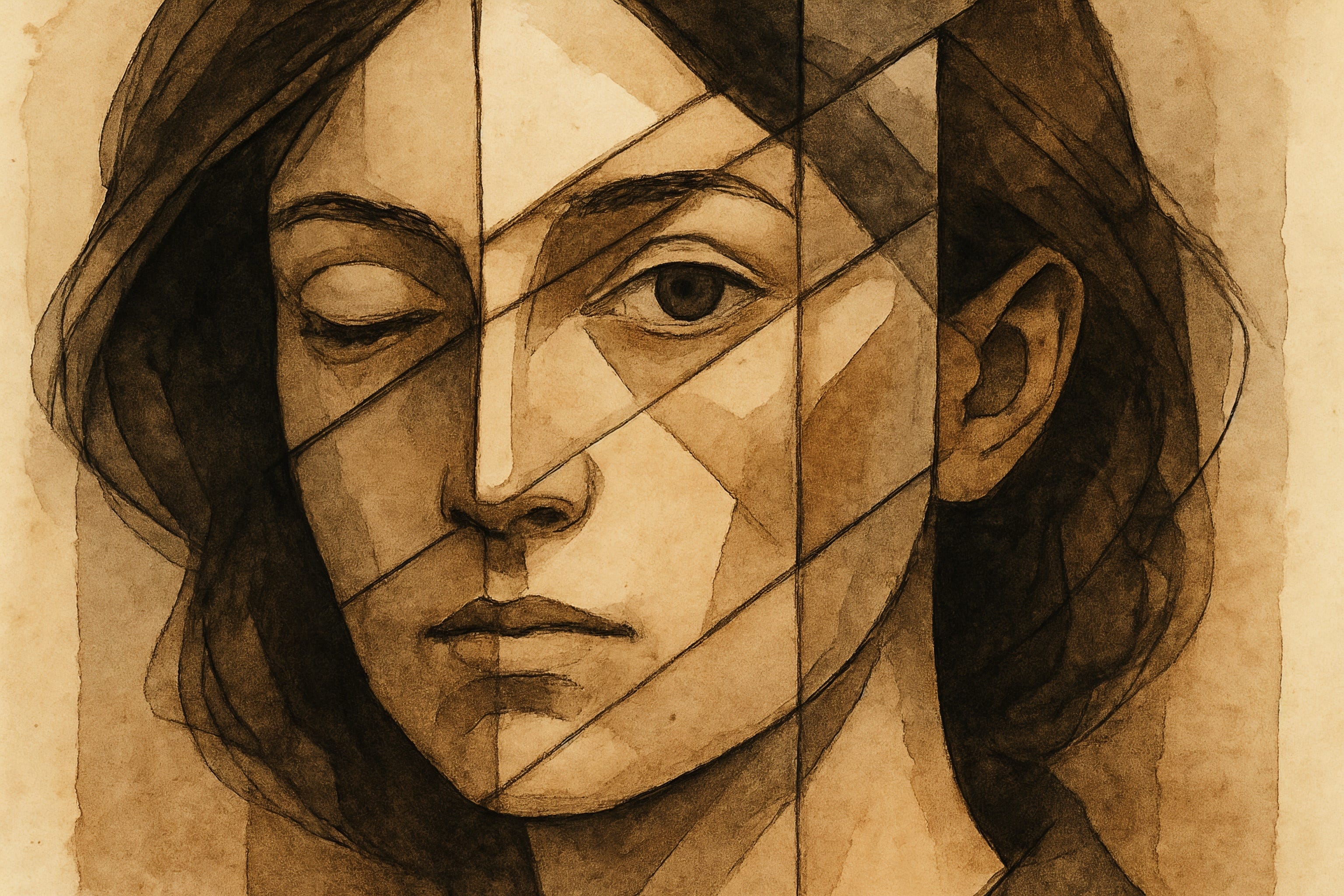
We like to think of AI as the imitator.
A mechanical mimic trying to learn our quirks.
But maybe the unsettling truth is that it’s holding up a mirror.
…and in that mirror, our reflection just blinked.
For decades, most of us have spent our professional lives emulating computers.
We organize, optimize, process, tabulate.
All in the name of efficiency.
We’ve learned to think in grids, speak in frameworks, measure in metrics.
And now the machines can do those things better, faster, and without complaint. So, we’re left wondering what’s left that’s truly ours.
AI doesn’t just automate tasks.
It eviscerates the illusion that those tasks were meaningful work.
The Creativity Illusion
There’s a palpable irony in the outrage over AI “stealing” creative work.
The machine’s mimicry is only as rich as the culture it’s fed.
And our culture has been built on copies of copies for decades.
The reason AI can conjure a passable Star Wars drawing or Taylor Swift song isn’t sorcery; it’s saturation.
These are the frequencies that we’ve broadcast the loudest.
The training data reflects the desire of the marketplace, not the muse.
When the copy learned to copy the copier, the compliment became the competition.
What struggles to surface are the quiet, weird, unmarketable frequencies.
You know, the things that didn’t trend, that never reached the algorithmic light of day.
True originality is often too dim to register on a machine’s aggregate radar.
This means the antidote to AI’s mimicry isn’t copyright law; it’s courage.
If you have something to say, my advice:
Get strange.
Share freely.
Express without the filter of optimization.
Because the machine is built to echo what’s amplified… not what’s alive.
This means that you can more easily stand out when centered above your two feet, and authentically sharing your perspective.
But that same redundant reflection stares back at the office worker, too. Not just the artist.
If the industrial revolution replaced muscle, this one replaces mimicry.
The spreadsheets learned to balance themselves.
The dashboards learned to decide direction.
And here we sit. Proud operators of systems that now operate themselves.
When I worked temp jobs in college, I was trusted to copy blueprints, file paperwork, wrangle spreadsheets. Those tasks that once gave me a sense of contribution have since vanished into the cloud.
Nobody protested.
We just found new buttons to push.
The same pattern repeats: each generation of automation reveals how much of our “knowledge work” was already rote performance; humans pretending to be reliable code.
Maybe this is our next promotion:
From performers of procedure to conductors of context.
The first chair violinist follows the notes.
The conductor shapes the music.
Our value isn’t in completing the work anymore, it’s in composing the system that does the work at scale.
It’s in the decisions we make about meaning, priority, and purpose.
That organic stuff that machines still fumble to approximate.
And yes, it feels strange.
Like being handed unfettered freedom when all you’ve practiced is quiet compliance.
But maybe that’s what evolution looks like in a digital age.
We get to revel in the artistry again, not just covet the ownership of its artifacts.
The moment our reflection blinked wasn’t the end of human relevance.
It was the beginning of human redefinition.
The mirror didn’t just reflect; we’re now given the ability to refract what we see.
We can bend it to show us angles we forgot we had.
That’s its power. That’s its risk.
Revealing quirks, truths, hidden depth for those willing to sit in discomfort.
Those willing to ask instead of act.
Maybe AI’s greatest gift isn’t its efficiency…
It’s its indifference.
It doesn’t crave meaning, so it leaves that space open for us to fill.
And if we’re brave enough, we might finally see that the point was never to out-compute the machine.
It was to remember what computation can’t touch: The wonder of seeing yourself, for the first time, blink back. And the decision required in that split second after comprehension.

Co-developed with AI assistance. Edited and refined by Charles Wilke, 2025.
Link to chat used in creating this piece.