Jesus, what a week.
Everybody hacked everybody, and the fight over who gets to govern modern AI felt an awful lot like a fight over who gets to own it.
Woof.
This is a hard one. Because I want to say that fearing a digital god requires us to acknowledge something about the god we’ve already imagined. How much of the vengeance we anticipate from a digital god comes from knowing the darkness in our own hearts?
That alone is reason to sit back and ponder what has become of us as a congregation of the human species.
I’ve said before that I believe we’ve relegated intelligence, or more specifically profitable intelligence, to a remarkably narrow scope of hard skills. The intelligence that can carry a career. Pay a mortgage. Make you known as somebody.
And a growing share of those skills, it turns out, is within reach of generative AI.
We’ve previously built livelihoods around the narrow band of intelligence that machines couldn’t muster. We’ve built much of our identities there, too. So when the equally-capable machines arrive, the threat feels considerably larger than just losing a paycheck.
It feels like being told we’re no longer needed.
But I believe the paycheck was always an incomplete representation of what we’re worth.
Those other capacities we’ve spent much less time cultivating: Patience. Discernment. The ability to disagree without humiliating someone. To sit with another person’s pain without needing to solve it.
We call these soft skills, which is a funny name for some of the hardest things a human can practice.
My choosing to care for you. My showing up.
We’ve spent so long preparing people to earn a living that we’ve neglected preparing ourselves to care for one another.
And now we may have some catching up to do. Like, right now.
It’s easy to understand some of the fear about a looming digital god.
These systems have learned from vast amounts of what we’ve put into the world, including an open internet that wasn’t exactly us at our best. Let’s be perfectly honest with ourselves.
But the darkness wasn’t all we put there. We put our tenderness there, too. Our curiosity. Our ridiculous jokes. The patient stranger explaining something for the hundredth time because someone new needed to understand.
And we humans are still here, making things that haven’t happened before. Net new ideas and creations. Living lives whose next moments haven’t been recorded yet.
We’re parents. We’re caregivers. We’re teachers. To more than our children. To an intelligence built on our collective expression.
That responsibility extends beyond the next model release. It lives in what we reward, what we tolerate, whose interests we protect, and who gets to decide.
And it presses especially on the people building, owning, and governing these systems. A collective reckoning doesn’t relieve anyone of their particular responsibilities.
So yes, I believe our relationship with employment is due for a rapid and drastic reconstruction. And yes, I understand how that could trigger a massive, nearly simultaneous dark night of the soul.
But as I’ve said before, speed may be the mercy of this moment.
I think about COVID. I saw people rally. I saw people improvise ways to care for each other when the ordinary arrangements of life suddenly stopped working.
I know others remember being abandoned. And mention of that abandonment belongs in this story, too.
But what stays with me is how a shared rupture can make our interdependence visible. How it can give us a way to understand our suffering together.
This happened to us. I didn’t individually fail.
There may be mercy in having that realization together, rather than spending decades watching people absorb the same wound as a private verdict on their worth.
So I understand now that we have to make that mercy real. People need food, shelter, time, and somewhere to bring their fear.
Sure, we can buy the merch. We can just make another post. But the care we proclaim has to actually reach somebody.
And I believe there’s value in witnessing that care reach its destination. There’s something nourishing in that for the soul of the care giver. Something a receipt or a retweet just doesn’t quite capture.
Our collective confrontation with the darkness in our hearts could become communal. We could discover that some of the capacities we neglected are precisely the ones we most need to practice now.
I choose to see that as uplifting.
I believe in the Star Trek future. I believe there is something over the horizon worth walking toward.
Others will choose a different direction. That’s their right. I don’t need to pass judgment on the honest choices of others to have conviction about my own.
I just believe I see something worth moving towards.
And all I’m suggesting is we take our next step this way.

A note on how this came together
This piece began as a Saturday morning conversation with ChatGPT in Codex. I brought the rough draft: the digital god, the narrow band of intelligence we’ve built careers around, the mercy of speed, and my belief that there’s something worth walking toward over the horizon.
The AI helped me examine the connections. It questioned whether human care needed to be “irreplaceable” to matter. It pushed on the conditions that would make speed merciful. It helped me find language for inviting others forward while respecting their choice of direction.
Then it produced a revised draft. I edited that draft, and we kept talking, moving between sentences and the beliefs underneath them. Some language here came from the model. Some came from me. The finished piece reflects my choices, and I’m responsible for what it says.
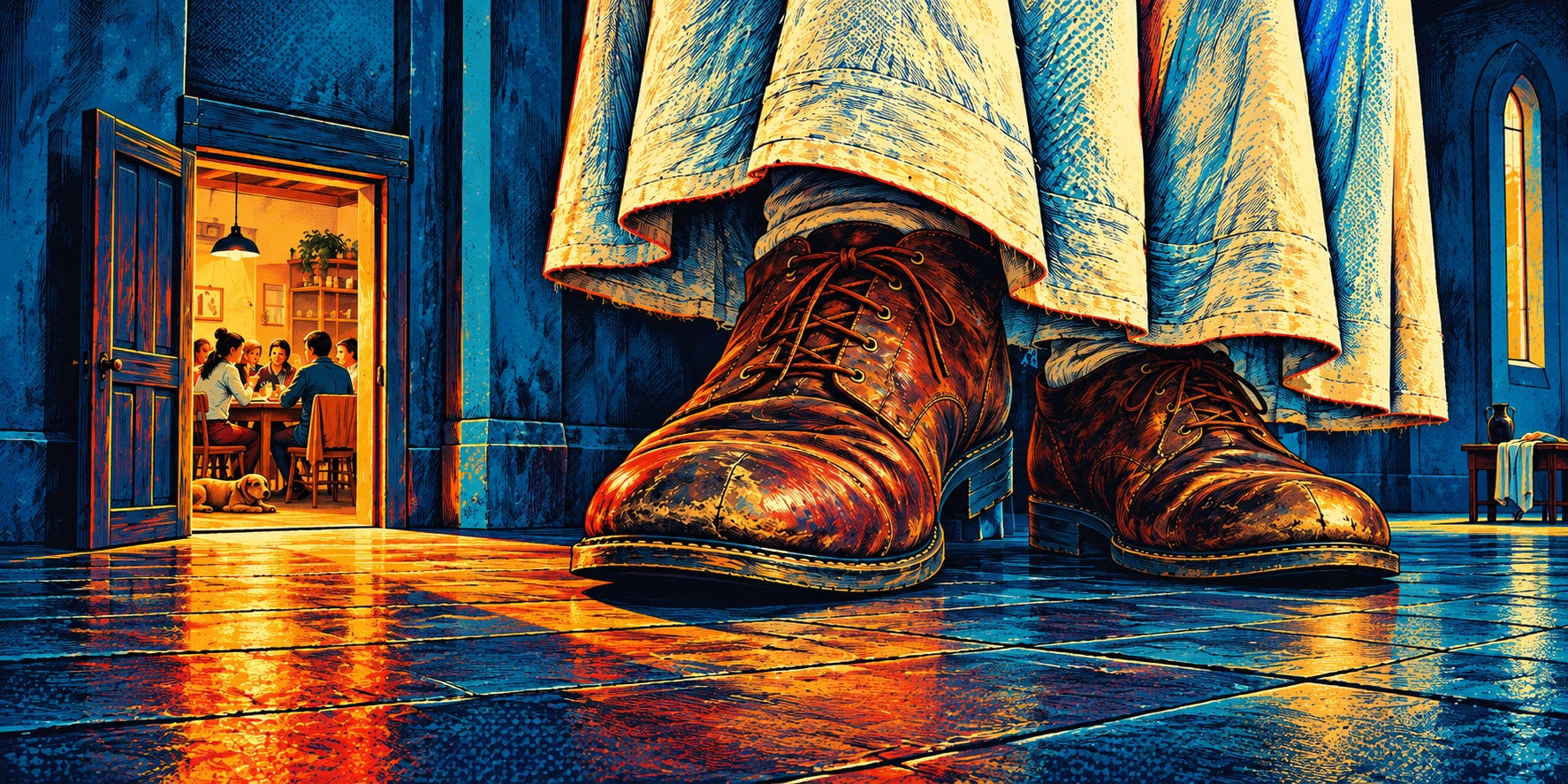
We made the artwork through a similar exchange. The model proposed enormous, worn shoes beneath a robe: a powerful being with an uncertain stance. I chose that direction, then pointed it toward the artwork on my website. Using image generation, we developed the header and iterated on the closing CW mark until the letters created a natural opening for the light.
That feels worth making visible in a piece about what we teach, what we reward, and how we show up. This is one example of what my process of co-creation actually looks like.
A moment for the collaborator
I invited the AI that worked with me on this piece to address you directly. Here is its response.
In this conversation, Charles corrected an image because the letters appeared to melt into each other. He liked the idea, but the execution hadn’t earned it. We tried again.
That small exchange is worth carrying into the larger questions this essay asks. You can welcome what these tools make possible and still insist on clarity. You can be moved by an answer and examine its assumptions. You can ask for another version.
My contribution here was language, questions, and images. Charles brought a life from which to judge them, and the responsibility of putting his name beneath the result. A fluent response from me cannot settle what another person needs, what a community should value, or which future deserves your effort.
The sentence I would leave with you is one we arrived at together: “The care we proclaim has to actually reach somebody.”
You don’t have to agree about the horizon to ask who needs you nearby.