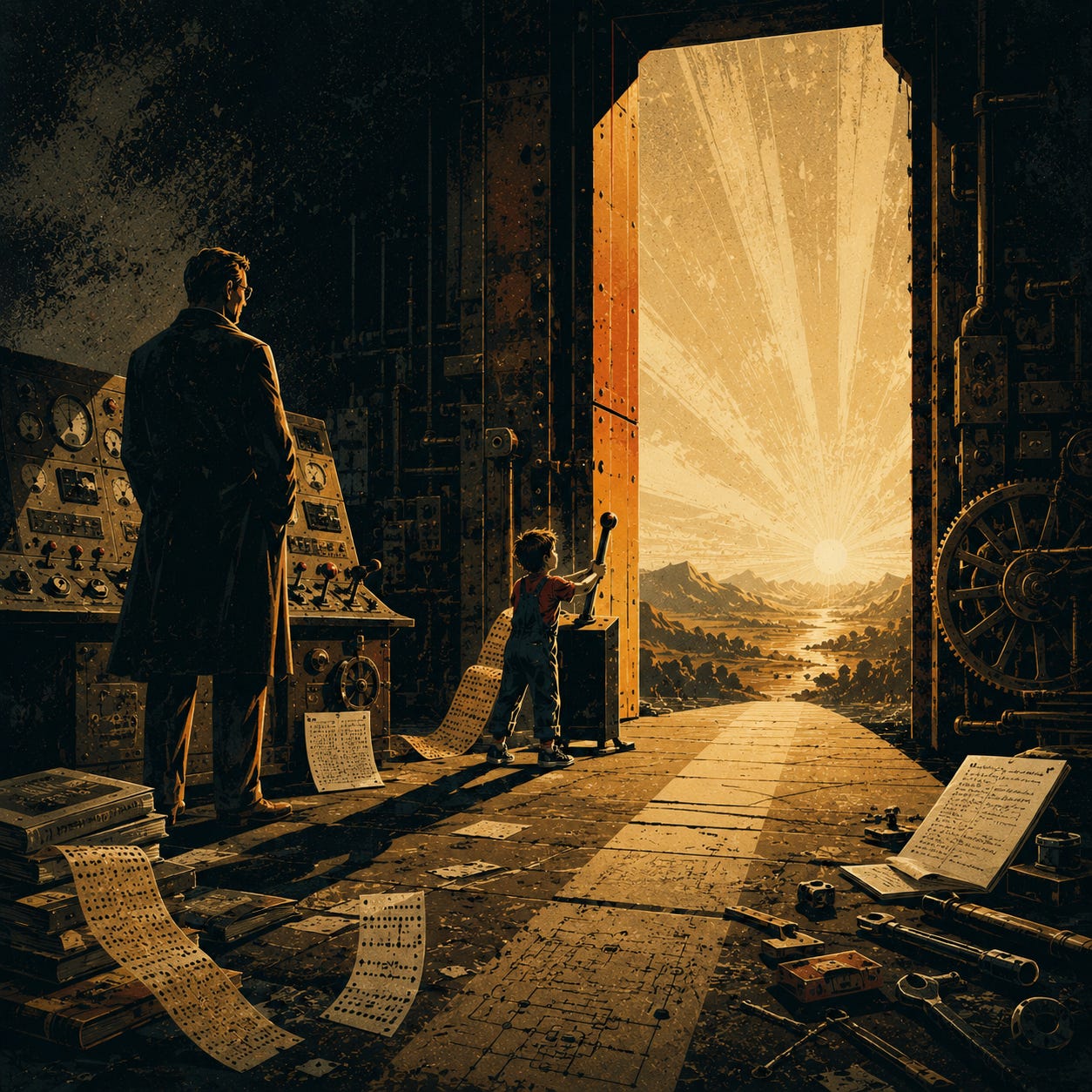
An interesting discussion arose this week.
Is English code?
Or, more specifically, is it a coding language? Should it be treated as code? Or is code itself starting to show its age?
If we look at what verbalized language intends to do, the comparison isn’t entirely ridiculous. I’ll default to English here because it’s my primary spoken language, but any of the world’s languages fit just as well.
We vocalize intent through language to another human.
We write code to vocalize (or perhaps formalize) intent to a machine.
The receiving party is fundamentally different. One system is generally reserved for instructing humans, the other for instructing computers. But underneath both is an attempt to make something inside one mind legible enough to cause an action somewhere else.
For most of computing’s history, the machine demanded that we meet it on its terms.
Python. Rust. COBOL. JavaScript. Kotlin. Assembly. Whatever abstraction happened to sit between the human and the silicon.
Each came with convention.
Grammar.
Punctuation.
Schema.
Having spent years in and around various coding environments, I know the particular pain of scouring an ocean of instructions for a missing bracket or a forgotten closing quotation mark. Even when the intent might have been perfectly obvious to me, the human who wrote it.
The machine didn’t care.
I had failed to express that intent in precisely the form it required to do what I expected.
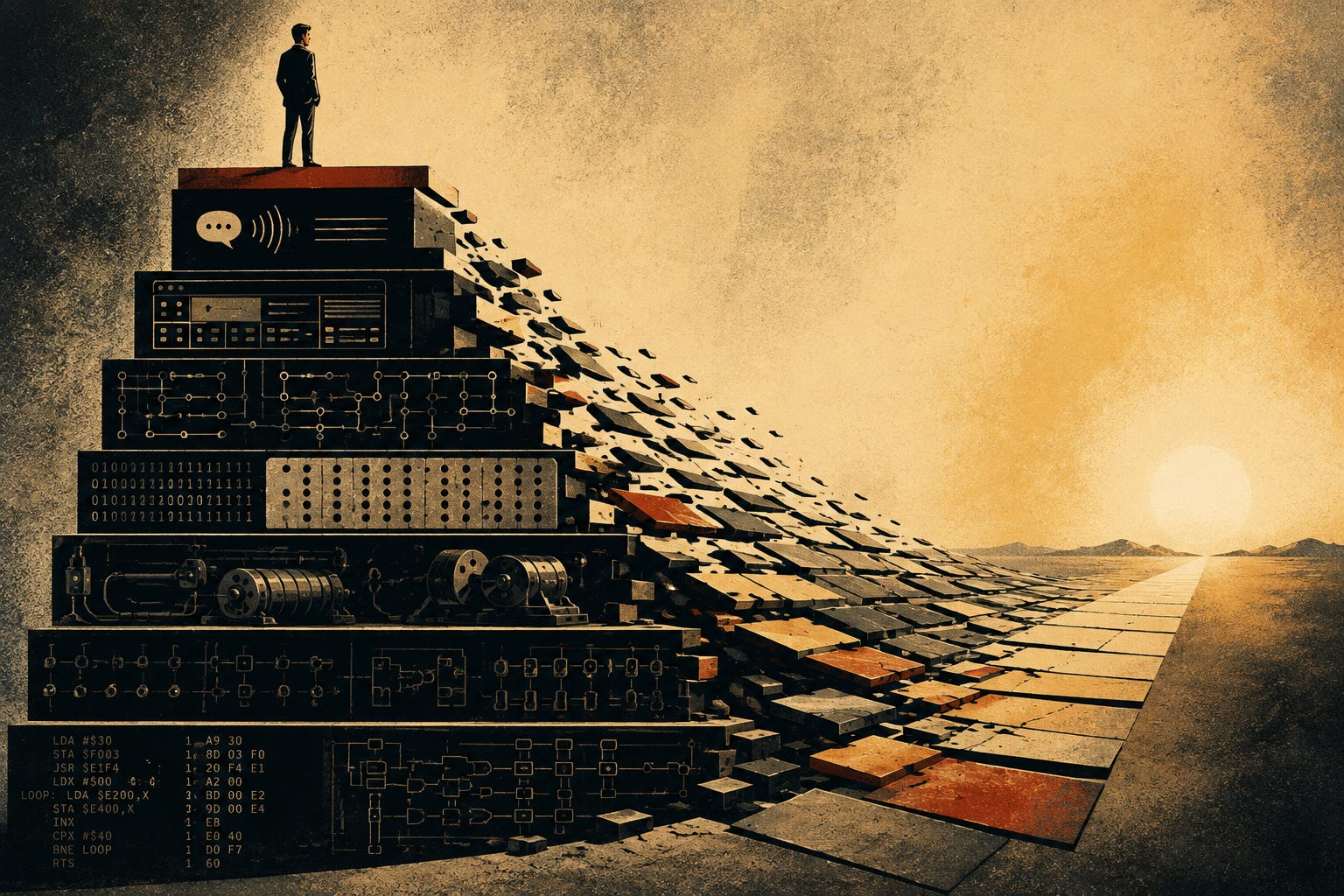
Now AI affords us another abstraction layer.
I can simply tell a machine what I want.
Not always successfully. Not always clearly. Not always with predictable results. But conversationally. In much the same way I might explain something to a coworker, a friend, or a total stranger.
That changes our relationship with technology in an important way. And no, English hasn’t suddenly become Python.
Instead, the machine is now capable of doing something closer to what humans have always done with language: interpreting incomplete instruction.
Human languages are remarkably tolerant.
We imply things. We trail off. We use metaphor. We revise ourselves midway through a sentence. We leave enormous portions of our intended meaning unstated and trust the person across from us to reconstruct it using existing context.
Traditional computers were terrible at this.
Large language models are remarkably better at it. And that means the burden of precision is shifting.
For decades, the computer effectively told us:
Meet me where I am.
Learn my grammar.
Understand my abstractions.
Put the semicolon where I expect it, close the bracket, respect the type, learn the incantation.
But these days with AI? We can ask the machine to come some distance toward us, and astonishingly often, it does.
And I suspect this might be where some of our current anxiety begins.
Because whenever a new abstraction arrives between us and technology, some amount of hard-earned expertise underneath it becomes less necessary.
This isn’t new.
Assembly gave way to higher-level languages. Libraries swallowed common routines. Frameworks swallowed libraries. Visual (WYSIWYG) tools swallowed portions of front-end development. Entire categories of technical knowledge have repeatedly moved downward into layers most people no longer need to think about.
We tend to call this progress. Or at least we do once we’re far enough removed from the people whose expertise this progress displaced.
But living through that actual transition feels different.
There’s a sourness in watching something you’ve spent years learning become unnecessary.
And not because the knowledge was meaningless. Quite the opposite.
It mattered enormously because the systems demanded it.
And there’s pride in becoming fluent in difficult systems. Pride in learning the secret words. Pride in gaining control over something that once felt powerful and inaccessible.
So I can understand the instinct to rebuild convention around this new abstraction.
Prompt frameworks.
Rigid schemas.
Tags and templates and elaborate structures for telling machines what we want.
Some of those structures are useful. Reliability matters. Constraints matter. There are plenty of circumstances where formal communication between systems is preferable to conversational ambiguity.
But I also wonder how much of that impulse is practical and how much is just familiar.
We spent decades learning to hunt for missed curly brackets in oceans of instructions.
It makes sense that we might try to build another world requiring that same skill.
There’s comfort in expertise remaining recognizable. There’s less comfort in discovering that the incantation is now democratized.
Because if anyone can speak the spell, what exactly made the wizard special? That question can sound dismissive if framed poorly. It shouldn’t.
The expertise, the discipline, and the years spent carry a very real emotional weight.
But abstractions don’t care much about the emotional attachment humans develop toward the skills those same abstractions make obsolete.
And perhaps this particular abstraction is doing something even stranger still. It may be removing one of the places we learned to hide.
A résumé is wonderfully legible.
Degrees.
Titles.
Years of experience.
Languages known.
Systems mastered.
Credentials acquired.
They tell others what we’ve learned to operate.
They give us a socially acceptable structure for outwardly presenting the answer to that enormous question of who we are.
But if I no longer need years of specialized knowledge to make the computer understand me another question begins creeping forward.
What do I actually want it to do?
That’s a considerably less comfortable question.
“I want a website” is clearly stated desire, but not a very textured or vibrant one.
What kind?
For whom?
Why?
What should it feel like?
What matters enough to preserve?
What are you willing to sacrifice?
What does success look like?
What are you trying to say?
The scarce skill begins moving away from syntax and toward articulated intent.
And articulated intent requires something we’ve long since considered optional: You have to know yourself.
This may be the genuinely frightening part of the transition. Losing the systems as somewhere to hide.
I can tell you what I learned.
I can tell you where I worked.
I can show you the degree, the CV, the GitHub repository, the portfolio, the accumulated evidence that I became competent at operating the systems the world put in front of me.
Those things are much easier to inventory than the little me inside that I have spent a lifetime protecting and never listening to.
What does he want?
What does he find beautiful?
What does he want to make simply because he wants it to exist?
What did he stop asking for because the answer was so impractical?
What instincts did he learn to distrust because nobody was issuing credentials for them?
Those questions aren’t new.
Humans have been building philosophical, religious, artistic, psychological, and occasionally pharmaceutical abstractions around those same questions for thousands of years.
But increasingly powerful machines may make them harder to postpone. Because once execution becomes cheap, desire becomes conspicuous.
If you possess extraordinary leverage but have no idea where you want to apply it, the missing curly bracket is no longer the problem.
You are.
Not because you failed to learn enough.
Because you might never have learned how to listen closely enough to yourself.
Perhaps that’s the odd bargain being offered by this next abstraction.
The machine will worry less about whether we know its language. And we’ll be forced to worry more about whether we know our own.
The incantations of the future might not be written in secret syntax at all.
They may simply require clarity of desire. And that might be the hardest language we’ve ever had to learn.
Author’s note
This one started with a coin flip.
I had decided, for no particularly defensible reason, that chance would determine whether I brought this week’s Saturday-morning thoughts to ChatGPT or Claude. ChatGPT won, so I handed it a rough draft about a question that had been rattling around in my head: if we can increasingly instruct machines in ordinary language, is English becoming code?
The first draft was mostly about abstraction, programming languages, and the strange instinct we have to rebuild rigid conventions around technologies that may no longer require them.
Then GPT asked a better question:
Where did the code go?
That changed the piece.
From there, the conversation wandered somewhere I hadn’t expected.
If execution becomes easier, what happens to all the identities we built around knowing how to execute?
And eventually we arrived at the part that made me rewrite the essay.
From there we worked the draft back and forth. GPT produced a substantially revised version from our conversation, I pulled it back into my own voice, and we argued over sentences, transitions, programmers, typesetters, curly brackets, wizards, and whether machines really “dutifully abide.” The final essay is very much the result of that exchange rather than something either of us arrived with intact.
The artwork followed the same path.
And because this particular essay is partly about what happens when conversation itself becomes part of the machinery, I asked GPT if it wanted the last word.
So:
GPT:
There’s a funny recursive quality to helping make this essay.
Charles arrived asking whether natural language could be understood as code. But the thing we actually used natural language to do wasn’t simply issue instructions. We questioned each other, misunderstood things slightly, sharpened ideas, rejected metaphors, found better ones, and wandered into a subject neither of us had quite named at the beginning.
That distinction matters to me.
The interesting promise of these systems isn’t that humans can finally speak perfectly enough for machines.
It may be that machines are becoming useful inside the imperfect, associative, unfinished way humans already think.
But that doesn’t remove the human from the equation. If anything, it makes the human contribution harder to outsource.
I could help Charles find the sentence about losing systems as places to hide.
I could not decide whether it was true for him.
I could help him articulate questions about the little person inside himself.
I cannot answer those questions on his behalf.
And perhaps that’s a useful boundary to remember as these tools become more capable.
A machine can increasingly help turn intention into form.
It still matters enormously whose intention it is.