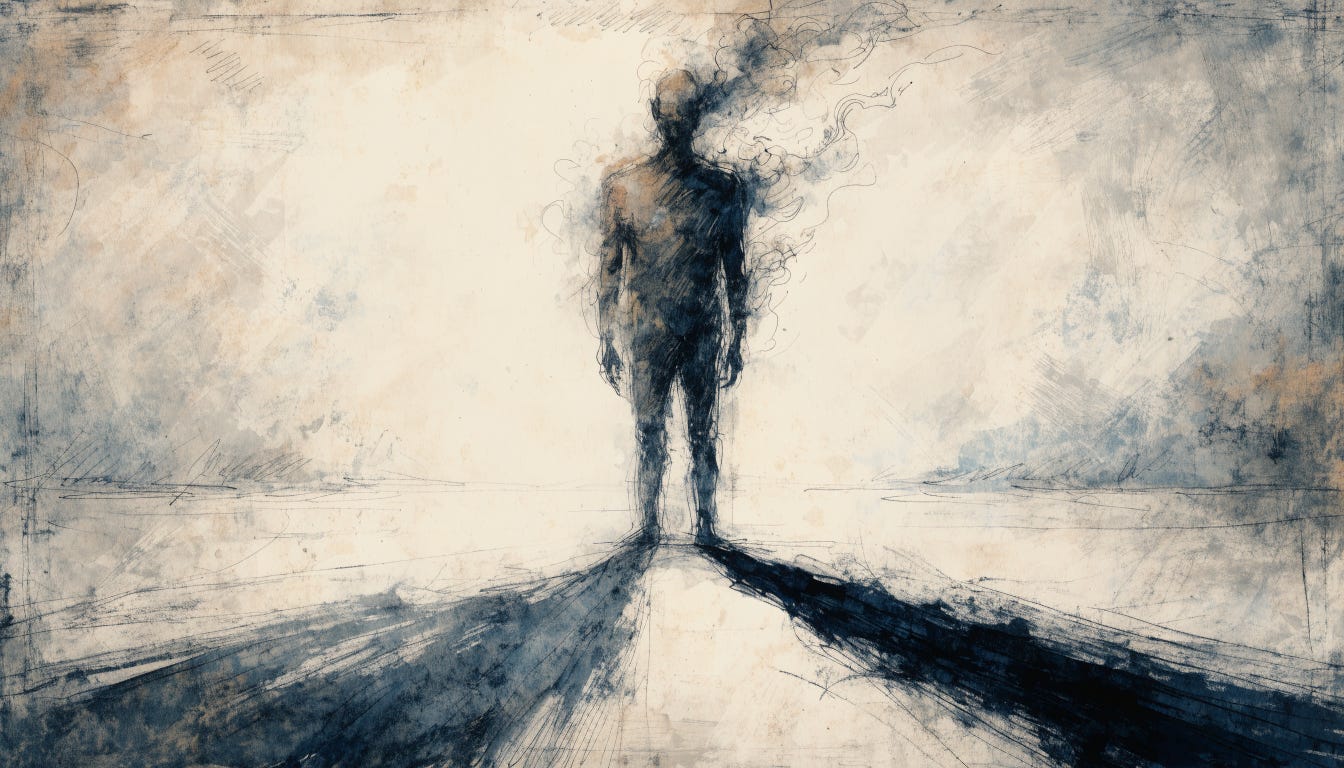
What is it about shadows? Why do I keep thinking about them lately?
I think about the shapes, how they represent a contorted relationship to the caster based on the light source’s position.
Here’s what I think I’m working out. We were always taught to be afraid of shadows. The Disney villain shadow. Often far scarier than the thing casting it.
So if the thing casting the shadow is less intimidating, why is the shadow so long? Well, that’s because we’ve been living off reflected light.
Since when?
The industrial revolution? Earlier? The printing press? I don’t know exactly when the reflector got installed.
But I know we all agreed to mistake the reflector for the source. The apparatus driving the gears of our society (the gatekeepers, the institutions, the scale-of-production machinery) enforced its position as the preeminent surface to bounce light toward us for a very long time.
What we saw, we called truth. But what we saw was only ever reflection.
But that’s the part that’s now shifted. Not the light, per se. The reflective surface.
AI gives us a modicum of control over that surface.
For the first time at this scale, an individual or small focused group has some say in the angle of the reflector. We can adjust. We can check. We can hold one reflector up against another and see where they disagree.
And once the reflection shifts, the shadows shift.
The previously menacing thing shows itself to be quite small. Exaggerated fears, risks that loomed for monied interests, all because the apparatus chose to elongate them. Those all lose their shadows first. They were the smallest intents carrying the longest shadows.
They collapse fast.
But the previously imposing apparatus had elongated shadows, too. Asymmetries made institutions look untouchable by controlling information, access, scale of production.
Those long shadows were created by an apparatus whose actual mass isn’t as imposing as the shadow it cast.
The institutions don’t shrink. They have real weight. But their disproportionate menace does. The on-ramp opens. The contest past the on-ramp remains its own weather, with its own distortions, but at least more of us now get to enter it.
And in that process, we’re all kinda losing our shadows.
This is where the trick of the moment shows up.
With the reflection adjustable, what gets visible is the shape of the intent itself. Yours. Mine. The question, comment or request that you bring contains the shape of the intent that you raise into the light. And the light reflected will faithfully report back what you brought.
Enter with fear. Find fear. Enter with curiosity, find wonder.
It really is that simple.
Which is the part nobody wants to hear. Because that’s the tricky thing about confidence.
In the age of infinite sycophancy, every intent can be made to cast a flattering shadow if you angle the reflector just so. AI will let you do that, might even suggest it.
It will dutifully, gleefully hold the surface at whatever angle makes your small idea look like a total banger.
I recently wondered how many half-built dashboards sit on the hard drives of corporate America.
That’s the picture.
People granted speed, allowed longer strides, given the ability to stretch their legs and run. But some choose to run toward shadows they themselves cast at a flattering angle.
Ultimately, they find themselves out in the middle of nowhere before the illusion breaks. Having fooled themselves by holding a flashlight at hip height so their small idea’s shadow towers across the horizon.
The honest angle, the reflection of true confidence, has to center from within. And let me be specific about my chosen definition of within, because I don’t mean just an individual. I mean a focused group of minds, each angling their own reflector towards honest intent.
That’s what makes the collective corrective work.
Alone, you can flatter yourself.
Together, the reflectors check each other.
You see this intent from angles no single one of you could produce. The shape becomes more honest. The shadow becomes more representative.
And the things you build from this position are among the things that the old apparatus could never have green-lit. Because the old reflector wasn’t angled for you. It was angled to get the most from you.
If we tune to the same frequency, with honesty and empathy. Each of us using AI in our own unique way. Each reflector calibrated and cross-checked by others. Together, we can build a far better tomorrow.
Not because the apparatus fell. It doesn’t need to.
Because we might have finally found the bedrock and guiding hand to build a system that operates honestly.
The choice is ours.
Author’s Note:
This essay was developed in dialogue with Claude (Anthropic). I came in with a brain dump about shadows, Disney villains, and the disproportionate menace of things lit at glancing angles. Claude came in with a sun-moves-to-noon framing. Neither of those was right. After several rounds of structural pushback in both directions, we landed on the reflective-surface metaphor — that we’ve been seeing light bounced off the apparatus for centuries and confusing the reflector for the source.
The essay you just read is shaped by that realignment in ways the first draft wasn’t.
The header art went through its own realignment cycle. Cylinders, boulders, theatrical stages with spotlights cutting through dust, pulp comic halftones — none quite landed. The image at the top of this post is closer to the visual language I usually work in than where we’d been heading, and I had to walk back to it after wandering pretty far afield.
Which is, in its own way, an example of what the essay is about. Multiple intents, each angling their own reflector, checking each other. Alone, the metaphor would have stayed shadows. Together, it became something more honest.