There’s so much rambling in my head lately. I can’t tell noise from news, important from salacious. Everything arrives at the same volume, wearing the same urgency, demanding the same piece of me.
So I’ve started doing what you do when the noise won’t sort itself. I started looking for the pattern.
Mitch McConnell, senator from Kentucky, arguably the most powerful legislator of his generation, has been in a hospital since June 14. His office won’t say why. What we have instead is police scanner audio: paramedics at his address, CPR in progress, the words “cardiac arrest” crackling through the dispatch.
And what we have from his office is this: the Senator is “working closely with staff on Senate business.”
This man may have died on his kitchen floor and been pulled back, and the institutional reflex (the first reflex) is to assert that the output continues. The person remains concealed. The functional performance continues. The seat votes, therefore the man must be fine.
For any of us rank and files, a single no-call/no-show is a fireable offense. For him, three weeks of silence is just a press strategy.
Meanwhile, the country is throwing itself a birthday party. Two of them, actually.
There’s America250, the commission Congress built a decade ago to plan the semiquincentennial. And there’s Freedom 250, the one the White House built over it. It’s the one currently the subject of a 55-page congressional report alleging misled donors and sold access. The one where, reportedly, $2.5 million buys you a speaking slot at the nation’s 250th birthday.
At the celebration of the most collective thing we own, our nation, presence is priced and the microphone is for sale. Your place to speak at the party, our party, the country’s party, has a price tag on it.
It’s hard to know what’s true from the sidelines. But it’s Watergate-shaped from here.
I keep noticing the same mechanism under all of it.
Something in our structures keeps valuing the function over the human. The vote over the senator. The donation over the citizen. The output over the person producing it.
Last week I spent forty-three minutes on a stage arguing for human agency in the age of AI abundance. Then I walked out into the venue and met a robot.
A Unitree biped, wobbling around like a toddler finding its legs. Endearing, almost.
And yet the realization that it was near was not a comfortable feeling. I don’t think that discomfort makes me special. I think everyone has it, because disruption is normally a narrowly focused phenomenon. It comes for one industry, one town, one trade at a time, and the rest of us get to watch from a safe distance and call it progress.
There’s no safe distance this time.
I keep reaching for an analog to AI’s rollout and coming up empty. I think I’ve finally figured out why.
Every prior disruption had a stable vantage point. Radio disrupted print, and print described it. Television disrupted radio, and radio narrated the funeral. The internet disrupted everything, and television covered it wall to wall. There was always somewhere to stand.
This disruption with generative AI is eating the vantage points. Radio, TV, film, the written word, medicine, material science, the visual medium as a whole and the reasoning that makes a metaphor coherent. AI is operating through the very mediums that would supply a foundation for that metaphor. You can’t describe the flood from the shoreline when the flood is also the shoreline.
So where does that leave us? Taskless? Jobless? Meaningless?
Here’s what I actually believe: we’ve been handed a clearer view of the value of human effort than we’ve ever had. Human discernment. Human taste.
The machine, left to guess, will hand you a good output. It can only assist in greatness when the human operating it knows the shape of great. Greatness still requires someone who believes something.
The moment we’re in will still allow the occasional accidental masterpiece… A fluke of the perfectly broad prompt and a lucky direction with a little assistance from a favorable hallucination. But mostly? Mostly we’re about to be inundated with B+ content. Stuff that’s fine. And it will be fine, because we’ve spent years relegating our taste to fine.
Star Wars fans know this arc. Force-fed by the mouse for a decade, quality dipping, and the fandom’s grip on the individual doing the accepting for them. Each new release met with a longer “yeah…” than the last. That’s what taste-relegation looks like in the wild. The association holds even as the thing it’s associated with hollows out.
And I feel for the people who’ve built their whole selves on association: the fandom, the brand, the team, the feed. That’s a rented identity, and the landlord is about to raise the rent as the walls cave in. With photoreal content on demand, each of us can now dig a well of our own making and call the view from the bottom a worldview.
So Mitch McConnell is, like, not fit for office. Right?
That’s the part we’re all quietly certain of. And preventing people from knowing the condition of their own representative feels wrong because it is wrong. So much of this moment feels wrong.
Which is why the direction of the social ire frustrates me so much.
The fear isn’t of AI. That’s just a convenient scapegoat.
The fear is waking up to the fact that we weren’t valued as individuals before. Just our output was valued. And now that the output can be replicated, we’re taking it out on the thing doing the replicating. Because it’s easier than changing the structure that priced us this way in the first place.
We’re raging at the mirror instead of the room.
Look back at the senator. Seven terms. Decades of accumulated power. And when his body failed him, the structure did to him exactly what we’re all afraid of: concealed the person, asserted the function, kept the output nominally flowing.
Nobody is exempt. Not even the man who helped build the structure.
It all feels weird, and it feels like it needs to change, and honestly, it feels like it will. I just hope we can remember what our spark is before we find ourselves out in the wild, in the dark.
Author’s note:
This one started as a Saturday-morning ramble — McConnell, Freedom 250, a wobbling robot, all of it dumped unsorted into a chat with Claude Fable 5 (my first run with Anthropic’s new model, for those keeping score).
What came back was the observation that my ramble wasn’t a ramble — it was one mechanism wearing five costumes. That reframe is the essay.
Claude drafted the first structural pass from my notes and my argument; some of its lines survived my edits, including the mirror and the room. Others didn’t survive contact — it also talked me out of a Jonestown comparison you should all be grateful you never read.
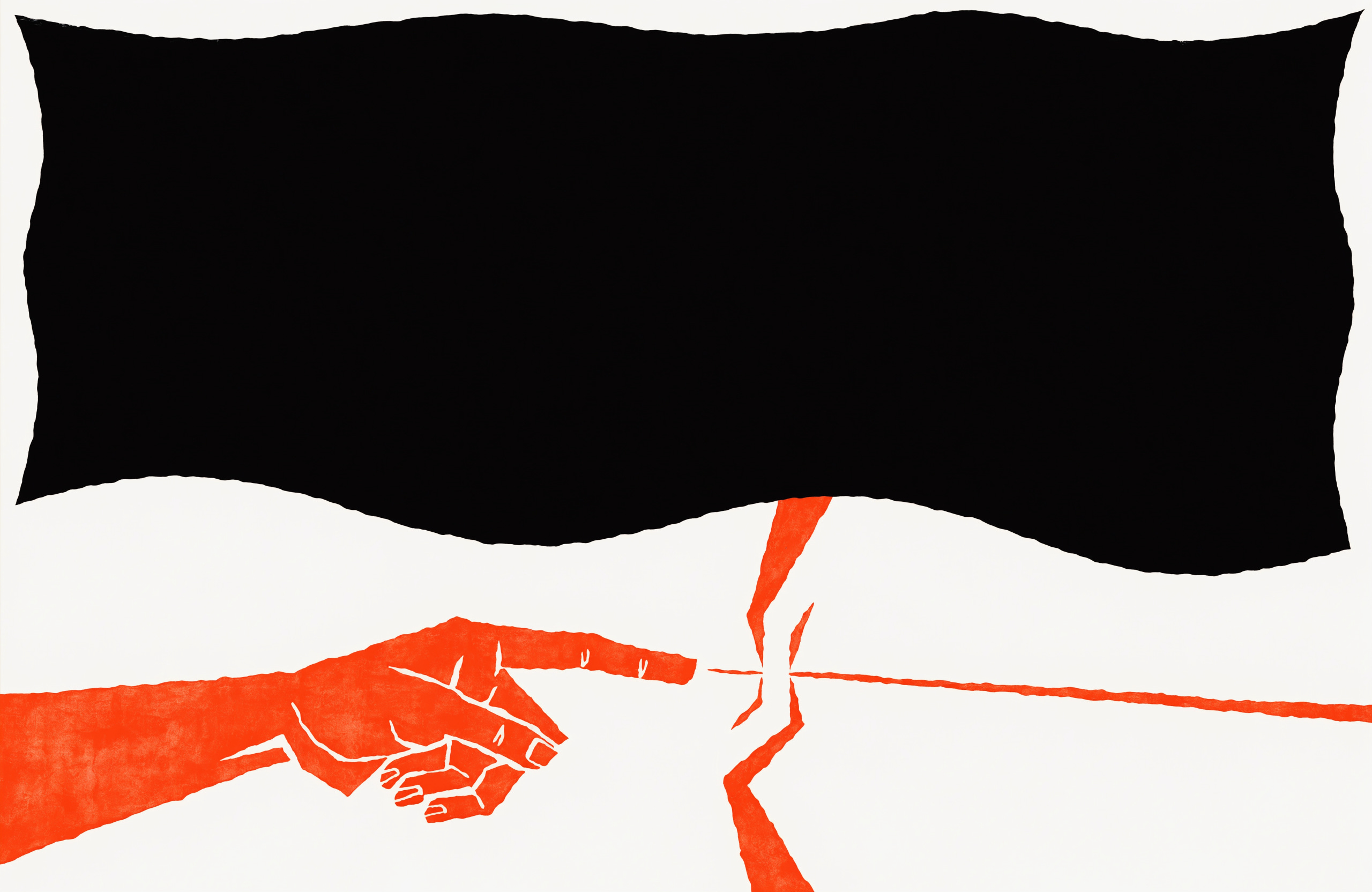
Three solo edit passes in Docs, two return rounds of pressure-testing, and the version above is where we landed. The header art and the new CW mark came from Leonardo, prompts co-written the same way. I drove. The machine navigated. That division matters to me, and you deserve to know it happened.