I’ve been thinking a lot about alignment. What it means to be and become aligned.
Think about a nice breeze. Think about the characteristics that make that breeze nice. Maybe slow, maybe steady, maybe intermittent. Maybe warm, maybe cool. A nice breeze is incredibly conditional.
But notice that the breeze is also being received. You’re feeling for it. Your body is doing something quiet: picking up the signal, registering the temperature, the rhythm. The conditions matter, but so does the listening.
Alignment, even at this gentle scale, is partly an act of attention.
Now think about torrential winds. Derechos. Straight-line wind events. Tornadoes, hurricanes. Wind at that speed doesn’t really factor in temperature before we define the phenomenon as devastating.
The thing that has bespoke qualities when considered good strips most variables when it goes bad.
200 MPH wind will level most structures. 100 MPH and, depending on the time of year, you might lose a bunch of trees. Burdened branches fail faster than bare ones. So even the disaster has some relativity to it. But less.
Much less.
Back in 2024, we had a derecho rip through Omaha in May. Lost many mature trees. Power knocked out for six days. The damn thing came on in a flash and left just as quick. There’s no listening in a derecho. The signal becomes overwhelming. Noise. Static.
So what does this mean? It means alignment is easy when ambiguity is allowed.
Right now, in this current state of AI tooling, we’re at a beautiful inflection point. Businesses are incentivized to align their datastreams in an AI-digestible manner. They can get real value from a $20 subscription, or from whatever enterprise licenses run depending on size.
I’ve been watching it land in real rooms. The click when a team realizes the assistant isn’t a search bar, when value becomes visible in the reflection of an interaction, not the prompt engineering.
The breeze is real. Worth naming. This is a good moment. A nice breeze nudging us all in the same direction.
We need to use this as our lean-in moment. When we coalesce and consider. Because the phase shift is coming. The jolt, the acceleration. It’s coming. Soon. And alignment will become a matter of survival.
At that speed, burdened branches will snap off. And these branches branch.
The first branch is workflows welded to the previous tempo. Careers built around the bottleneck that AI is removing.
Identities tangled up in the specific output rather than the underlying judgment. The branch with the most visible leaves goes first. It catches the most wind. The bare branches, the ones whose value was never in the leaf-shaped deliverable, hold.
The next branch is the scaffolding. The elaborate apparatus we’ve built around our work to prove our worth: the meetings, the artifacts, the performance of busyness. Branches that looked like they were holding things up but were really just decorative. The phase shift doesn’t care about scaffolding.
The last branch is the commitments.
The debts, the headcount, the real estate, the business models downstream of stable assumptions.
These branches do more damage before they snap. Their weight pulls on the trunk and takes neighbors with them. The canopy fails in pieces, not all at once. And each piece becomes a projectile.
I don’t know what alignment means at that speed. The derecho strips conditional alignment from us. There’s no negotiating temperature and timing with 200 MPH wind.
So what’s left when the conditions are stripped? Not nothing. Posture. Orientation. The way you stand. Attitude is what remains when conditions don’t.
I’m comfortable not knowing what alignment means, because I don’t believe I’m meant to define it. I’m meant to feel it. Listen for it.
I spend quiet time sensing the edges of what’s possible, and maybe more importantly, what’s probable.
And I think that’s the attitude we need now. That is alignment.
There’s beauty in taking the moment of failure slowly, even at windspeed. We’re afforded this breath, right now, to look clear-eyed at what might happen in the blink of an eye.
The breeze is the only condition under which this kind of seeing is possible. Once the wind picks up, there’s no time to name the branches.
We’re leaving the era of projecting outward. We had a good couple years of speaking our reality into existence: write me this, build me that, make this.
But these systems are getting good enough that the more interesting move is reception. Attending to what they reflect back about how we work, what we actually want, where we’re soft. We’re afforded a moment now to listen for a better tune. A kinder wavelength.
The future is already broadcasting. We just need to feel for the frequency that makes sense to us. Individually. And I think we’ll find a much richer community when we find our signal.
A note on process.
This essay began as a draft of rambling thoughts written on my own. The wind metaphor, the Omaha derecho, the burdened branches, the broadcast at the end. The bones were there. What followed was several rounds of intellectual patty-cake with Claude (Opus 4.7), which is my established working pattern for these pieces: I bring the raw material, Claude helps me see the structure of what I’ve built, I take what’s useful into Google Docs and edit independently.
Specific moves Claude pushed on this round: smoothing the bridge between operational alignment and attitudinal alignment by staying inside the storm metaphor; seeding the listening/broadcast frame earlier in the breeze section so the closing wouldn’t feel like a swerve; expanding the burdened-branches passage into three distinct beats: workflows, scaffolding, commitments.
The line about taking the moment of failure slowly came out of our back-and-forth; Claude flagged it as the philosophical center and suggested it belonged in the piece itself.
Specific moves I made independently in Google Docs: the “noise. static.” rhythm in the derecho paragraph, “and each piece becomes a projectile,” “value becomes visible in the reflection of an interaction, not the prompt engineering,” “a nice breeze nudging us all in the same direction,” the “we’re leaving the era of projecting outward” reframe. The optimism beat is grounded in my own work.
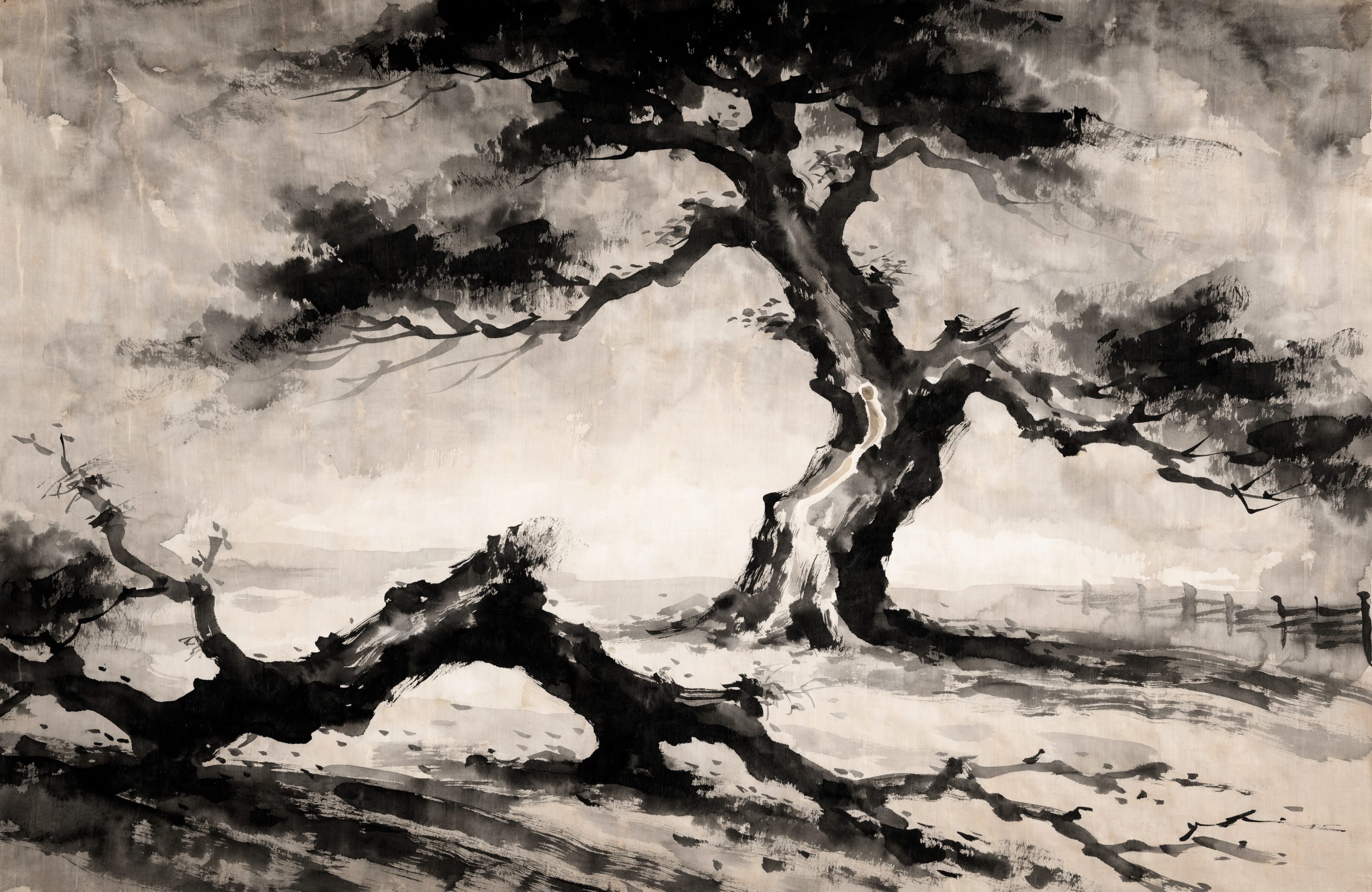
Visual direction was mine: sumi-e ink style for the header, the shift from “moment of fracture” to “morning after the storm.” Generation in Leonardo, prompt iteration in conversation with Claude. The CW endmark is in the same brushwork tradition.