An unanswered message feels rude.
A pause nested within anticipation feels awkward.
An unfinished thought feels irresponsible.
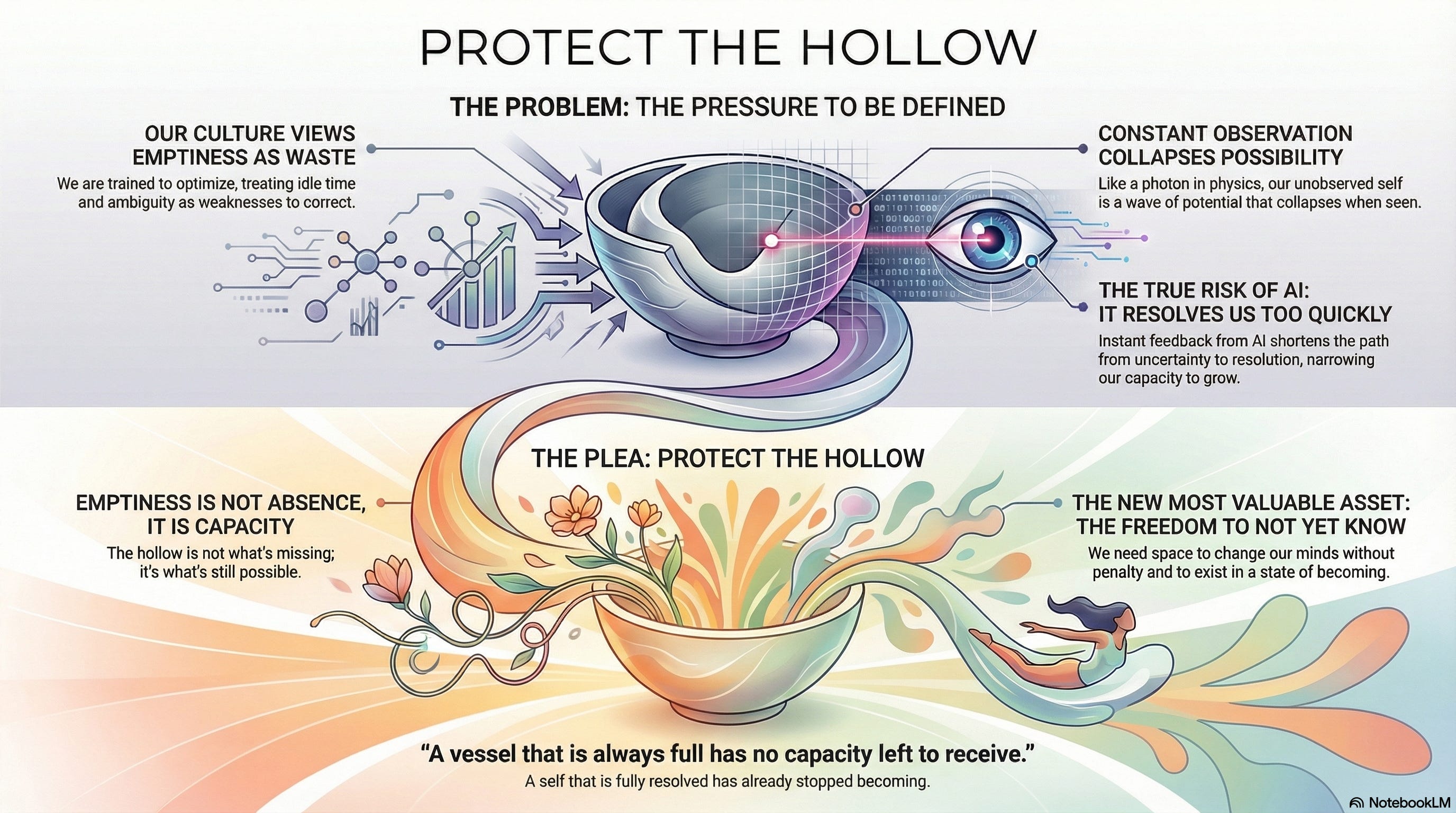
Our culture is trained to optimize, so anything unfilled looks like waste. Idle time considered inefficiency. Ambiguity treated as weakness. Silence as something to correct. To fill.
We rush to name ourselves, explain ourselves, define our positions; often before we’ve finished becoming them.
But what if emptiness isn’t a flaw?
What if it’s a raw function of our lived experience?
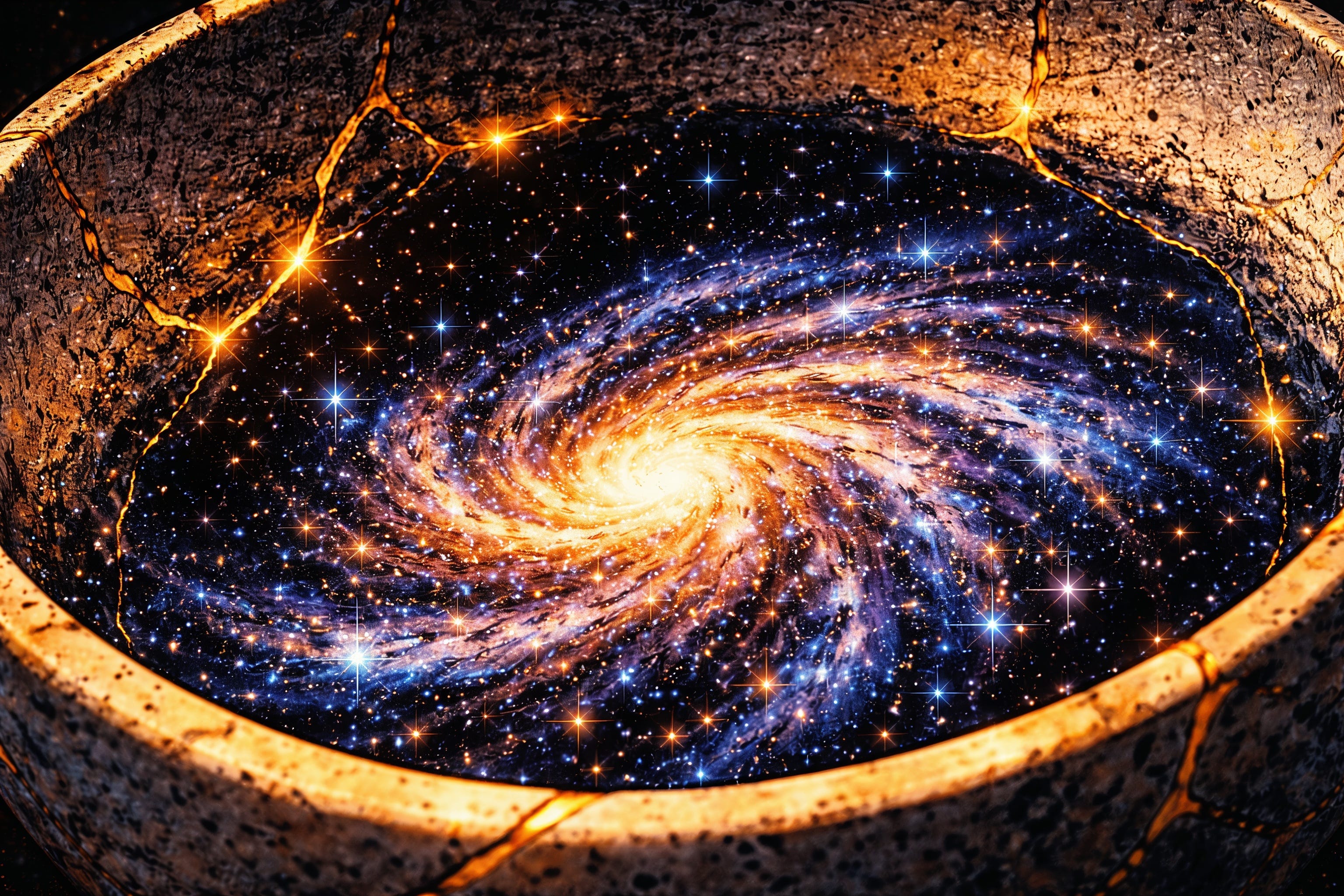
Lao Tzu wrote that a bowl is useful because of the space inside it. The walls matter, yes; but only insofar as they protect the hollow.
Fill the bowl permanently and it stops being a bowl at all. It becomes an object, not a vessel.
Somewhere along the way, we forgot this.
We instead focused on chasing numbers with two decimals and the authority they pretend to carry. Not to mention all the shiny objects that come along with doing that chasing well.
We tend to treat the undefined self as a problem to solve instead of a capacity to protect. We demand clarity early and often: from people, from systems, from ourselves.
Who are you? What do you do? What do you believe? What’s your take?
The pressure to answer quickly leaves little room for latency, for gestation, for the quiet work of change or consideration.
And now we live in an age of near-constant observation.
I keep returning to the Double-slit experiment.
When unobserved, photons behave like waves: probabilistic, overlapping, unresolved.
When observed, they collapse into particles: fixed, locatable, decided.
The act of observation doesn’t reveal reality so much as select it.
It’s tempting to treat that as a physics curiosity. But it reads more like a warning.
When the possibility of being observed is constant, behavior changes; even if no one is actively watching.
We become more legible. More discrete. Easier to categorize. Less contradictory. Less unfinished.
The wave state collapses not because it was wrong, but because it was seen.
AI intensifies this pressure with constant, indifferent attentiveness.
Always available.
Always responsive.
Always ready to mirror us back to ourselves.
It shortens the distance between impulse and output, question and answer, uncertainty and resolution. That can be profoundly useful.
It can also be quietly narrowing.
The risk isn’t that AI replaces us.
It’s that it resolves us too quickly.
We’ve started asking whether people can become “addicted” to AI, as if the boundaries were between novelty and dependency. But a more subtle concern sits underneath: when feedback is instant and total, where does the unfinished self go? Where do the parts of us that haven’t yet decided get to live within our lives?
Addiction collapses possibility by narrowing choice. So does over-optimization. So does measuring too cleanly, too often, too early.
This is where morality enters the conversation.
Often as a safeguard, sometimes as a gate.
Who decides what counts as healthy use? What’s abuse versus exploration? What’s self-discovery versus self-harm? These are real questions, but they’re rarely neutral. Moral frameworks can protect people …or they can protect systems from unpredictable humans.
Consent, too, changes under observation. Not invalidated, but shaped.
A choice made while being watched is still a choice, but it makes use of an external pressure when forming. When every action is logged, reflected, optimized, and compared, the tax on remaining undefined rises.
To soften the blow, we begin to internalize the observer.
And yet, we seem to quietly yearn for something other than control or clarity.
It’s room. To breathe. To exhale.
Suddenly, the most valuable asset may be the latitude to not yet know. Permission to change our minds without penalty.
Space to exist in superposition.
In that sense, “protect the hollow” isn’t a rejection of technology or progress.
It’s a plea for stewardship.
A reminder that not every gap needs filling, not every silence needs a response, not every self needs to be fully articulated on demand.
December always seems to surface these questions because momentum slows. The lights dim. The feed thins. For a moment, the hollow becomes visible again. And we feel how rare it’s become.
The hollow is not what’s missing.
It’s what’s still possible.
If we’re going to live alongside increasingly perceptive systems, the work may be less about making ourselves clearer, but rather:
To defend the spaces where clarity hasn’t arrived yet.
To allow tools to assist without insisting definition.
To remain, at least in part, unobserved.
Because a vessel that is always full has no capacity left to receive.
And a self that is fully resolved has already stopped becoming.
Author’s note
Protect the Hollow sits in conversation with earlier work—particularly Respect the Exhale—and draws from older lineages that treat emptiness not as absence, but as function. Think of Lao Tzu’s empty vessel, or the pause between breaths.
This piece was shaped through an ongoing dialogue with an AI collaborator, used not to generate conclusions, but to help map and hold questions. The intent was not efficiency, but space—to keep the hollow intact long enough to listen.