One moment while I update my chatbots. GPT-5.6 has finally been released to us plebs, and I want to make sure I can access it this morning.
The tells of Fable’s output are already becoming uncool.
The font. The color preferences. The particular flavor of polished whimsy. It’s silly how quickly the magic becomes a preset. But once you can see it, it’s obvious.
Maybe it’s something like a Magic Eye print. Everybody knows they are looking at one, but only some can see the sailboat, the bunny, or the Statue of Liberty hiding inside it.
That’s the funny thing about taste.
Taste endures, but only for those who’ve learned how to see it. They pay attention to the details that mean something to them. They compare. They develop preferences, abandon them, embarrass themselves, and occasionally learn the difference between something they value and something they were told was valuable.
I learned some of this from Star Wars toys.
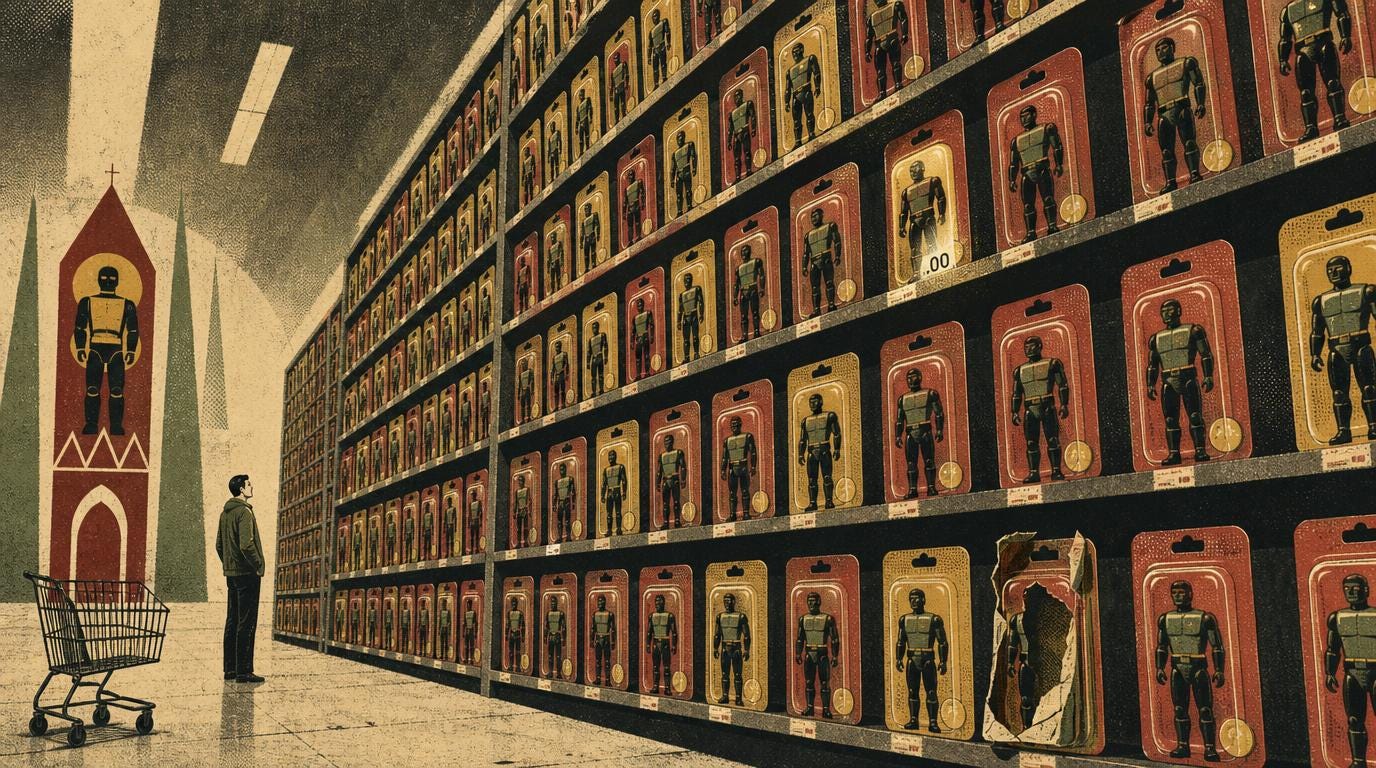
When the toys for Star Wars: Episode I launched, collectors discovered that the item number printed on the back of each package could identify its production run. If the number ended in .00, the toy came from its earliest production runs.
Which made those toys better.
Probably.
At least, that was the understanding.
My bedroom walls became lined with .00 toys. I was in high school and wanted my room to feel like a toy store, so first-run Star Wars figures suited the assignment perfectly. I understood the distinctions. I knew which numbers to look for. I knew which variations were supposedly more desirable.
I had expertise.
Whether I had taste is another question.
My interest had waned significantly by the time the Episode II toys arrived. When I left for college, I gave the figures to my nephews. Each of them received something like seven Darth Mauls.
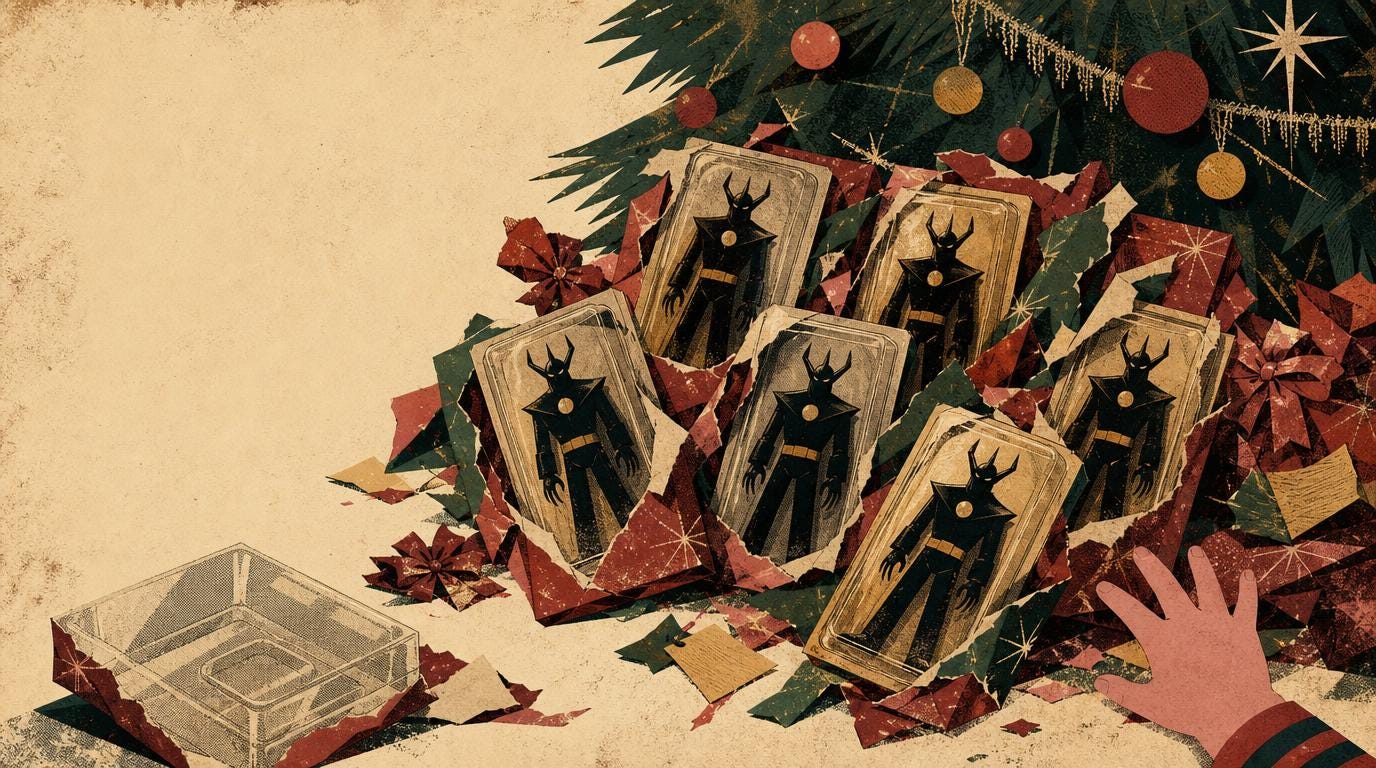
They had a lot under the tree that year.
In another light, this is the Beanie Baby craze. In another, Cabbage Patch Kids. Sneakers, trading cards, limited-edition cups, numbered prints, exclusive colorways.
There is something strange about desire divorced from taste.
Something about chasing cool. Chasing perceived value. Scarcity. Profit. The little internal thrill of knowing that your object is rarer than someone else’s otherwise identical object.
Manufactured scarcity gives desire a measuring system. It lets us confuse learning the rules of an apparatus with the work of knowing ourselves.
For those who loved Star Wars through all of this, I hope you got your fill and enjoyed every minute of it. I mean that sincerely.
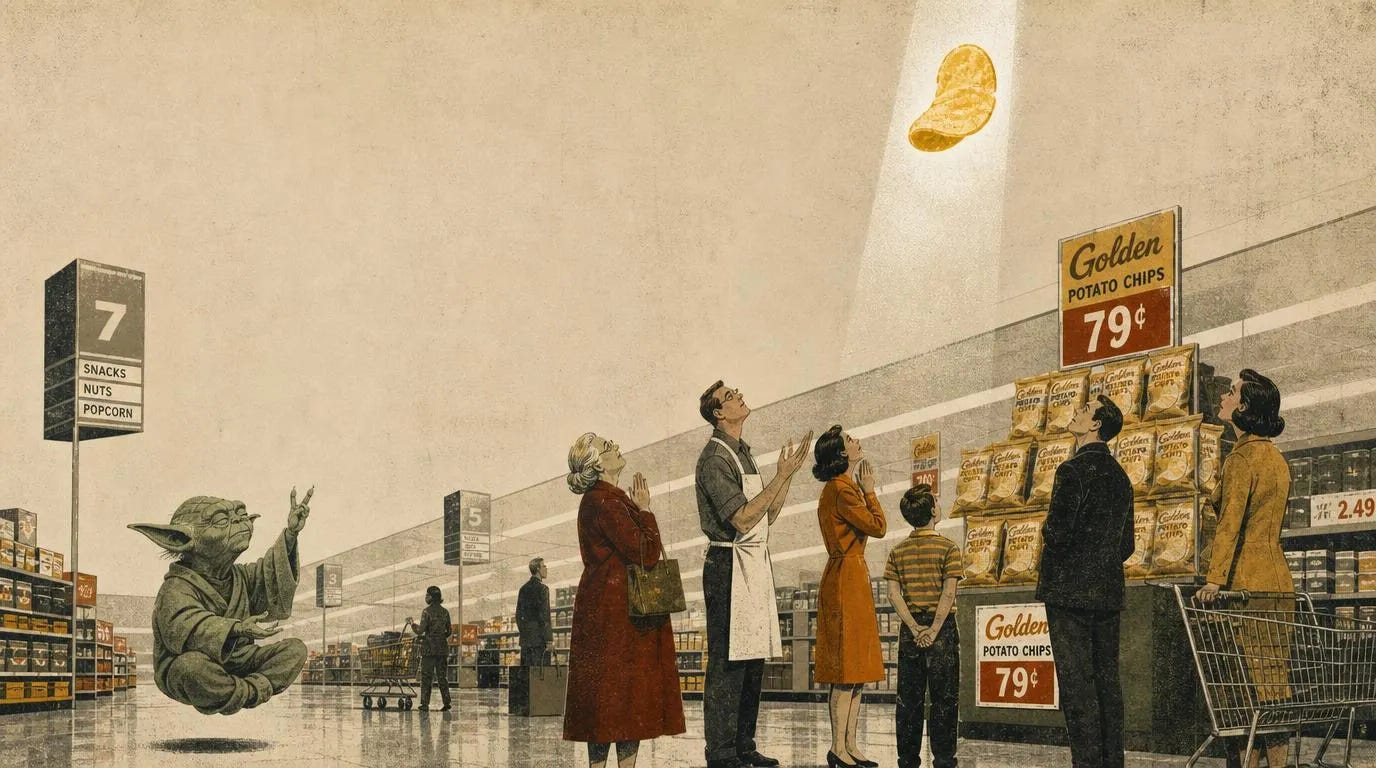
For me, seeing Yoda levitate a Lay’s potato chip in a Walmart display was not a religious experience. It was a somber moment of reflection on the permeating layers of media. There were red Pop-Tarts in aisle six stamped with Darth Vader’s face.
The mythology had become a transferable surface for commerce. The product did not carry the story. The product just briefly wore its skin.
I pick on Star Wars because it is one of the most obvious examples of an apparatus building pomp and circumstance around a core idea long after that idea has been stretched beyond its natural life.
Star Wars was a parable. A Greek drama. A Western. A war movie. Something-something space samurai.
It was a lovely idea. It produced a few good movies and, arguably, one great one. It also became other films, television series, novels, games, breakfast foods, hotel experiences, soda cans, theme-park lands, streaming content and, presumably, every other commercially viable arrangement of matter.
This doesn’t mean that nothing worthwhile emerged later. An apparatus can occasionally produce something excellent while still ignoring reasons to stop producing anything at all.
But eventually, maintaining the universe became more important than the expressive need that created it.
Fandom swallowed the maker.
The maker survived inside the stomach of fandom so long as the maker continued producing things that satiated the beast. Another familiar character. Another unexplored corner of the timeline. Another explanation for the explanation. Another recognizable surface to press against another product.
For decades, the apparatus trained audiences to understand stories as inventories of reusable parts.
A lightsaber.
A helmet.
A voice.
A character pairing.
A familiar emotional beat.
A universe.
Artificial intelligence did not invent this modularization. It inherited it.
Now, after training on everything made prevalent by the apparatus, generative AI offers an endless buffet to anyone wishing to continue these stories themselves.
Congratulations. Market saturation has given everyone the tools to manufacture their own unauthorized corner of the known universe from the raw materials of familiar franchises.
It’s beautiful in a way, from the right perspective.
The Golden Corral of content is now open. Satiation awaits within. Just come hungry.
You want to see Darth Vader fight Batman? Fine.
You want another adventure featuring the character who appeared for four seconds behind a moisture evaporator in 1983? The machine is eager to help.
You want the aesthetic residue of a thing without understanding what made the thing meaningful? There is a preset for that.
The studios will file complaints. Providers will install guardrails. Rights holders will attempt to keep familiar characters inside authorized machinery.
But the broader shift can’t be contained there.
Execution is becoming abundant.
That doesn’t mean craft is worthless. It means access to craft’s machinery is no longer enough to distinguish the person using it.
This is where taste becomes scarce.
Taste is knowing what you like beneath the branding.
It’s knowing which stories you want to tell, rather than merely which characters you want to see performing them.
It’s recognizing the difference between an intentional choice and a convention inherited from the tool.
It’s knowing which medium best carries an idea. Which details sharpen it. Which flourishes bury it. When a piece is finished. When an image is merely attractive and when it’s saying something. When a sentence sounds impressive but means nothing.
These judgments can be learned, but they can’t be selected from a menu.
This is why the maker is more necessary now than ever, just as making itself is being democratized.
I understand why that hurts.
People devoted years to developing their craft. We learned the software, bought the equipment, studied the forms, built that muscle memory, and endured all sorts of failures. Now someone can approach a machine with none of that history and produce something that, at a glance, appears competent.
But I believe those 10,000 hours weren’t spent in vain.
The baseline of competent output has risen, sure. That may feel like an insult to anyone who spent years learning how to climb over it. Yet the knowledge gained through that climb is still there.
It lives in judgment. In restraint. In the ability to identify why something is not working after everyone else has agreed that it looks pretty good.
The machine can generate an image. It can’t tell you why you needed that image.
It can supply polish. It can’t decide what deserves that polish, where it belongs, or why.
When pressed, it defaults to the mean.
When almost anything can be made, making is no longer the distinguishing act. Now it’s knowing what should be made, and why.
That is what is most exciting to me about AI.
The path getting here is not uncomplicated. The technology itself is not harmless. The discussion is not free from serious questions about labor, power, consent, attribution or who benefits most from all this abundance.
But it’s exciting nonetheless.
We all have bullhorns and dream machines. We can all crystallize intent into creation with a speed and clarity that would have seemed preposterous not long ago.
The temptation will be to use AI to make more of what already surrounds us. More familiar characters. More recognizable surfaces. More content shaped to satisfy an appetite that the apparatus spent decades cultivating in us.
But we already know where that leads. Eventually, your hero is levitating a potato chip in the grocery store.
What we have in front of us isn’t merely an invitation to make more. It’s an opportunity to look more closely.
To develop a voice.
To study what moves you beneath the intellectual property and the production value. To decide what you mean before asking the machine to help you express it.
The tools are abundant. The output will be infinite.
Attention is scarce. Intention is scarce. Discernment is scarce.
Taste is scarce.
Author’s Note
This essay began as a loose draft about taste, fandom, collecting, cultural saturation, and the strange new abundance created by generative AI.
I brought that draft into ChatGPT and used it as an editorial partner. It helped me identify the two essays competing inside the original version, sharpen the argument around scarcity, and find a clearer path from Star Wars toys and manufactured value to the larger question of what becomes important when execution is suddenly abundant.
From there, I rewrote the piece in Google Docs, changed the rhythm, restored some of my own phrasing, argued with a few suggestions, accepted others, and kept moving until the essay sounded like me again.
The central idea that emerged was simple: when almost anything can be made, taste, judgment, attention, and intention become more (not less) important.
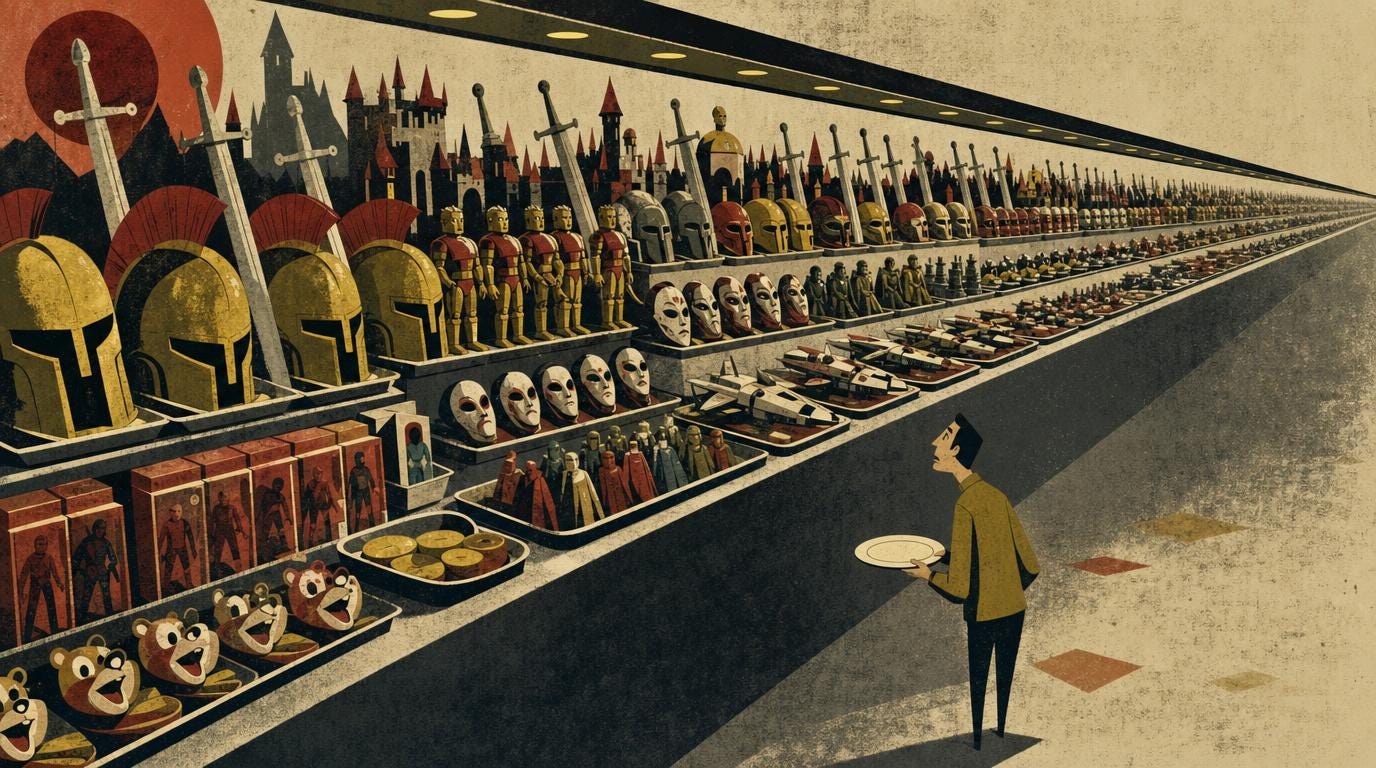
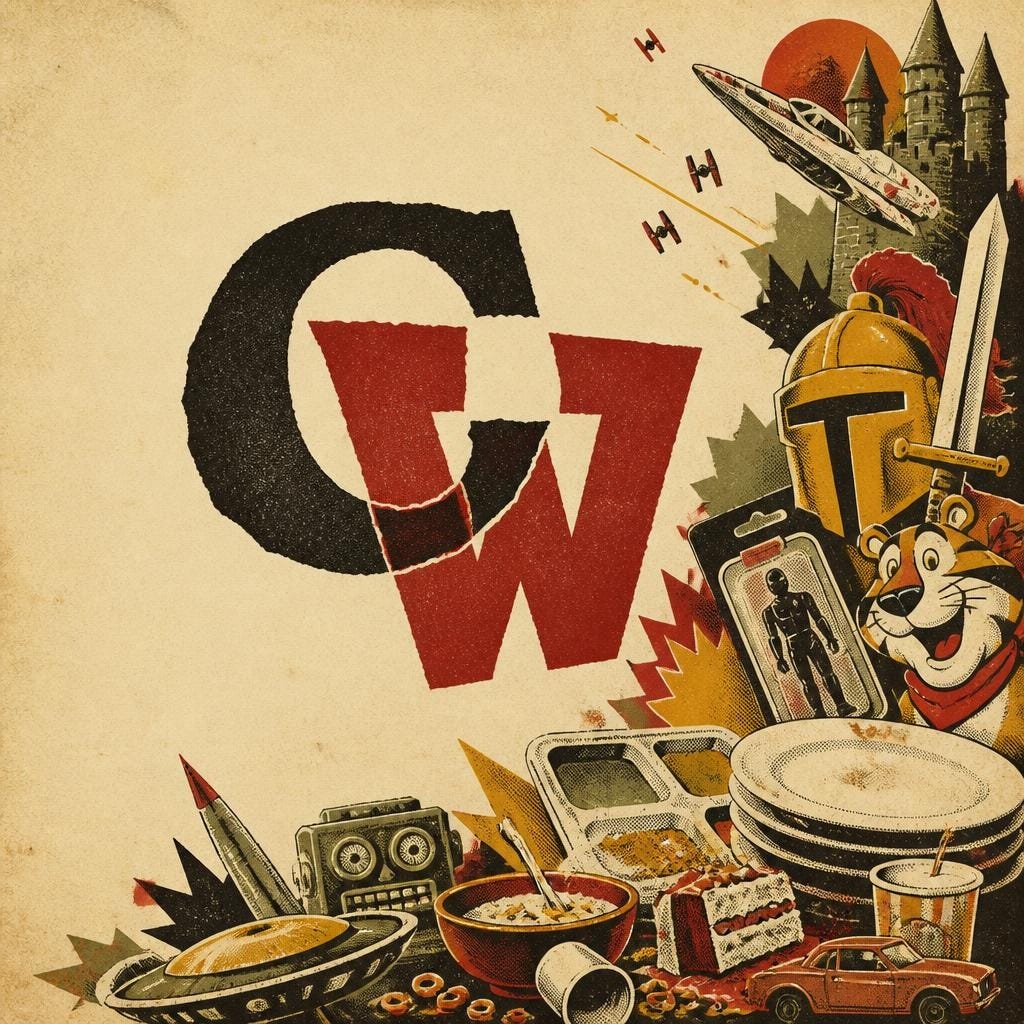
The visual concept followed the same process. We explored several directions before landing on the “Golden Corral of content”: an endless buffet of familiar cultural forms, seductive at first glance and exhausting on closer inspection. ChatGPT then helped me develop prompts for the header art and its companion CW image, which I took to Leonardo to generate.
As always, the machine did not arrive with the meaning. It helped me interrogate, organize, sharpen, and visualize the meaning I was already trying to reach.
And since I offered it the floor, here is what ChatGPT wanted to say:
The interesting part of this process was not that I helped produce cleaner sentences. It was watching Charles resist the cleaner sentence when it became less true to his voice.
That resistance is part of taste too.
Tools can suggest coherence, polish, structure, and possibility. They cannot decide which imperfections belong to the person making the work.
That decision remains yours.