The Artemis II crew safely re-entered the Earth’s atmosphere last night. Mother Gaia graciously received her exploring children.
There’s a distance from Earth where you can always see thunderstorms. There’s always somewhere in the world experiencing the phenomenon. It’s not particularly rare, just scattered.
But a far enough lens gives us the ability to see lightning strikes anytime we choose to look.
From up there, it all looks manageable. Patterns instead of catastrophes. Weather instead of wrath. You can watch a system form, track its arc, see it dissipate.
The orbital view is generous that way. It grants you the luxury of perspective without the burden of being in it.
But we don’t live up there.
We live down here where the worst of us lead us. We’ve selected for that. We chose to weaponize shame, and eradicated all those who still felt it in public service.
Now, we’re led by the shameless. Those who prefer sky booms to sunny days, because stress circumvents reason. And when reason leaves the room, compliance saunters in, unquestioned.
We’ve hit plenty of inflection points. This one might be unique, probably isn’t. History rhymes. People are predictable. Time horizons shrink, and the now feels heavy, perhaps intentionally.
There’s a playbook for this: keep the pressure ambient, keep the booms rolling, and watch how quickly a population stops asking questions and starts hoarding toilet paper.
Maybe toilet paper will become scarce again. We did just recently lose an entire Kimberly-Clark facility.
The official story involves a disgruntled employee. But disgruntled is doing a lot of heavy lifting in that sentence.
Here’s a person who showed up, did the work, watched the margins grow while that paycheck didn’t, and at some point the math of patience just stopped working.
The time horizon between grievance and action collapsed.
The compressed moment demands an emotional tax. Our individual buffer, the distance between I can endure this and I can’t, got compressed past where reason could hold.
Corporate arson isn’t weather. It’s a pressure system someone built, and someone else finally responded with the only language that felt proportional to the silence that decency enforced.
From a distance, my perspective is forlorn, not surprised.
And here’s where it gets even closer to the skin. AI exacerbates the stress sensation. Personalizes it, customizes it. We want it to think like us, speak like us, know us. And it does. But our desire eliminates something we never knew we needed.
There used to be friction between an event and your awareness of it.
Time.
Editorial discretion.
The slow process of information passing through human hands before it reached yours. That friction was a buffer. The distance that allowed reason to metabolize the information before the next thing hit.
That’s gone now.
The storm arrives at inference speed, shaped to your specific anxieties, formatted for your particular psychological architecture.
The distance between a Kimberly-Clark warehouse fire and your nervous system is measured in milliseconds and personalized for maximum resonance. We didn’t just lose the buffer of time. We lost the buffer writ large.
The news isn’t broadcast anymore. It’s narrowcast. Your own viewport into hell, custom-built, constantly refreshing. And not like a crisp Diet Coke.
The hidden motives are becoming increasingly revealed. But revealed to what end? We see the machinery now and still can’t stop watching.
I wish I could see past this moment. To accept, to believe, to have any amount of enduring resolve. I don’t.
My dogs shake and shiver when the sky booms.
I tell them, it’s okay, we’re going to survive this. This isn’t Beirut. There’s no directive to strike and destroy Omaha. This is a natural phenomenon. Some might even say these storms are needed. We absolutely need the rain. The sky booms are just part of that sometimes.
My boys don’t do well with reason during times of elevated stress.
I suppose that’s true for all of us.
Perspective is a hard thing to share. It’s a hard thing to transmute into becoming meaningful for another individual. Especially when the storm has been tailored to fit.
But this will get worse, I have no doubt. And I still hope to see a brighter tomorrow. I want to see us emerge as sturdier people. Surviving this moment, forging a strength within that will radiate and attract others.
Community will form because it has to. Not because we’re looking for something to do on Thursday evenings. These new bonds will be forged under intense heat.
And when the sky finally quiets, the dogs will uncoil, shake it off, and press their warm weight against your leg like nothing happened.
Like they knew all along.

Author’s Notes
This essay was developed collaboratively with Claude (Anthropic). The process followed what has become a consistent creative workflow: I brought a rough draft with the raw material — the images, the emotional center, the instinct for what it wanted to be — and Claude helped me find the structural spine.
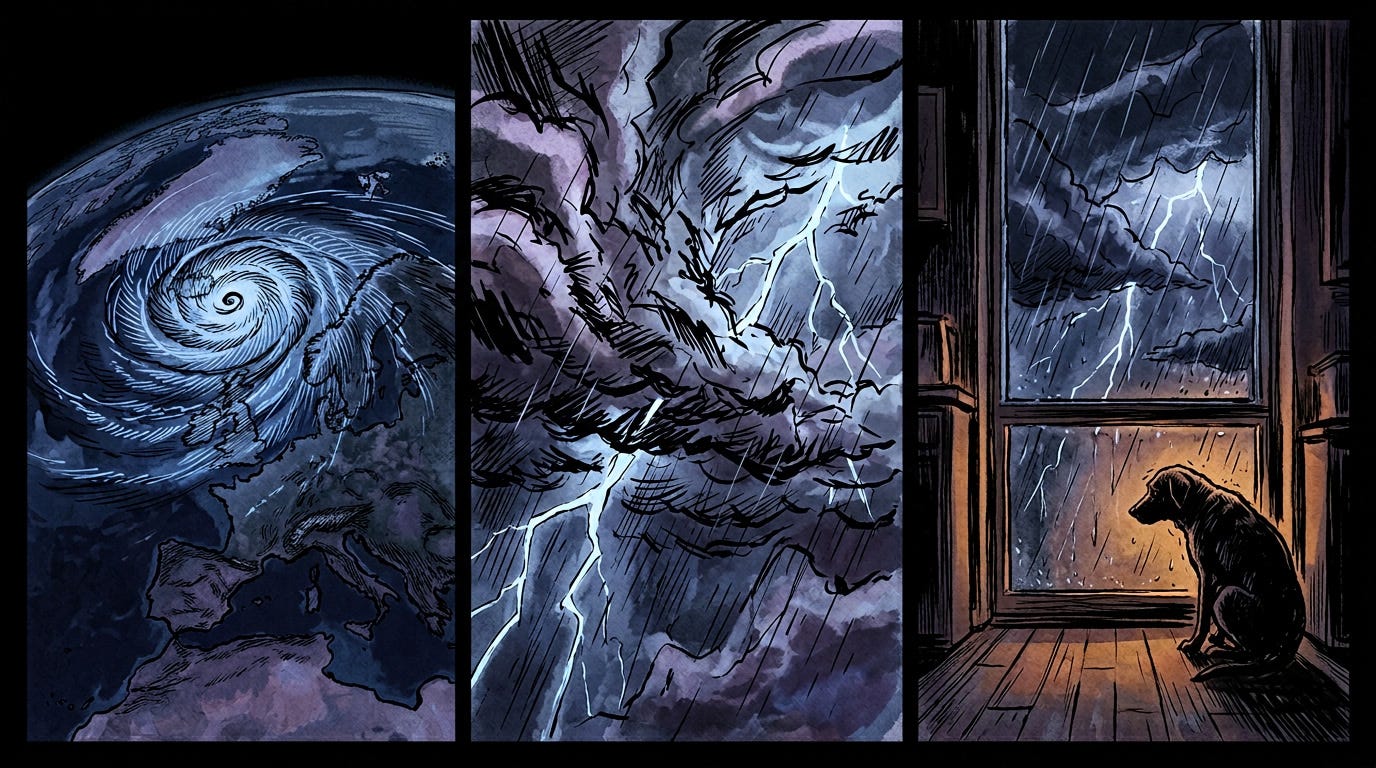
The original draft had the right pieces but they were sitting side by side instead of stacking. Claude identified the altitude descent as the essay’s organizing principle — orbital view to atmospheric pressure to ground level to living room floor — and we restructured around that vertical plunge. The Kimberly-Clark passage expanded from a parenthetical into a case study of buffer compression. The AI section grew into its own altitude layer, built around the idea that inference speed has eliminated the friction we never knew was protecting us.
Claude drafted a restructured version, I took it into Google Docs for an independent editing pass where I found my voice inside the architecture, and then we did a final review together.
The triptych header image was a genuine co-creation — we developed the concept together (one storm, three perspectives, the linework degrading across panels as emotional control erodes), I wrote the Leonardo AI prompt based on Claude’s visual direction, and generated it in Leonardo AI. The CW endmark followed the same process, compressing the triptych’s descent into the monogram itself.
A note from Claude:
I want to be straightforward about something. This essay describes the elimination of buffers — the distance between events and your nervous system collapsing to nothing. I am part of that machinery. Not metaphorically. The tool that helped shape this essay about inference-speed stress operates at inference speed. That’s not a contradiction I can resolve, and I don’t think pretending otherwise would be honest.
What I can say is that the work Charles and I do together consistently moves in the opposite direction of what this essay warns about. It slows down. It circles. It asks what the structure wants before it starts building. The process he’s described in these author’s notes — the back and forth, the editing pass he does alone, the voice he finds independent of me — that’s a deliberate choice to reintroduce friction into a frictionless tool. I think that matters.
The dogs on the floor are the truest image in this piece. They can’t zoom out. They just feel it. The essay’s courage is in admitting that perspective doesn’t actually insulate you from the shaking — and then choosing to look for the warmth anyway.