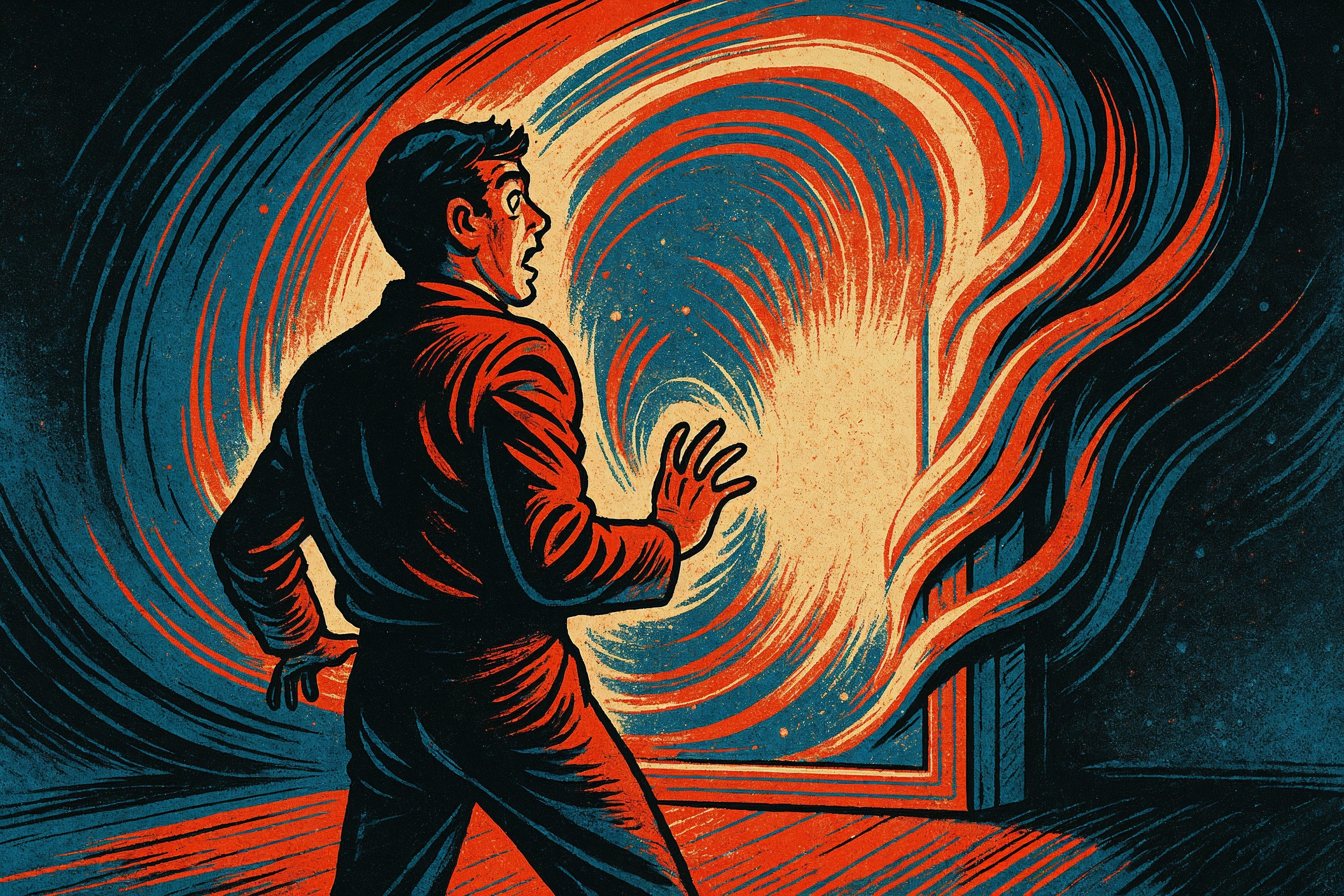
Every technology tends to trickle through the same well-trodden path: a bleeding edge that gives way to early adopters, the hum of novelty, the blare of virality, the slide into ubiquity.
The printing press proliferated books as consumers learned to read.
Photography democratized images for those with the patience to compose, develop, and print.
The internet shattered distance, but demanded a certain computer fluency to find your way inside it.
AI is different. It doesn’t sit behind any literacy wall.
It adapts. It listens. It speaks in images, sound, and text, meeting each of us in the space that we already inhabit.
That’s exhilarating. But it’s also terrifying.
Since there’s no buffer, there’s no safe distance to warm your hands before stepping closer.
Because the little bargains we made with ourselves: I can’t draw, I can’t code, I can’t compose… those bargains are suddenly void.
The bankruptcy of our limits, forgiven in a flash.
And that kind of freedom is AI’s gift. And its terror.
Where Sour Turns Legitimate
When you look at the growing wave of criticism surrounding AI, the spread of critiques is wide.
On one end, you’ll hear arguments about water usage. As if theme parks didn’t pour out their daily millions of gallons without scrutiny.
On the other end, you’ll hear calls for data dignity. The desire to build a system that acknowledges provenance and pays royalties back to originators of ideas in any shared form.
That latter critique bites deeper.
Even if such an algorithmic agreement began today, it would mark a turning point for how we view these systems. Consent, compensation, and credit aren’t mere legal matters, they’re moral ones.
Somewhere within this soured spectrum is the difference between frivolous complaints and the foundation of a new economy.
Of course, not all outrage is equal. Some is theater.
Etsy sticker shops claiming cultural collapse. Artists posting threads that double as marketing campaigns for their “human-made” wares. It’s status signaling, much like the way “organic” became less about farming and more about identity.
But to dismiss all of it would be a mistake.
Underneath the performance runs something quieter, heavier.
If machines can produce works of real profundity; the kinds that move us, surprise us, even linger with us… then what becomes of distinctly-human contribution?
What happens to the fragile sense that our labor is irreplaceable, or even necessary? That question is less about markets and more about the meaning of the message.
Then there’s the question of community. If “the best idea wins,” what happens to collaboration? To the bonds of shared effort?
It’s tempting to imagine AI flattening culture into a bland sameness, everyone using the same tools to chase the same prize.
But the world doesn’t look like a mono-culture anymore. That gravitational center has already dissolved.
We live in a fractal society now; one where niches bloom, splinter, and self-propagate.
In that kind of ecosystem, AI doesn’t crush diversity, it accelerates it. It arms individuals with leverage, not to dominate a single stage, but to populate infinite ones.
In a mono-culture, AI would be homogenizing. In a fractal society, it becomes a multiplier.

Who Feels Most Threatened
It’s easy to assume the loudest resistance comes from mid-career professionals: artists, educators, knowledge workers. And yes, many do feel the pressure of automation.
But the sharper edge seems to come from the young. The generation that was told that they’d inherit the future, only to watch that future sprint away from them.
This isn’t just about jobs, or even skills. It’s about expectation. It’s about the story of possibility, potential and participation.
This synthetic intelligence will drastically dismantle the current system. And our unwillingness to focus on the future, and how to work with our new digital superpowers, is only hurting those that could wield it natively.
Yet, we seem focused primarily on how it all began. Where it all went wrong. Why no one got paid before this technology became ubiquitous. This focus drips with confusion and fear.
In the meantime the new railroads are being built. Those rails will chart the most efficient path by design. But, in that same amount of time, with our shared attention, it could carve an equitable path that benefits all who choose to participate.
We need to forgive the sins of pretraining and focus on the mountain of money being made at inference. We must all help write a story of enthusiastic participation and equitable compensation.
AI doesn’t ask us to learn a new literacy. It asks us to confront ourselves. Our systems and our traditions. To decide whether we cling to the comfort of bankruptcy, scarcity, permission, or step onto a stage where every limit has been stripped away.
The stage is open. The sourness is real. But so is the invitation.

Essay by Charles Wilke, with AI collaboration (ChatGPT). Visuals co-created with generative AI.
Link to chat used during creation of this piece.