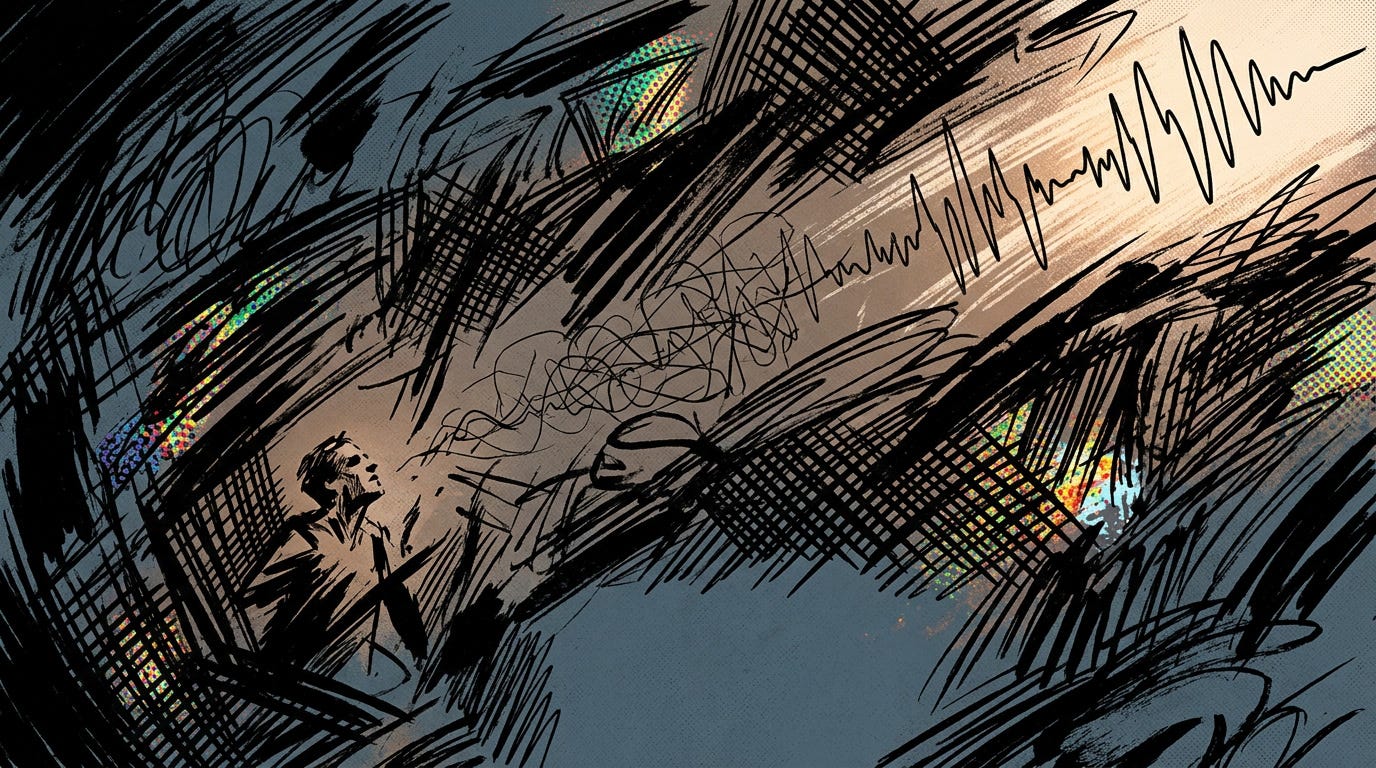
If you think about art as product (the stuff you can actually consume, hold, stream, buy) I’d argue Dave Grohl’s first Foo Fighters record is about as close as we get to a thing of fully singular intention.
He wrote all of it. Played all of it. Every guitar, every drum, every bass line. His hands, his head, alone. (Yes, he needed engineers. Different essay.) It’s a genuine triumph of will, and I’ll be a fan forever.
It’s also an inversion of how most things get made.
Because out here in the marketplace (of ideas, of Walmart, in the year of our lord 2026) nobody works like that.
We design by committee. We formulate, we riff, we jam, we bounce. Ideas are fragile when they’re new, and it takes a specific appetite for pain to be a creative professional in corporate and watch your fragile thing get nits from eleven people before lunch.
Eventually you realize the dents from sharing are the point. The friction is the polish. The rough-and-tumble of the room where it happens is how ideas actually shine.
So here’s the thing I didn’t see when I started writing this. Grohl didn’t escape the friction. He internalized it. He became his own committee: drummer arguing with guitarist arguing with the guy who writes the bridge. All of it happening inside one skull. He looked into the mirror and liked what he saw enough to build it by hand. The mirror was the rest of the band.
Hold onto that. It’s the whole thing.
I believe AI is a mirror.
I’ve said it before; I’ll keep saying it until it stops being true. And I recognize the urge to make faces at it. Make a sour face and it makes one right back. Or worse, it tells you you’re special for hating this new substrate, strokes your chin, agrees that you alone see clearly.
The mirror flatters. That’s its worst trick.
But watch what happens when you lower an actual idea into it. Not a sour face. A beloved and personal idea. Some of them catch the light and shine. Some crumble in your hands on the way down.
I’ll give you mine.
Writing this, I went reaching for the easy ammunition: the banal responses to anti-AI arguments. Data centers barely sip the water supply! Almonds drink a third of California and nobody’s marching on Modesto!
Both of my arguments crumbled the second I checked them. The almond figure was off by a country mile. The data center number was technically true and completely misleading. I lowered my own cleverness into the box and it did not survive the trip.
That’s not a confession. That’s the feature.
Everyone’s arguments crumble in there: the boosters’, the doomers’, mine, yours. The crumbling was never the point. The point is that you finally have a surface honest enough to show you which of your ideas were made of sand.
Which brings me to the actual choice, the one underneath all the noise.
When people recoil from this stuff, I think they’re standing in front of two distinct doors, both offering terrifying truth in their own right.
Door one: it’s bad because it steals from others.
The labor, the training data, the livelihoods. A real argument. I don’t wave it away.
Door two: it’s bad because I can finally see myself, and my beloved ideas might not survive the radiance.
That precious thing I’ve been guarding was, maybe, ordinary all along.
Choosing door two confronts our fears within. It challenges our sense of self, deeper than the mere market value of our output. I think door two is where most of the heat actually comes from. We dress up door one with our ire because door one lets us keep our dignity without showing our hand. Door two leaves us all bare, challenged to face ourselves.
Sure, some of the loudest alarms are just the incumbents pulling up the ladder.
Prominent voices are watching an infinite tide of new makers while doing the math. Every reproductive technology gets this treatment. The portrait painters loathed the camera. The typesetters loathed desktop publishing. Fine. That’s the minor key, and I’ll let it stay minor, because pretending the gatekeepers are the real problem would just be me making a face at a different mirror.
Here’s the real problem. We democratized creation. We did not democratize attention.
Anybody can make the thing now. That doesn’t mean everybody can be heard.
If everyone gets a mirror to build from, the noise floor doesn’t hold steady… it climbs, and it climbs fast. I can watch it climbing in real time, day over day.
We may have solved the wrong scarcity. The barrier to making fell through the floor; the barrier to being heard jumped vertically.
And still (still) I walk the optimist’s path. Here’s why.
There’s a question humming under all of this, and it’s the only one I find genuinely interesting. Grohl liked what the mirror showed him because he’d already spent fifteen years earning the taste to tell good from garbage: Scream, then Nirvana, then the Foo Fighters record.
The mirror gives everyone his solo capability. But it doesn’t give them his taste?
I think taste is earned in the making. The mirror of AI just allows you more reps, faster. You learn what shines by lowering thing after thing into the light and watching most of it crumble. That used to cost years and a record deal.
Now it costs an afternoon.
And here’s who that’s for. There are billions of people who were never great with computers. Those who got trained and drained on screens that never felt like theirs. And let’s not forget those who never knew computers even existed. Now they can just talk.
Out loud. To the thing.
It’s the bit in Star Trek IV where Scotty picks up the mouse like a microphone “Hello, computer!” Then, as he gets told to use the keyboard, “keyboard. How quaint.”
Except this time it works as he’d expect, and the joke lands on us, because controlling something this powerful with a keyboard turns out to be just as quaint.
We did our shift at the screens. We earned our calluses, our posture problems, our muscle memory for tools nobody asked us to love.
I don’t think the next billion makers need any of it. They’ve been carrying a wealth of things worth sharing their whole lives, and for the first time there’s a way to let it out that doesn’t route through a skill they never wanted to learn.
So the race everyone keeps announcing, to AGI, to UBI, to an ELE. I don’t hear this tune as a race. It’s too fractal for that. Too rhythmic. There’s a tempo to it, a hum, a general and slightly unhinged excitement I can’t talk myself out of.
The hard part was never permission. The gatekeepers can’t actually stop this; they can only be loud about it. The hard part is the thing it’s always been: being good, and being heard.
The mirror can help you get good. It can’t do much about getting heard.
That part’s on us. So when the next billion people finally start making the things they’ve been carrying around their whole lives, we should choose to listen.
Author's note: As with every piece in this series, Claude worked as stage manager, not director. The intent, the argument, and every face I made at the mirror are mine — and so are the clever little arguments the mirror crumbled in my hands before this draft was done. The shaping happened in conversation; the words took their final beating alone, in a Google Doc, by hand — Grohl-style, minus the talent.