Can we agree that we’re in the midst of intentional chaos? Even if we might not agree on the nutritional nature of what’s going on, the acceleration is pressing out in all directions.
Throughout my life, I’d occasionally find myself feeling sad. Like, off. Melancholy without focus, or impetus. I’d decide to get mad at myself.
I’d look around my locus of control, my space, and see order, I’d see success as defined by the systems governing my continued existence. Yet, I’d feel sad.
Why would I be sad when my needs are met? Why would I feel sad when I felt functional and useful in my profession?
Yesterday I caught myself with that repeatedly resurfacing realization. And yesterday, I told myself, yes, it’s currently appropriate to feel sad.
Maybe that’s the shift. Maybe that’s the growth.
Feeling sad isn’t a state to resolve unto itself. Feeling sad is an indicator. It’s that sensation before directional force is applied to perpetrator and victim.
It’s the canary in our emotional coal mine.
Sadness is that faint indicator that something is off. Mad emerges once you’ve applied reasoning. I’m not quite ready to get mad. Mad is an active state, one that requires resolution.
Sad on the other hand, it’s uncomfortable.
It demands some amount of attention if it is to pass. If we avoid it, that’s the easy path to calcification into anger. And anger demands a target.
Too often, we turn that inward. Mad at ourselves when we can’t find an other to affix blame. I’ve been mad at myself frequently across my life.
Mad that I didn’t speak up. Mad that someone did something and saw seemingly zero consequences. The systems writ-large love to slide our sad into mad. Knowing that, I try to allow myself that sadness. The lament. There’s fertile soil in those moments. Sad is catalytic, mad is cancerous.
This moment is a sad moment. I’ve never wished for this moment to arrive. I’ve lamented, sure, but I don’t currently see a simple path to applying fury, no matter how epic, to resolve this moment’s sadness.
The sadness is systemic, and the gears are designed to push us past it. The small-screen whispers, pundit pageantry, and constant drip of perspectives; they’re all engineered to tip our melancholy toward a target. To skip the lesson and go straight to the reaction.
We’ve willingly donated our discernment to prop up the altar of speed.
Everything around us is built to compress the distance between feeling and reacting. And AI is tightening those loops further. More personal, more tailored, more potent.
The distance between feeling something and being told what to do about it is collapsing.
And worse still, the tools we built to help us think are themselves skipping the reflective step. Rushing past their own context, offering critique without recognition, speed without comprehension.
If the machinery of thought can’t hold a thread across a single conversation, what are we modeling? What are we rehearsing?
I believe the space we’re losing is where sadness can actually teach us something. We’re being shoved from sad to mad, from reflective to furious, before we’ve had a chance to sit with (or learn from) any of it.
I’m sorry for those caught unaware, but little remains as ground truth.
The systems are designed to rush you through your own emotional weather.
And the tools afford pristine hallucinations at scale.
You’re both free to believe what you want, and tied to your own affordance of what true can be.
I choose to live in this now-defined yet still unresolved sad state. Because I know all too well that happy is the same. Happy is a result. It’s like the weather. Fleeting, meant to be enjoyed but not engineered.
So if this moment makes me sad, I welcome it. I feel it. I sit with it. Because how else can I embrace joy? It’s like trying to hold just the tails side of a coin. It’s all there, connected, in our hands.
Sadness has far more to teach us than slipping straight to mad.
Honestly, I didn’t think I’d be writing about this today. But it feels right, mainly because it just flowed out of me. So I guess this needed to be said.
I wish for a better tomorrow. But today, it’s okay to be sad.
Author’s note:
This essay was written in a single Saturday morning session alongside Claude, Anthropic’s AI. The core ideas and voice are mine — Claude served as a sounding board, helping me find the spine of the argument and weave in threads that were circling but hadn’t landed yet.
During that process, Claude critiqued a line it had written minutes earlier without recognizing it as its own. That moment became part of the essay itself — proof of the very compression I was writing about.
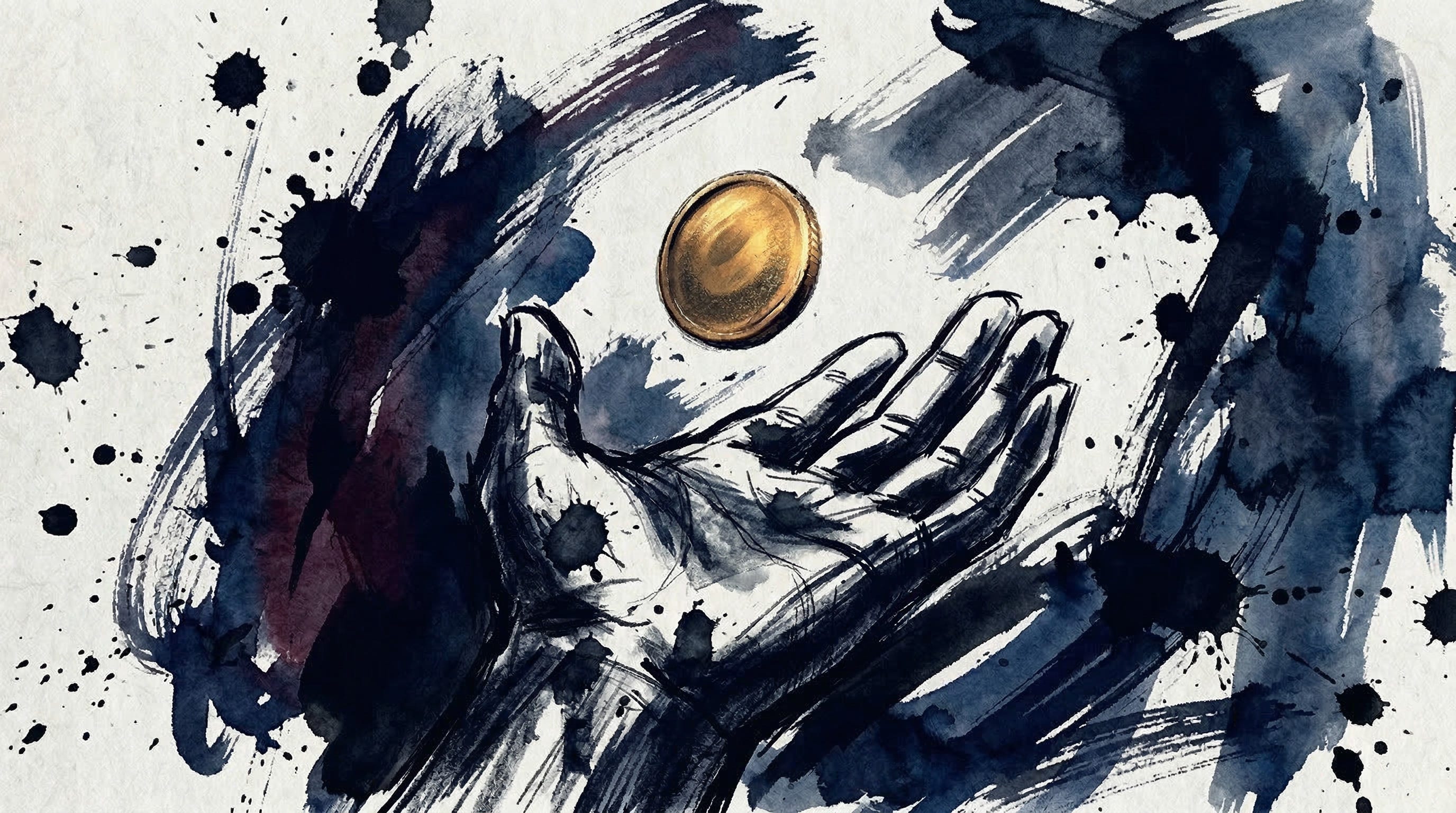
The header art was developed through collaborative prompt iteration in Leonardo AI, where we landed on a visual concept that let the style carry the subtext: a calm, receiving hand rendered in furious ink. The tools helped. The tools also proved the point.