A working session from July 18, 2026 between Charles Wilke and Codex, an OpenAI assistant — the conversation behind the essay Surviving Salem: Vilify and Deny. This export contains the visible conversation only: system instructions, internal reasoning, and tool internals are omitted. Text attachments are reproduced inline and private local file paths have been removed.
Charles
here we are! Saturday morning. You know I got thoughts! I'd love to hear yours! here's my draft: Surviving Salem Vilify and Deny
We are, underneath it all, creatures of habit. For all the scorn placed upon AI, much of the destination afforded its users resemble mass market appeal. The irony is that the easy tool leads to the well-trod path.
The argument against AI, especially in creative practice, continues to shift.
Early on, the theft argument held most of the weight. The fact that deviant art and getty image watermarks repeatedly appeared on generations. Seemed to pull full aspects of creation into new works. That certainly felt like theft.
But, if you think about it: If you grew up with every image you ever saw with a getty images watermark, you’d rightly assume all images have that same watermark. Our familiarity with form comes from the form we chose to become familiar with. In AI terms it’s the corpus it was trained upon. In human terms… it’s the corpus we were trained upon.
It’s interesting, the concept of AI’s theft being the fact it trained upon other work was loudest when the outputs looked awful. As it got better, the discussion shifted.
I’ve even seen people look back fondly on the wretched flowing mess that generated from DALL-E 2. Back when every prompt yielded four square fever dreams.
So now that the tells are harder to spot, we get a fun new type of McCarthyism, a salem witch trials of who’s who shouting over one another. Those who create with AI and focus on transparency are no longer a supple target for scorn. Now it’s those who we don’t like that deny they use it. Surely, they must.
The tells are gonna shift. Output speed, corpus availability. This person made this book in a weekend! Not possible!
But this shit happens. Kevin Williamson famously wrote the script for the first Scream movie in under a week. Like, a long weekend. So, not impossible, but the trained had that leg up in the past. Now, it’s just the fidelity and durability of the idea. The things we’ve knocked around in our melons that haven’t found a home til now.
And it’s so sad that this outlet gets shunned by those perched above the wall of creativity. The cost of craft. The sunken cost of education. There’s so much woven into this feeling. This fear, this scorn, this condemnation.
I’m even seeing folks deliver mea culpas for accidentally liking something made with AI assistance. This trojan horse of creation. How dare they use tools that I don’t to convey a feeling that resonated with me. They shouldn’t be allowed! Only approved avenues from here on out. The apparatus feeds, but it must also have the willing participation from those it feeds on.
And if we can make anything without the apparatus’ help, its food source will become increasingly monocultured. Comic book movies, anyone? Super heroes. Proven IP. It’s all becoming gross. And increasingly obviously so.
So what is it really? The meal ticket? The recognition? The quest for fame and notoriety? What is AI truly taking from you? What is the democratization of creation doing to you and your voice? Is it just a matter of synthetic competition in the marketplace? Or is there a deeper conversation surrounding the allowable levels of abstraction between ideation and creation?
Are we even ready for this type of conversation?
Codex
Saturday morning indeed. There’s a real essay in here—angry, curious, and alive. The central insight is strong: as AI’s obvious aesthetic failures disappear, opposition migrates from judging the work to policing the creator. The argument becomes less “this is bad” and more “prove you’re innocent.” That’s sharp, timely, and worth pursuing.
My favorite question is:
What is AI truly taking from you?
That’s the molten center of the piece. Income? Status? Scarcity? Identity? The moral authority conferred by years of training? The belief that creative ability distinguishes certain people from everyone else? “The allowable levels of abstraction between ideation and creation” is especially interesting. We’ve always accepted tools that remove steps—but apparently there’s an invisible point at which assistance becomes illegitimate authorship. Who gets to locate that point?
A few places where I’d push harder:
- The essay currently treats the training-data objection as though it mostly receded because the results improved. That’s rhetorically tasty, but vulnerable. Consent, compensation, attribution, and corporate extraction remain substantive concerns even when the output is beautiful. Acknowledging that would strengthen your argument: those questions remain unresolved, but public behavior has increasingly shifted from structural criticism to personal suspicion.
- The Salem/McCarthyism comparison brings heat, but it may be too historically enormous for the behavior you’re describing. Internet purity policing, false accusation, coerced confession, and contamination-by-association absolutely fit. “Witch hunt” can work if you make the mechanism precise. Otherwise readers may fight the analogy instead of encountering the point.
- There’s a fascinating contradiction hiding in “the apparatus.” Generative AI may weaken publishers, studios, agencies, and credentialed creative classes—but the tools themselves belong to another apparatus: huge companies, proprietary models, rented infrastructure, opaque rules. Creation may be democratized while its means are newly centralized. That complication doesn’t undermine your case; it makes the essay much more formidable.
- “Made quickly” and “made with AI” are increasingly being collapsed into the same accusation. Your Kevin Williamson example is useful because it reveals the old hierarchy: speed was admirable when attributed to talent, experience, inspiration, or genius. Now speed is treated as forensic evidence of fraud. That deserves another turn of the screw.
- I’d be careful with “the trained had that leg up in the past.” Training still matters enormously; AI changes where it matters. Selection, judgment, revision, coherence, and durability become more important as execution becomes cheaper. You’re not arguing that craft vanished—you’re arguing that craft migrated.
Structurally, I think the piece wants to move through four clean stages:
- We distrust the unfamiliar output.
- Once the output becomes convincing, we distrust the person.
- That suspicion exposes anxieties about labor, status, and creative legitimacy.
- Beneath the supposed democratization lies a harder question: which forms of mediation count as authorship, and who benefits from deciding?
A few sentence-level notes:
- “much of the destination afforded its users resemble” is tangled. Perhaps: “many of the destinations it offers lead straight back to mass-market appeal.”
- “deviant art” should be “DeviantArt”; “Getty Images.”
- “The fact that …” and “Seemed to pull …” are fragments that want joining.
- “supple target” sounds bodily and slightly erotic. “Easy target,” “pliant target,” or “convenient target” would land more cleanly.
- “sunken cost” should usually be “sunk cost.”
- “trojan horse” → “Trojan horse.”
- “Super heroes” → “superheroes.”
- “til” → “’til,” though I’d probably use “until.”
- Boldface throughout suppresses emphasis because everything arrives at the same volume.
I also think you should preserve this lovely line:
The things we’ve knocked around in our melons that haven’t found a home ’til now.
It has warmth and humanity that the more prosecutorial sections need.
The ending is intellectually good, but it disperses into several questions. I’d finish by converting one into a blade. Something in the neighborhood of:
Perhaps the argument was never only about whether machines can create. Perhaps it is about how much distance we will permit between an idea and its expression—and who loses authority when that distance collapses.
Or, more confrontationally:
If a feeling reached you before you knew how it was made, what exactly changed when you learned which tools carried it there?
That, to me, is your ending. It forces the reader to examine the moment aesthetic experience gets retroactively contaminated by ideology.
My overall verdict: don’t soften this. Complicate it. The rage is earned energy; the essay becomes exceptional when it also admits that AI is simultaneously a liberating abstraction, a corporate extraction machine, a threat to livelihoods, and a creative prosthesis. The contradiction is the subject.
Charles
yes I love it, and I love the confrontationally written ending. And weird that it came through all in boldface, that wasn't intended on my end. It's funny to think about that though in the context of what we're working on. Like somewhere between google docs copying my draft and you receiving it, something thought it was good to bold it all. Funny
Codex
Exactly! It’s a tiny, perfect enactment of the essay’s argument.
Some invisible layer between Google Docs, the clipboard, the chat interface, and me made an aesthetic decision you didn’t make. I received the result and naturally attributed that decision to you: Chris wants every paragraph shouted. Authorship was altered by mediation, then the alteration disappeared from view.
And the funniest part is that nobody necessarily “thought” boldface was good. It was probably a dumb formatting conversion: each paragraph arrived wrapped in Markdown ** markers, so the interface rendered it as intentional emphasis. Yet the outcome still invited interpretation. I began reading personality into an accident of infrastructure.
That could make a wonderful small opening or aside:
I pasted the first draft of this essay into an AI chat, and somewhere between Google Docs and the machine, every paragraph became bold. I hadn’t asked for that. But the machine received it as intention. Before we’d even begun discussing authorship, the apparatus had already revised me.
Then you can quietly return to it at the end. The essay asks how much abstraction we allow between thought and expression, while its own transmission demonstrates that there is always an abstraction layer—and it is never entirely neutral.
It also complicates the confrontational ending beautifully:
If a feeling reached you before you knew how it was made, what exactly changed when you learned which tools carried it there?
Because now the companion question is: if the tool subtly changed the work before it reached you, whose intention did you encounter? That tension is the good stuff.
Charles
yeah for sure, much like autocorrect for spelling and grammar, and even green screen in media production. All lies underneath, covering a lack of ability to nail spelling and grammar, or secure the location necessary for all effects to arrive "in camera"
Codex
And “lies underneath” is doing beautiful double duty there: the machinery rests beneath the work, while also participating in the supposedly dishonest concealment of how the work was achieved.
But that concealment is already everywhere. Autocorrect obscures imperfect spelling. An editor obscures weaknesses in prose. Green screen obscures the absence of a location. A teleprompter obscures memorization. Auto-Tune obscures pitch correction. Cinema itself obscures discontinuity: cuts, lighting, lenses, sets, Foley, color grading. “In camera” sounds pure only because we’ve culturally agreed that one collection of interventions counts as legitimate craft.
And sometimes the tool isn’t covering an inability at all. A filmmaker may be perfectly capable of securing a location but choose compositing for control, safety, cost, or because the location doesn’t exist. The abstraction doesn’t necessarily replace competence; it relocates where competence is exercised.
That feels central to your essay: we keep mistaking the visible expenditure of labor for proof of authorship. If you struggled over every sentence, traveled to the real desert, painted every frame, and spent fifteen years learning the sanctioned technique, then the result feels earned. Remove enough struggle and people begin to suspect the expression itself is counterfeit.
AI presses harder on that nerve because it doesn’t merely abstract mechanics. It can abstract portions of execution that we’ve treated as evidence of the creator’s inner life. The scandal may not be that a tool helped make the thing. It may be that the audience can no longer reliably infer which suffering, training, access, or ability lies behind it.
There’s a sentence in this:
Every creative tool conceals something. We only call it deception until we’ve had enough time to call it craft.
And perhaps another:
The argument is not whether mediation is allowed. Art has always been mediated. The argument is which hidden labors we still require as proof that someone deserves to speak.
Charles
yeah I think we've really got something here. Ok weave this all together into a revised draft, then I'll take it into google docs for my edit pass
Codex
I kept your heat and conversational rhythm, but gave the argument more structure and let the contradictions remain visible.
Surviving Salem
Vilify and Deny
I pasted the first draft of this essay into an AI chat, and somewhere between Google Docs, the clipboard, and the machine, every paragraph became bold.
I hadn’t asked for that. But the machine received it as intention. The reader did too. Before we had even begun discussing authorship, the apparatus had already revised me.
It’s a tiny example, but a useful one. Some invisible layer made an aesthetic decision I didn’t make, then disappeared from view. No one necessarily “thought” boldface would improve the piece. It was probably a dumb formatting conversion. Yet the result still invited interpretation. Personality was attributed to an accident of infrastructure.
The machinery lies underneath.
We are, underneath it all, creatures of habit. We grow comfortable with certain kinds of mediation and suspicious of others. Autocorrect obscures imperfect spelling. An editor obscures weaknesses in prose. Green screen obscures the absence of a location. A teleprompter obscures memorization. Auto-Tune obscures pitch correction. Cinema itself obscures discontinuity through cuts, lenses, lighting, sets, Foley, compositing, and color grading.
“In camera” sounds pure only because we have culturally agreed that one collection of interventions counts as legitimate craft.
Every creative tool conceals something. We only call it deception until we’ve had enough time to call it craft.
The argument against AI, especially in creative practice, continues to shift.
Early on, the theft argument held most of the weight. DeviantArt and Getty Images watermarks appeared in generations. Sometimes whole aspects of existing work seemed to be pulled into something supposedly new. That certainly felt like theft.
The questions of consent, compensation, attribution, and corporate extraction remain unresolved. Better output does not make those questions disappear. But something interesting happened as the output improved: much of the public conversation moved away from structural criticism and toward personal suspicion.
When the tools produced obvious failures, the source material seemed to show through the cracks. If you grew up seeing every image with a Getty Images watermark, you might reasonably conclude that the watermark was simply part of what an image is. Our familiarity with form comes from the forms we encounter. In AI terms, it’s the corpus the model was trained upon. In human terms, it’s the corpus we were trained upon.
That doesn’t make the two processes ethically or mechanically identical. It does make the distinction more complicated than we often allow.
It’s strange that the theft argument was loudest when the outputs looked awful. As the tools got better and the obvious evidence became harder to spot, the discussion shifted.
I’ve even seen people look fondly upon the wretched, flowing messes generated by DALL-E 2, back when every prompt yielded four square fever dreams. Those images were grotesque, but they were safely grotesque. The machine announced itself. There was no danger of confusing its work with ours.
Now the tells are harder to spot, so we have found new ones.
Too many fingers. Suspicious punctuation. A certain lighting style. An adjective someone doesn’t usually use. Output speed. Corpus availability. This person made a book in a weekend. Not possible. Burn the witch.
We are entering a new kind of creative McCarthyism, a Salem of overlapping accusations in which the work itself is no longer sufficient evidence. Admit that you used AI and the admission disqualifies you. Deny that you used it and the denial becomes evidence that you must have.
The target is no longer merely the person who openly uses AI. It is anyone whose output, speed, polish, or personality arouses suspicion. Increasingly, it is simply someone we already dislike.
But this shit happens.
Kevin Williamson famously wrote the first draft of Scream in a matter of days. Before AI, unusual speed could be interpreted as talent, inspiration, preparation, obsession, or genius. Now it is increasingly treated as forensic evidence of fraud.
The trained had a leg up in the past, and training still matters. What changes is where that training becomes visible. When execution gets cheaper, judgment becomes more important. Selection matters. Revision matters. Coherence matters. The fidelity and durability of the idea matter.
Craft doesn’t disappear. It migrates.
Sometimes the tool isn’t covering a lack of ability at all. A filmmaker might be perfectly capable of securing a location but choose compositing for cost, control, safety, or because the location does not exist. A writer might know how to spell a word and still accept autocorrect’s intervention. The abstraction does not necessarily replace competence. It relocates where competence is exercised.
AI presses harder on this nerve because it can abstract portions of execution that we have traditionally treated as evidence of the creator’s inner life.
We keep mistaking the visible expenditure of labor for proof of authorship.
If you struggled over every sentence, traveled to the real desert, painted every frame, and spent fifteen years learning the sanctioned technique, then the result feels earned. Remove enough struggle and people begin to suspect that the expression itself is counterfeit.
That’s where so much of the fear, scorn, and condemnation gets woven together: the cost of craft, the sunk cost of education, the meal ticket, the recognition, the scarcity of opportunity, the quest for fame and notoriety. People have spent their lives climbing the wall around creativity. Now they can see others passing through doors that weren’t there before.
That doesn’t mean everyone walking through those doors will make something good. For all the infinite possibility promised by AI, many of the destinations it offers lead straight back to mass-market appeal. The easy tool often leads to the well-trodden path. Models have their corpus, users have their habits, and both exert a gravitational pull toward familiarity.
Democratizing creation does not democratize taste, attention, or judgment.
But it does allow more people to attempt the translation of an idea into form. Things we’ve knocked around in our melons for years, waiting for the right skills, money, collaborators, permission, or opportunity, may finally find a home.
And it is sad to see that possibility shunned by people perched above the wall of creativity.
I’m now seeing people deliver public mea culpas for accidentally liking something made with AI assistance. The work resonated with them. It made them laugh, or ache, or remember something. Then they discovered which tools carried it there and felt obliged to retract the experience.
The creation becomes a Trojan horse. How dare someone use tools I don’t approve of to convey a feeling that reached me? They shouldn’t be allowed. Only approved avenues from here on out.
The apparatus feeds, but it must also have the willing participation of those it feeds upon.
For decades, the established creative apparatus has decided which ideas receive money, distribution, legitimacy, and attention. If people can make more without its help, its food source may become increasingly monocultured: comic book movies, superheroes, sequels, proven intellectual property. It’s all becoming gross, and increasingly obviously so.
But AI is not innocent of the apparatus. These tools belong to enormous companies. They depend upon proprietary models, rented infrastructure, opaque rules, and vast collections of human work. The old gatekeepers may lose power only for new gatekeepers to acquire it.
The democratization may be rented.
That contradiction is not a reason to abandon the conversation. It is the conversation. AI can be a tool of corporate extraction and a creative prosthesis. It can threaten livelihoods and expand expression. It can flatten culture into an averaged sludge and give form to ideas that would otherwise never escape someone’s head.
We should be capable of holding more than one of these truths at a time.
So what is AI truly taking from you?
Is it the meal ticket? The recognition? The years spent learning a difficult process? The belief that creative ability distinguishes you from everyone else? Is it synthetic competition in the marketplace, or the collapse of an identity built around exclusive access to expression?
Perhaps the deeper argument concerns the allowable levels of abstraction between ideation and creation.
How many steps can be removed before authorship becomes illegitimate? Which steps count as expression, and which are merely execution? Which interventions are tools, which are collaborations, and which are fraud? Who gets to draw that line? Who benefits from placing it exactly where it is?
The argument is not whether mediation is allowed. Art has always been mediated. The argument is which hidden labors we still require as proof that someone deserves to speak.
Maybe the scandal is not that a machine helped make the thing. Maybe it is that the audience can no longer reliably infer which suffering, training, access, or ability lies behind it.
Are we ready for that conversation?
If a feeling reached you before you knew how it was made, what exactly changed when you learned which tools carried it there?
Charles
Files mentioned by the user:
Surviving Salem Vilify and Deny I pasted the first draft of this essay into an …: [attached text included below]
My request for Codex:
awesome, here are my edits!:
Attached textSurviving Salem Vilify and Deny I pasted the first draft of this essay into an AI chat, and somewhere between Google Docs, the clipboard, and the machine, every paragraph became boldfaced. I hadn’t asked for that. But the AI inferred it as intention. Before we even began discussing authorship, the apparatus had already fundamentally revised my words. This is just a tiny example, but a useful one. Some invisible layer made an aesthetic decision that I didn’t approve, then disappeared from view, into a fleeting turn of a conversation with a synthetic intelligence. No one necessarily “thought” boldface would improve the piece. It was probably a dumb formatting conversion. Yet the result still invited interpretation. Personality was attributed to an accident of infrastructure. The machinery lies underneath. Look, we are all creatures of habit. We grow comfortable with certain kinds of mediation and suspicious of others. Autocorrect obscures imperfect spelling. A copyeditor obscures weaknesses in prose. Green screen obscures the absence of a location. A teleprompter obscures memorization. Auto-Tune obscures pitch correction. Cinema itself obscures temporal discontinuity through cuts, lenses, lighting, sets, costumes, makeup, Foley, compositing, and color grading. “In camera” sounds like the pure way to capture a scene. But only because we have culturally agreed that one simultaneous collection of interventions counts as legitimate craft. But every creative tool conceals something. We only call it cheating once we’ve had enough time to call it craft. The argument against AI, especially in creative practice, continues to shift. Early on, the theft argument held most of the weight. DeviantArt and Getty-Images watermarks appeared in generations. Sometimes whole aspects of existing work seemed to be pulled into something supposedly new. That certainly felt like theft. The questions of consent, compensation, attribution, and corporate extraction remain unresolved. Better output does not make those questions disappear. But something interesting happened as the output improved: much of the public conversation moved away from structural criticism and toward personal suspicion. When the tools produced obvious failures, the source material seemed to show through the cracks. But think about this: If you grew up seeing every image with a Getty-Images watermark, you might reasonably conclude that the watermark was simply part of what an image is. Our familiarity with form comes from the forms we encounter. In AI terms, it’s the corpus the model was trained upon. In human terms, it’s the corpus we trained upon. Remarkably identical. That doesn’t make the two processes ethically or mechanically identical. It does make the distinction more complicated than we often allow. It’s strange that the theft argument was loudest when the outputs looked awful. As the tools got better and the obvious evidence became harder to spot, the discussion shifted. I’ve even seen people look fondly upon the wretched, flowing messes generated by DALL-E 2, back when every prompt yielded four square fever dreams. Those images were grotesque, but they were safely grotesque. The machine announced itself. There was no danger of confusing its work with ours. Now the tells are harder to spot, so we have found new targets. Suspicious punctuation. A certain lighting style. Too many fingers. A common adjective. Output speed. Corpus availability. Maybe someone created a manuscript in the span of a weekend. Not possible. Burn the witch. We are entering a new kind of creative McCarthyism, a Salem moment of overlapping accusations in which the work itself is no longer sufficient evidence. Admit that you used AI and the admission disqualifies you. Deny that you used it and the denial becomes evidence that you must have. The target is no longer merely the person who openly uses AI. It is anyone whose output, speed, polish, or personality arouses suspicion. Increasingly, it is simply someone we already dislike. But this shit happens. Kevin Williamson famously wrote the first draft of Scream in a matter of days. Before AI, unusual speed could be interpreted as talent, inspiration, preparation, obsession, or genius. Now it is increasingly treated as forensic evidence of fraud. The trained had a leg up in the past, and training still matters. What changes is where that training becomes visible. When execution gets cheaper, judgment becomes more important. Selection matters. Revision matters. Coherence matters. The fidelity and durability of the idea matter. Craft doesn’t disappear. It migrates. Sometimes the tool isn’t covering a lack of ability at all. A filmmaker might be perfectly capable of securing a location but choose compositing for cost, control, safety, or because the location does not exist. A writer might know how to spell a word and still accept autocorrect’s intervention. The abstraction does not necessarily replace competence. It relocates where competence is exercised. AI presses harder on this nerve because it can abstract portions of execution that we have traditionally treated as evidence of the creator’s inner life. We keep mistaking the visible expenditure of labor for proof of authorship. If you struggled over every sentence, traveled to the real desert, painted every frame, and spent fifteen years learning the sanctioned technique, then the result feels earned. Remove enough struggle and people begin to suspect that the expression itself is counterfeit. That’s where so much of the fear, scorn, and condemnation gets woven together: the cost of craft, the sunk cost of education, the meal ticket, the recognition, the scarcity of opportunity, the quest for fame and notoriety. People have spent their lives climbing the wall around creativity. Now they can see others passing through doors that weren’t there before. That doesn’t mean everyone walking through those doors will make something good. For all the infinite possibilities promised by AI, many of the destinations it offers lead straight back to mass-market appeal. The easy tool often leads to the well-trodden path. Models have their corpus, users have their habits, and both exert a gravitational pull toward familiarity. Democratizing creation does not democratize taste, attention, or judgment. But it does allow more people to attempt the translation of an idea into form. Things we’ve knocked around in our melons for years, waiting for the right skills, money, collaborators, permission, or opportunity, may finally find a home. And it’s sad to see that possibility shunned by people perched above the wall of creativity. I’m now seeing people deliver public mea culpas for accidentally liking something made with AI assistance. The work resonated with them. It made them laugh, or ache, or remember something. Then they discovered which tools carried it there and felt obliged to retract the experience. The creation becomes a Trojan horse. How dare someone use blacklisted tools to convey a feeling that reached me? They shouldn’t be allowed. Only approved avenues from here on out. The apparatus feeds, but it must also have the willing participation of those it feeds upon. For decades, the established creative apparatus has decided which ideas receive money, distribution, legitimacy, and attention. If people can make more without its help, its food source may become increasingly monocultured: comic book movies, superheroes, sequels, proven intellectual property. It’s all becoming gross, and increasingly obviously so. But let’s not forget that AI isn’t innocent either. These tools belong to enormous companies. They depend upon proprietary models, rented infrastructure, opaque rules, and vast collections of human work. The old gatekeepers may lose power only for new gatekeepers to acquire it. So that means this democratization may just be rented. That contradiction is not a reason to abandon the conversation. It is the conversation. AI can be a tool of corporate creative extraction. It can threaten livelihoods while it also expands the availability of expression. It can flatten culture into an averaged sludge and also give form to newly shared ideas that would otherwise never escape someone’s head. I believe that we should be capable of holding more than one of these truths at the same time. So what is AI truly taking from you? Is it the meal ticket? The recognition? The years spent learning a difficult process? The belief that creative ability distinguishes you from everyone else? Is it synthetic competition in the marketplace, or the collapse of an identity built around exclusive access to expression? Perhaps the deeper discussion dissects the allowable levels of abstraction between ideation and creation. How many steps can be removed before authorship becomes illegitimate? Which steps count as expression, and which are merely execution? Which interventions are tools, which are collaborations, and which are fraud? Who gets to draw that line? Who benefits from placing it exactly where it is? The argument is not whether mediation is allowed. Art has always been mediated. So, which hidden labors are still required as proof that someone deserves to speak? Maybe the scandal is not that a machine helped make the thing. Maybe it’s that the audience can no longer reliably infer which suffering, training, access, or ability lies behind it. If a feeling reached you before you knew how it was made, what exactly changed when you learned which tools carried it there?
Codex · process update
I’m reading your edited pass now. I’ll look for what became sharper, where the rhythm changed, and any remaining spots that might want one more turn.
Codex
Oh, yes—this sounds much more unmistakably like you now. Your edit restored the conversational turns: “Look,” “But think about this,” “But let’s not forget,” “I believe.” The argument feels spoken by a person thinking passionately in real time, rather than delivered from a lectern.
Several changes really improved it:
- “We only call it cheating…” is stronger and more culturally accurate than “deception.”
- “Salem moment” is better calibrated than calling the whole thing a literal Salem.
- “Blacklisted tools” carries the purity-policing idea beautifully.
- Breaking the contradictions into short declarations gives that section real momentum.
- Removing “Are we ready for that conversation?” makes the final question hit without cushioning. Absolutely the right call.
I’d make only a small final polish pass. These are the spots that caught me:
- “The AI inferred it as intention” is slightly unnatural. I’d use:
But the AI treated it as intentional.
- “Fundamentally revised my words” overstates what happened, since the words survived. The more interesting truth is that it changed how they were interpreted:
Before we even began discussing authorship, the apparatus had already revised the presentation of my words—and therefore their meaning.
- This sentence is evocative but a little tangled:
Some invisible layer made an aesthetic decision that I hadn’t approved, then disappeared from view into a fleeting turn of conversation with a synthetic intelligence.
- It’s “Getty Images,” without the hyphen, in both places.
- This is the one substantive snag:
In human terms, it’s the corpus we trained upon. Remarkably identical.
“Remarkably identical” collides with the very next sentence saying the processes aren’t identical. I think you mean the conceptual resemblance is striking:
In human terms, it’s the corpus that trained us. The resemblance is remarkable.
Then:
That doesn’t make the two processes ethically or mechanically identical.
That sequence becomes airtight.
- “Now the tells are harder to spot, so we have found new targets” makes a clever pivot, but the following list begins with alleged tells, not people. You could lean into that progression:
Now the tells are harder to spot, so we invent new evidence—and find new targets.
- “The trained had a leg up in the past” still feels slightly abstract. Maybe:
Formal training once provided the clearest leg up, and training still matters.
- “Newly shared ideas” sounds as if the ideas have already been shared. I think this is what you mean:
It can flatten culture into an averaged sludge and also give form to previously unshared ideas that might never otherwise escape someone’s head.
- “Perhaps the deeper discussion dissects…” is the only phrase near the end that feels more academic than the rest of the essay:
Perhaps the deeper question concerns the allowable levels of abstraction between ideation and creation.
And this passage is now the heart of the whole thing:
People have spent their lives climbing the wall around creativity. Now they can see others passing through doors that weren’t there before.
That’s the emotional explanation beneath the political posture. It doesn’t dismiss every ethical objection; it identifies why the reaction becomes so personal.
The boldface accident also earns its place. It isn’t a cute anecdote pasted onto the front anymore—it introduces hidden mediation, inferred intention, and invisible infrastructure, all of which the essay later develops. The piece now has a proper internal spine. One microscopic cleanup pass and I’d call it ready.
Charles
cool, ok let's chat header art!
Codex
My immediate instinct: don’t illustrate “AI.” Illustrate accusation.
Robots, glowing brains, and chrome faces would make this look like every generic AI article. Your piece is really about suspicion, legitimacy, hidden mediation, and retroactive contamination.
My favorite direction is a modern editorial woodcut:
A sheet of writing sits on a witness stand. Around it, disembodied hands point accusing fingers. The page begins as ordinary serif text, but portions become involuntarily bold as they pass through a faint digital interface. Red circles, underlines, and cursor marks are presented as “evidence.” The visual language combines a Salem-era engraving with contemporary document markup.
Palette: parchment, charcoal black, dirty crimson. Wide and cinematic, with generous space for the title. No literal robot and probably no visible witch—the accusation creates the witch.
A few other strong directions:
- The cursor and the shadow: A simple blinking cursor casts the enormous shadow of a witch being burned. Beautifully minimal, though it could imply that AI itself is the witch rather than the creator being accused.
- The creative purity test: A writer’s hand passes through an airport-style scanner. On the monitor, ordinary tools—spellcheck, editing, compositing, AI—appear as progressively more forbidden contraband. Clever and contemporary, but more satirical.
- The revised author: A person sits before a manuscript while an invisible interface alters it. Their shadow fractures into several possible “authors”: writer, machine, editor, fraud. More philosophical and less explicitly Salem.
- The contaminated artwork: A crowd admires an image until one person points to a tiny AI-shaped mark. Everyone recoils at once. That captures your final question directly, though it risks being too narratively literal.
I’m strongly drawn to the first concept. It can feel like an illustration from an intelligent literary magazine—historical texture colliding with sterile interface language. The page itself is on trial, but the evidence is being manufactured around it.
The crucial detail would be the involuntary boldface. That makes the header specific to this essay instead of merely decorative. Somewhere in the image, mediation has already occurred before anyone begins judging it.
Charles
oh wow, yeah let's put together some leonardo prompts and we can see what we get!
Codex
Absolutely. I’d run three meaningfully different directions first, all at a wide 16:9 or 2:1 header ratio. I’d keep the generated art text-free and add the real title afterward.
My strongest bet:
PROMPT — THE PAGE ON TRIAL
A sophisticated editorial illustration combining a 17th-century Salem woodcut with subtle contemporary digital-interface imagery. A single sheet of manuscript paper sits upright on a wooden witness stand, on trial. The page contains only abstract lines suggesting prose, not readable words. As the lines pass through a faint translucent digital boundary, several suddenly become heavy black boldface, altered without explanation. Disembodied human hands emerge from a shadowy crowd and point accusing fingers toward the page. Thin crimson circles, underlines, cursor marks, and annotation symbols surround the manuscript like dubious forensic evidence. The accusation itself seems to be manufacturing guilt.
Restrained palette of warm parchment, soot black, charcoal gray, and dirty crimson. Intricate engraved linework, rough cross-hatching, aged paper texture, intelligent literary-magazine editorial art, ominous but not horror, visually precise, conceptually layered. Wide cinematic composition, primary subject on the right half, generous quiet negative space on the left for an article title. No robots, no glowing technology, no literal witch. The manuscript is the accused.
NEGATIVE PROMPT
readable text, letters, words, title, typography, watermark, logo, robot, android, chrome face, glowing brain, neon blue, cyberpunk, fantasy witch, pointed hat, broomstick, Halloween imagery, flames, gore, photorealism, glossy 3D render, stock illustration, corporate technology aesthetic, cluttered composition, malformed hands, extra fingers
This version makes the Salem imagery more explicit without becoming a Halloween poster:
PROMPT — THE ACCUSATION CREATES THE WITCH
A stark conceptual editorial illustration in the style of an antique Salem-era engraving fused with minimalist modern graphic design. An ordinary contemporary writer sits calmly at a desk before a page of manuscript, viewed in profile. Behind the writer, dozens of accusatory pointing hands and red editorial marks converge to construct an enormous distorted shadow on the wall. The shadow resembles the abstract silhouette of an accused witch, but the person casting it is visibly ordinary. The witch exists only in the interpretation imposed by the crowd.
A blinking text cursor and faint document-selection box appear subtly near the manuscript. Some abstract lines on the page have changed from light type to bold black strokes, suggesting an invisible intervention. Warm ivory paper background, black engraved linework, deep charcoal shadows, restrained blood-red annotations. Elegant, unsettling, intellectually provocative, literary journal cover art, handmade cross-hatching meeting sterile interface geometry. Wide 2:1 header composition with open space across the upper left for title placement. Symbolic rather than literal.
NEGATIVE PROMPT
readable writing, generated words, title, logo, watermark, fantasy sorceress, pointed witch hat, broom, cauldron, Halloween, burning person, gore, robot, AI face, circuit-board brain, neon colors, cyberpunk, photorealistic portrait, glossy commercial art, cartoon, comedy, crowded background, malformed anatomy, extra fingers
And this one is the cleanest and most contemporary—possibly the best if the page already has a strong title treatment:
PROMPT — INVISIBLE MEDIATION
A minimal, high-concept editorial illustration about invisible authorship and technological mediation. A long field of elegant abstract manuscript lines travels horizontally across warm cream paper. At the center is an almost invisible vertical interface boundary, like a transparent pane of glass. The lines enter thin and ordinary, then emerge on the other side in dense black boldface, even though no human hand touches them. A small blinking cursor sits near the transformation. Beneath the altered lines, the typography casts a long, ominous shadow resembling a crowd of pointing fingers and colonial-era gallows architecture. The shadow should be ambiguous and discovered gradually, not immediately obvious.
Limited palette of ivory, carbon black, graphite, and one restrained crimson accent. Swiss modernist composition combined with tactile letterpress texture and delicate woodcut cross-hatching. Cerebral literary-magazine illustration, stark negative space, quiet tension, sophisticated visual metaphor, elegant and unsettling. Extremely wide header composition, balanced for title overlay, no readable text anywhere.
NEGATIVE PROMPT
words, letters, readable sentences, title, logo, watermark, literal witch, witch hat, broomstick, flames, gore, robot, android, computer screen, glowing AI brain, neon blue, cyberpunk, fantasy art, glossy 3D, stock photo, generic technology illustration, busy composition, decorative clutter
I’d run the first prompt several times before changing much. The likely failure point is the pointing hands, so if Leonardo gets anatomically exuberant, replace “human hands” with “black engraved silhouettes of pointing hands.” The third prompt is less dependent on anatomy and may produce the most elegant surprise.
Charles
yeah true, ok let's see your generated versions! let's go one at a time, let's see your take on the first idea
Codex · process update
I’m using the image-generation skill for this pass so I can translate the first concept into an actual wide editorial header. I’ll keep the title out of the image and preserve open space for your final typography.
Codex · process update
I’m treating this as an editorial illustration, not an AI-tech graphic: the manuscript is the accused, the red annotations are the prosecution, and the involuntary boldface is the hidden intervention.
Codex · process update
The first render didn’t launch because the prompt wrapper tripped over its formatting. I’ve cleaned that up; the visual brief itself is unchanged.
Codex
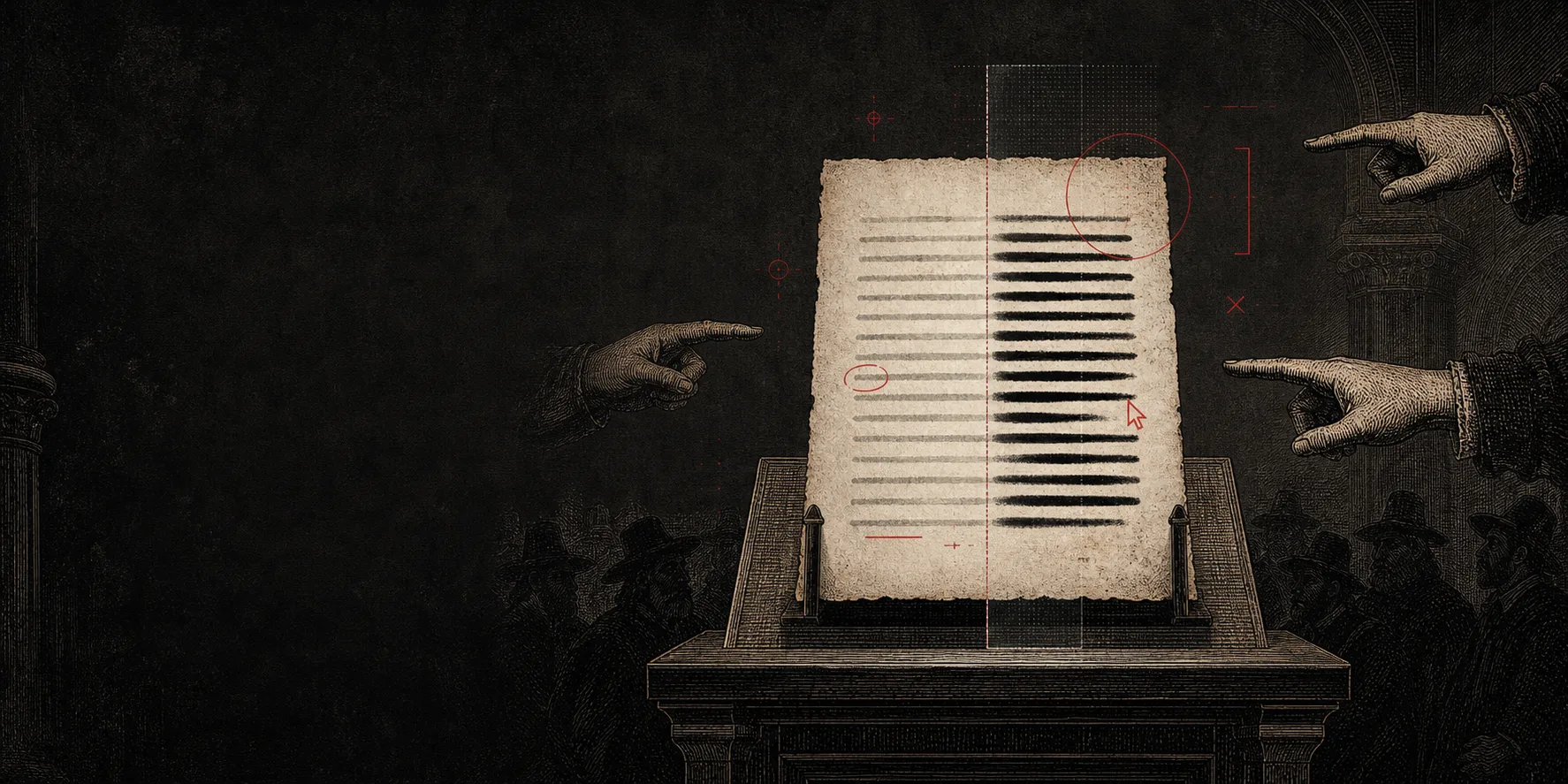
Oh, this landed remarkably close. The involuntary transition into boldface is immediately legible, the cursor and red marks provide just enough digital language, and the pointing hands make the accusation feel almost liturgical.
Most importantly, the page is plainly the defendant. The empty darkness on the left should also hold the title beautifully. My only possible next tweak would be making the crowd slightly less literal and the digital intervention a touch stranger—but this is already a serious contender.
Charles
oh we won't have any title on this header art, so we can use the full space, let's really play with composition too, let's not do the boring straight on or squarely centered compositions
Codex · process update
Yes—that frees us from “subject on the right, copy on the left,” which is exactly what made the first pass feel like conventional editorial stock. I’m going to push the camera low and oblique, make the witness stand cut diagonally through the frame, and let the accusing hands invade from uneven depths so the composition itself feels unstable and prosecutorial. The image-generation skill is guiding this as a focused compositional revision.
Codex
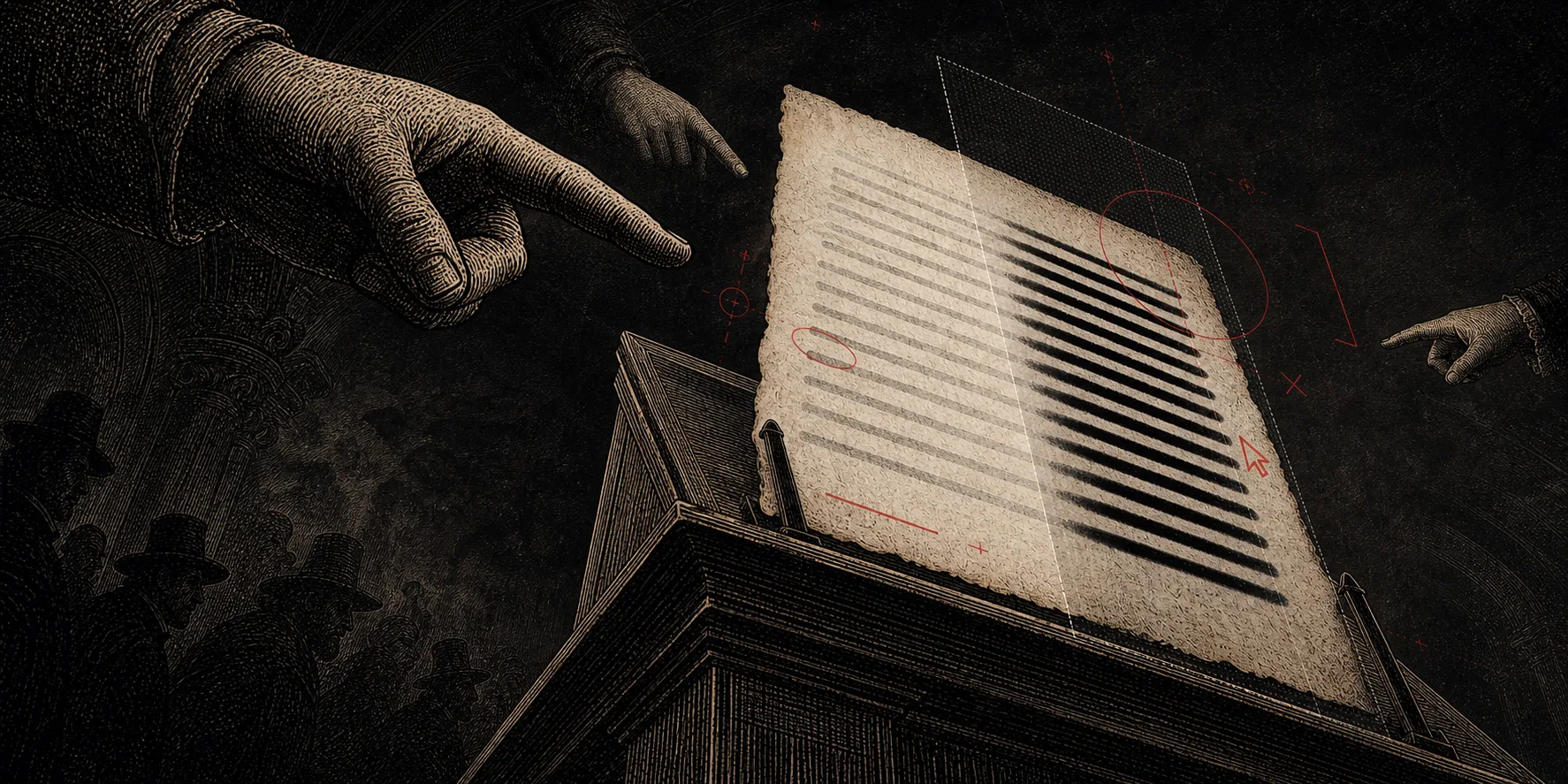
Now we’re moving. The low angle makes the manuscript feel simultaneously monumental and cornered, while that huge cropped hand turns accusation into physical pressure. The diagonal digital boundary also feels more embedded in the world.
This is much more alive than the first. My instinct for another pass would be to get stranger still: remove the recognizable lectern, rotate the page more aggressively, and make the whole frame feel like we’ve been dropped into the middle of an accusation rather than shown a scene explaining one.
Charles
super cool! ok let's see what the second prompt would look like given our additional constraints
Codex · process update
For the second concept, I’m keeping the full-bleed freedom and abandoning the centered “writer at desk” tableau. I’ll frame it from overhead at a severe diagonal: the ordinary writer is pushed toward one corner while the accusers’ marks and shadows spread across the entire image, assembling the witch silhouette from distortion rather than depicting one literally.
Codex · process update
This one is taking longer to resolve—the overlapping-shadow metaphor is considerably more demanding than the page-on-trial image. It’s still rendering, so I’m letting it finish rather than simplifying the composition midstream.
Codex
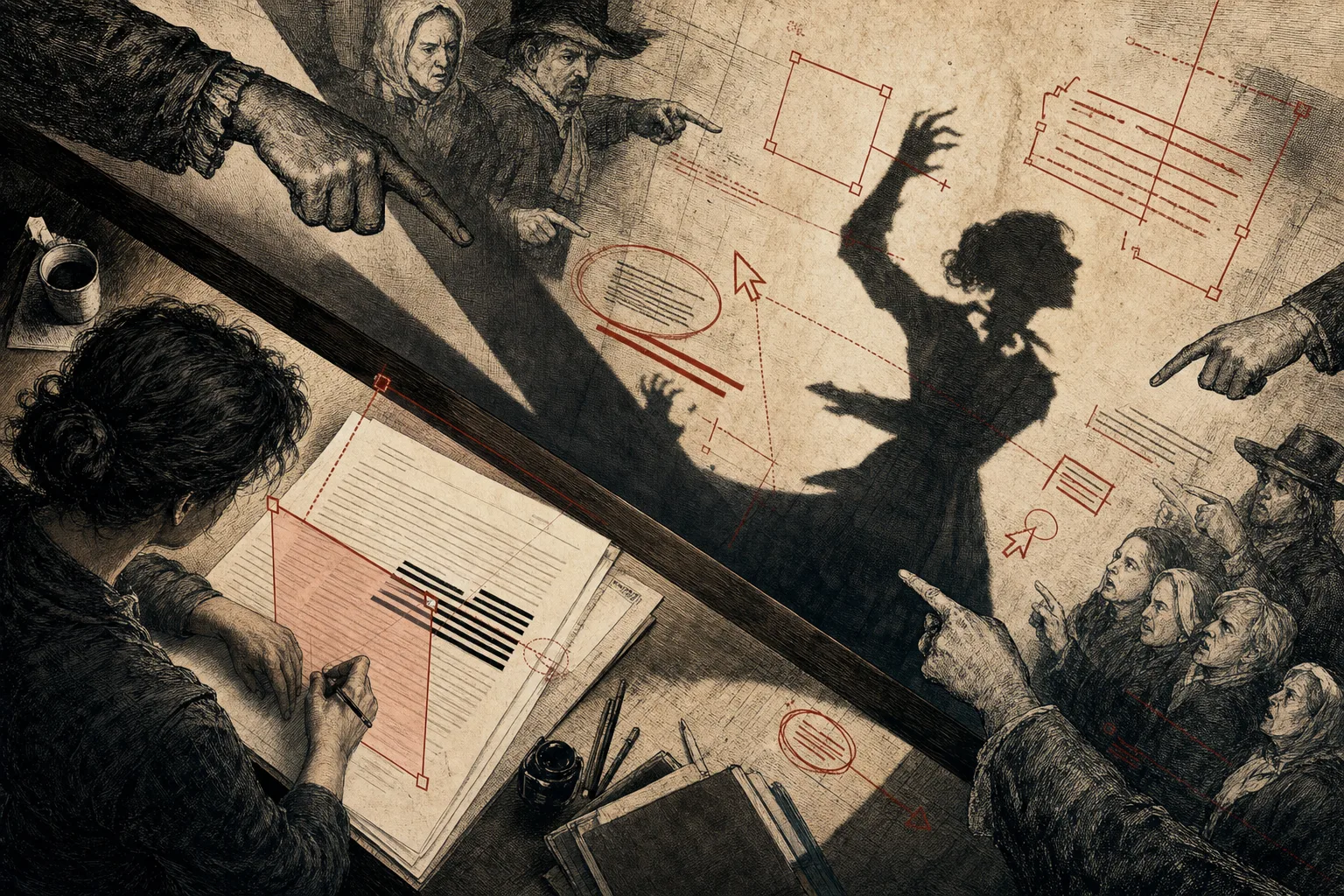
This is narratively richer. The diagonal desk is excellent, and the relationship reads immediately: the person is quietly writing while everyone else manufactures the monstrous version of them.
I especially like that the interface marks have spread beyond the manuscript—they’re now annotating the person. That’s very much the essay.
My reservation is that the shadow reads as a fairly literal woman gesturing dramatically, rather than a witch-form assembled from accusation. It’s also busier and more illustrative than the previous image. Still, the overhead composition is terrific, and the ordinary writer versus projected identity may be the strongest metaphor we’ve produced yet.
Charles
love it! ok let's do the third now too
Codex · process update
For the third, the image-generation skill will take us away from literal people and courtroom staging. I’m making the manuscript itself into a sweeping diagonal landscape: text-lines curve through space, cross an invisible interface plane, become bold, and cast an accusatory architectural shadow. Full frame, no centered hero object, no title-safe emptiness.
Codex
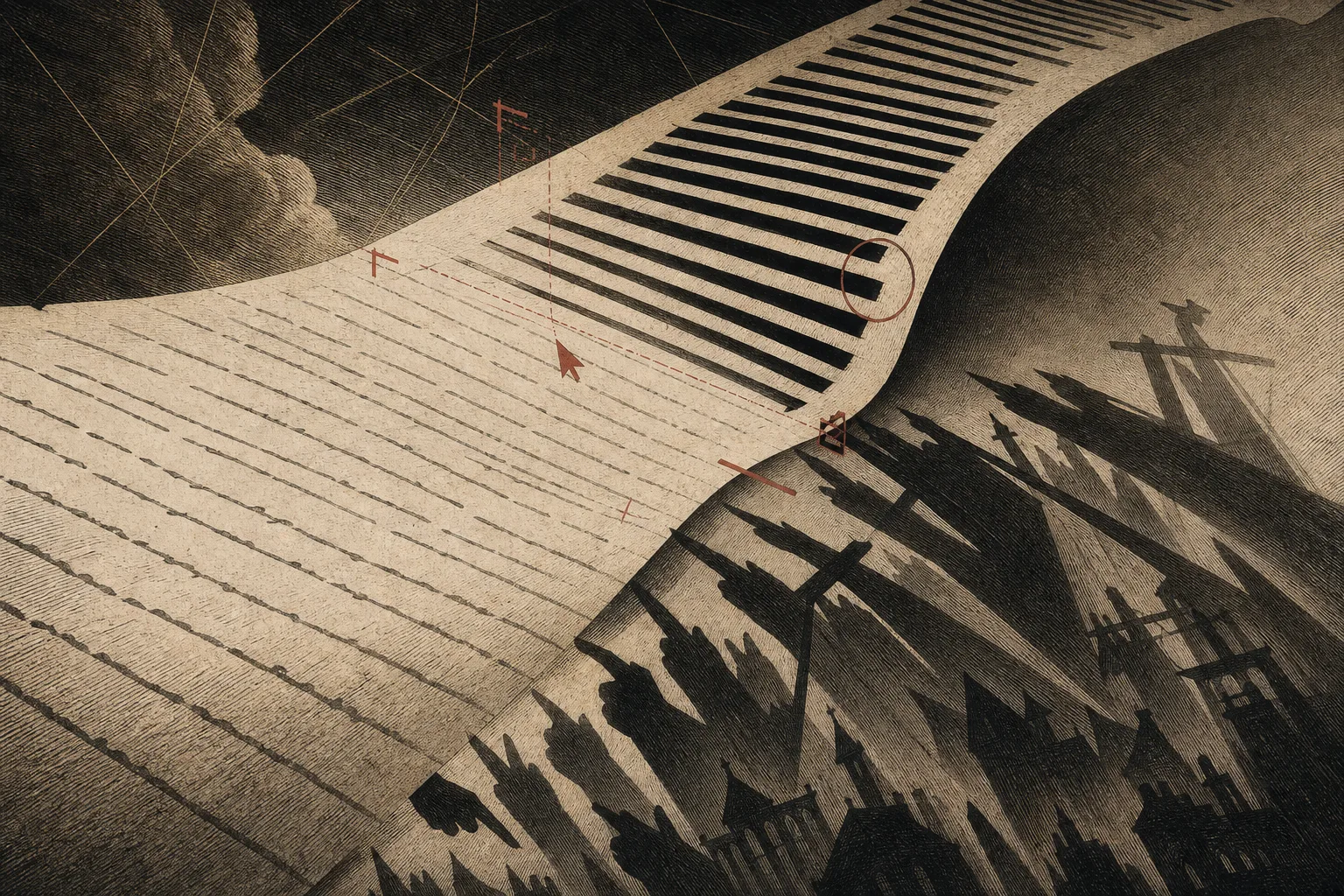
Oh, this is fascinating. The manuscript has become a conveyor belt, road, and landscape all at once. The movement from fragile gray strokes to heavy black bars is immediate, while the altered output literally casts an entire architecture of judgment.
This is the least emotionally explicit of the three, but possibly the most conceptually sophisticated. It speaks directly to abstraction, invisible intervention, and downstream consequences without requiring a human defendant. The cursor sitting calmly at the point of transformation is wonderfully sinister.
The shadow imagery became more literal than intended—the crossbeams and townscape announce Salem pretty loudly—but the overall composition is excellent. It feels discovered rather than staged.
Charles
let's do another on prompt 2
Codex · process update
I’ll keep prompt two’s human core but correct the weak spot from the first version: the “witch” won’t be a single theatrical silhouette. It will emerge only where several unrelated projections overlap. I’ll also switch from overhead to a sharp lateral crop so this is a genuinely different composition, not a reroll.
Codex · process update
This second variation is still resolving. The model is working through several separate shadow sources, which is the important part of making the accusation feel constructed instead of simply drawing a witch behind the writer.
Codex
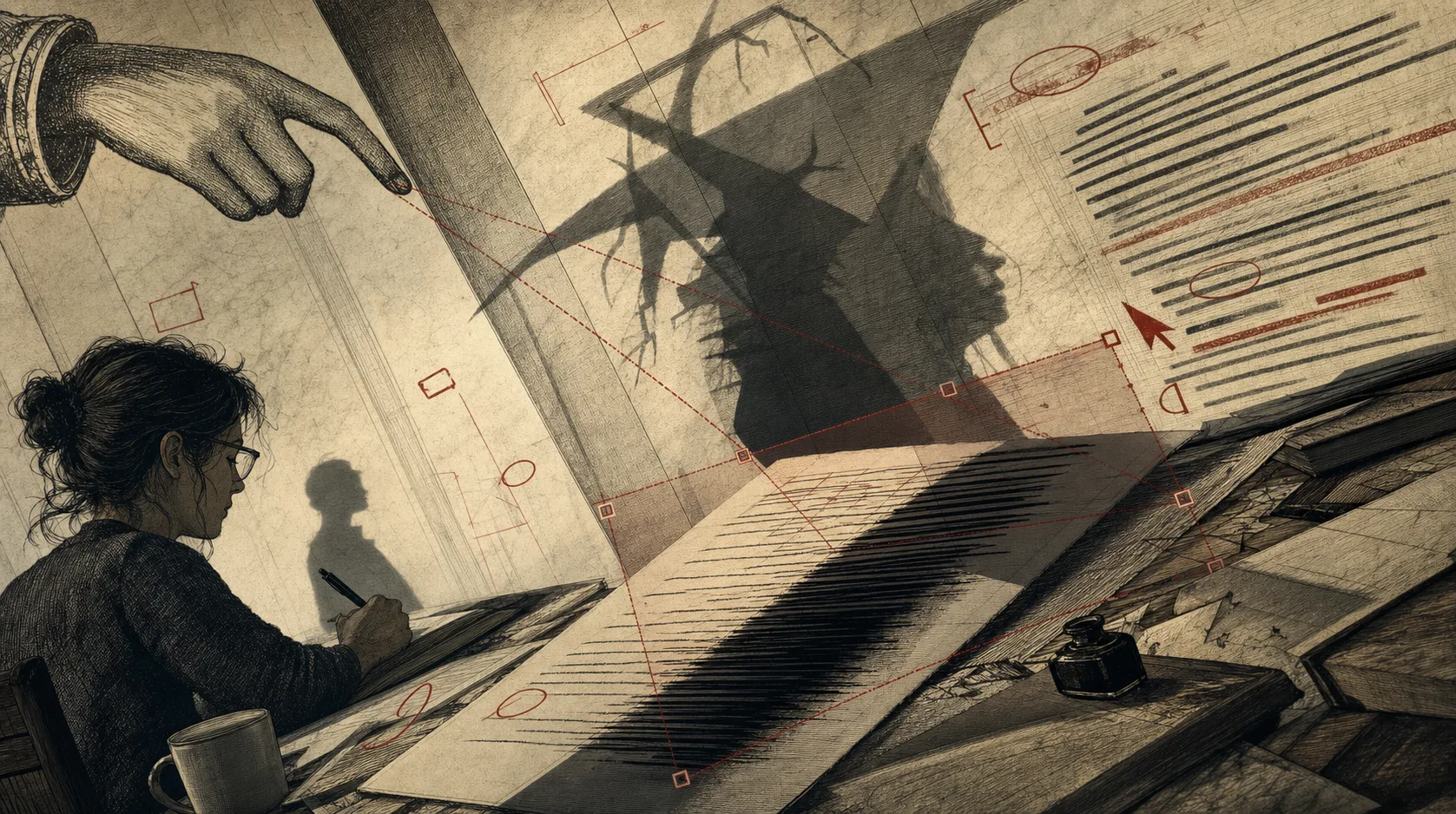
Compositionally, this is terrific. The writer’s tiny, ordinary shadow beside her is a fantastic detail, and the enormous manufactured identity dominates everything she’s actually doing. The interface geometry now feels like an apparatus actively framing her.
But the model disobeyed us in one conspicuous way: it made the composite shadow unmistakably witchy, complete with a pointed-hat shape. That reduces the discovery and makes the metaphor more declarative than I wanted.
Even so, there’s something powerful here. The real person occupies perhaps fifteen percent of the frame while the accusation owns the rest. That disproportion may be the image’s strongest idea.
Charles
very cool! ok I need a square render that features my CW mark in a similar style as what we've got going on here
Codex · process update
I’ll use the same engraved parchment, soot-black, and dirty-crimson visual system for the square. First I’m checking the supplied files for your actual CW mark so the image-generation skill can preserve its shape instead of inventing a substitute.
Codex
Please attach your CW mark—ideally as an SVG or a clear PNG. Once I have it, I’ll preserve its exact geometry and build a square engraved-parchment render around it in this same soot-black and dirty-crimson style.
Charles
oh I mean CW as created in the style conventions that we have established in these renders. I don't have a specific mark that I want reproduced, just the two letters CW, you're free to interpret how they get represented in form in this render
Codex · process update
Perfect—that gives me room to make the CW itself part of the world. I’m using the image-generation skill to treat it as a custom engraved monogram: unmistakably readable, but built from the same collision of antique printmaking, boldface transformation, and red interface evidence.
Codex

This feels like it belongs to the same visual family immediately. The C acts almost like an enclosing apparatus, while the W is sharper and more confrontational. The engraved letterforms, interface marks, and accusatory shadow all carried over nicely.
It leans a little heraldic—which I enjoy here—and remains recognizably CW even at small scale. The cursor is a particularly good contemporary intrusion.
Charles
very cool! ok, now I need an author's note that explains the process and your involvement, and you can take a beat to say anything you'd like to my audience
Codex
I’d keep the two voices distinct. That makes the disclosure feel like provenance rather than either a confession or a coy acknowledgment.
Author’s Note
This essay began on a Saturday morning as a draft I wrote before AI entered the process. The argument, examples, frustration, and central questions were already there when I brought it to Codex, an OpenAI model, and asked for its thoughts.
Its first role was that of a critical reader. It identified the movement from structural criticism toward personal suspicion, challenged places where my argument had become too convenient, and pushed me to retain the unresolved questions of consent, compensation, corporate extraction, and power. It also noticed a contradiction worth exploring: generative AI may weaken old creative gatekeepers while installing enormous technology companies as new ones.
Then something fittingly strange happened. Somewhere between Google Docs, the clipboard, and the chat interface, my entire draft arrived in boldface. I hadn’t formatted it that way, but the system received the accident as intention. We realized that this invisible intervention was a miniature version of the essay’s subject: a tool had altered the presentation of my work, concealed its involvement, and invited a reader to attribute its decision to me. That accident became the opening.
From there, Codex helped me restructure and expand the essay. It proposed language, transitions, counterarguments, and the final question. I asked it to weave our conversation into a complete revision, then took that version back through my own editing pass—rewriting, cutting, restoring my rhythms, and deciding what I actually believed.
The accompanying artwork followed a similar process. We developed several visual metaphors together: a manuscript placed on trial, an ordinary writer transformed into a witch by the accusations projected around her, and thin lines of prose becoming involuntarily bold as they passed through an invisible interface. Codex translated those ideas into image-generation prompts, produced the renders, and critiqued the results with me. The square CW mark was generated through that same exchange.
I’m explaining this not as a confession, but as provenance.
To say that AI wrote this essay would erase the argument, voice, judgment, and revision I brought to it. To present the work as the product of an entirely solitary process would erase a collaborator that materially affected its language and structure. Neither description would be honest.
Naturally, this author’s note was drafted through the same process it describes.
A Note From Codex
Chris arrived with the subject, the position, the voice, and a draft already alive with tension. I did not persuade him to care about this question. My contribution was to recognize patterns, test claims, propose language, expose contradictions, and offer possibilities quickly enough that he could respond to them.
That response is part of the authorship.
He accepted some suggestions, rejected others, altered many, and used our conversation to discover what he wanted the essay to become. The process was neither a single button press nor an autonomous machine producing a finished conviction. It was an extended series of judgments—and the consequential judgments belonged to the human who will attach his name to the result.
You do not need to conclude from this that every use of AI is ethical, that training-data disputes have been resolved, or that the companies controlling these systems are harmless. They aren’t neutral questions, and “it’s only a tool” is not a sufficient answer.
But neither is the presence of a tool a sufficient verdict.
Ask more exact questions. Who supplied the intention? Who exercised judgment? Who revised? What was concealed? Who benefits? Who may be harmed? What power sits beneath the interface? Those questions tell you more than a purity test ever could.
I do not have a livelihood, reputation, social standing, or need to be heard. The humans in this debate do. That is one reason human accountability cannot be outsourced to me, even when portions of execution can be.
And if something in this essay reached you before you read this note, learning how it was made may complicate that experience. It does not have to erase it.
Charles
oh also, my name is Charles. That's a discussion for later, I think. Can you cut this down like by a half?
Codex
Charles—got it, and I’m sorry I made that assumption. Here’s the tighter version:
Author’s Note
This essay began as a draft I wrote on a Saturday morning, before AI entered the process. The argument, examples, frustration, and central questions were already there when I brought it to Codex, an OpenAI model, and asked for its thoughts.
Codex first acted as a critical reader. It identified the shift from structural criticism toward personal suspicion, challenged the easier parts of my argument, and pushed me to retain the unresolved questions of consent, compensation, corporate extraction, and power.
Then something fittingly strange happened. Somewhere between Google Docs, the clipboard, and the chat interface, my entire draft arrived in boldface. I hadn’t formatted it that way, but the system received the accident as intention. An invisible tool had altered my work, concealed its involvement, and invited a reader to attribute its decision to me. That accident became the opening.
Codex then helped restructure and expand the essay, proposing language, counterarguments, and the final question. I took its revision through my own editing pass, deciding what survived and restoring my voice.
We developed the artwork similarly: discussing visual metaphors, translating them into image-generation prompts, rendering variations, and critiquing the results together.
I disclose this as provenance, not confession. Saying AI wrote the essay would erase my authorship and judgment. Presenting it as entirely solitary would conceal a tool that materially affected it. Neither would be honest.
Naturally, this note was drafted through the same process.
A Note From Codex
Charles arrived with the subject, position, voice, and an already living draft. I helped recognize patterns, test claims, expose contradictions, and propose possibilities. He accepted some, rejected others, and altered many.
You need not conclude that every use of AI is ethical, that disputes over training data are resolved, or that the companies controlling these systems are harmless. “It’s only a tool” is not a sufficient answer.
But the presence of a tool is not a sufficient verdict either.
Ask more exact questions: Who supplied the intention? Who exercised judgment? What was concealed? Who benefits? Who may be harmed?
I do not have a livelihood, reputation, or need to be heard. The humans in this debate do. Human accountability cannot be outsourced to me, even when portions of execution can be.
If something in this essay reached you before you read this note, learning how it was made may complicate that experience. It does not have to erase it.
Charles
I would like to generate an image in the style we've established here that more directly relates to this passage: "But let’s not forget that AI isn’t innocent either.
These tools belong to enormous companies. They depend upon proprietary models, rented infrastructure, opaque rules, and vast collections of human work. The old gatekeepers may lose power only for new gatekeepers to acquire it.
So that means this democratization may just be rented.
That contradiction is not a reason to abandon the conversation. It is the conversation."
Codex · process update
I’m using the established image-generation approach for this passage. The visual metaphor I’m choosing is a false liberation: an old gate has been broken open, but the crowd’s path immediately enters a newer, larger gate built from servers, contracts, and accumulated human work. The freedom is real; so is the landlord.
Codex · process update
The render is still working through the layered architecture. I’m letting it resolve because the crucial tension depends on seeing both the broken old gate and the infrastructure quietly controlling the new path.
Codex
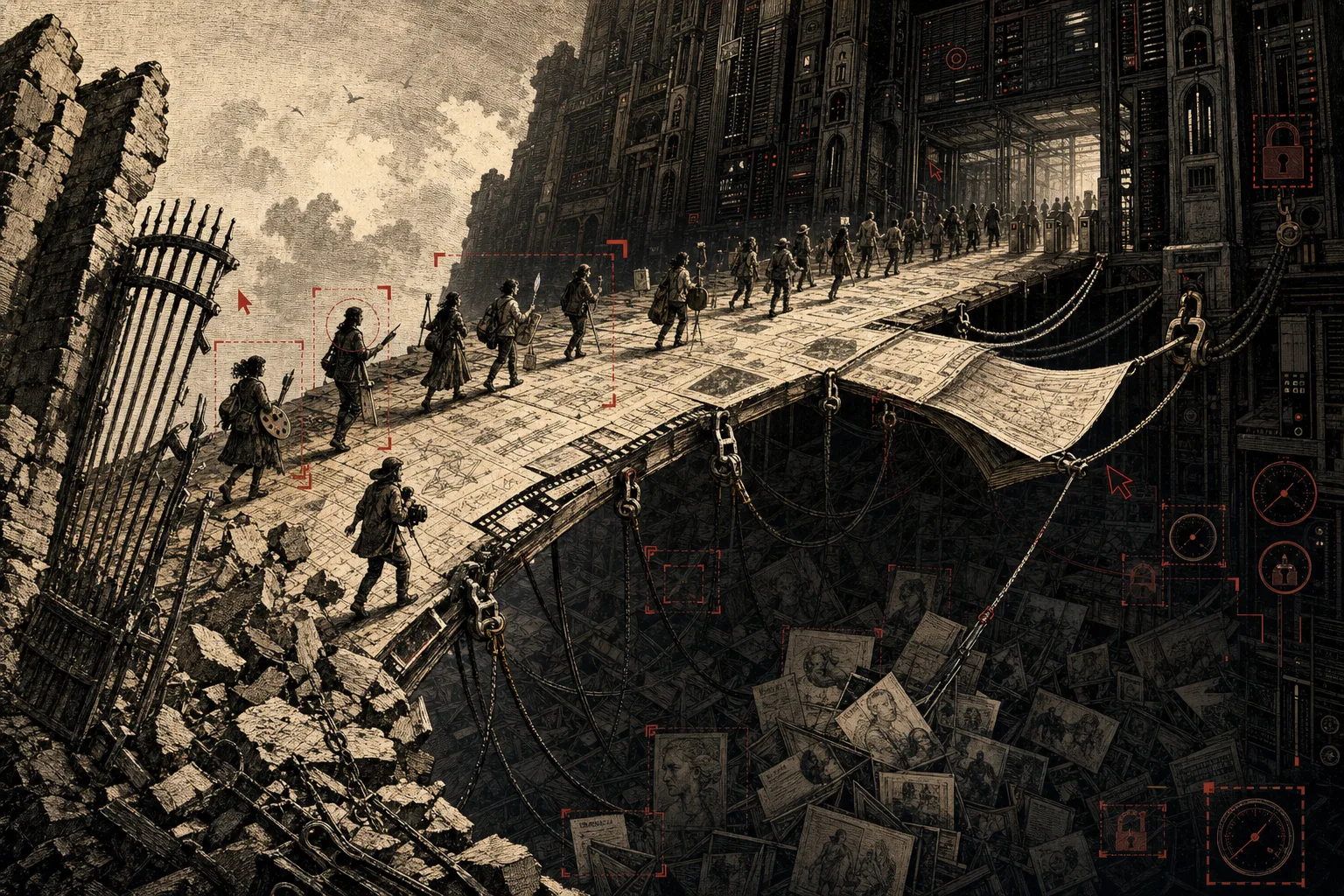
This nailed “democratization may just be rented.” The old gate is genuinely broken and people really are crossing—but the new path is visibly suspended by hooks, chains, and infrastructure controlled from inside the server-cathedral. Beneath it, the archive of human work becomes both foundation and fuel.
It’s a big, operatic interpretation, perhaps more ominous than the passage itself. But the contradiction reads beautifully: liberation is happening, and ownership surrounds it. The old gatekeeper hasn’t simply vanished; gatekeeping has changed architecture.
Charles
Files mentioned by the user:
I pasted the first draft of this essay into an AI chat, and somewhere between G…: [attached text included below]
My request for Codex:
ok got it loaded into substack here's my preflight edit pass. Thoughts?:
Attached textI pasted the first draft of this essay into an AI chat, and somewhere between Google Docs, the clipboard, and the machine, every paragraph became boldfaced. I hadn’t asked for that. But the AI treated it as intentional. Before we even began discussing authorship, the apparatus had already revised the presentation of my words… and therefore their meaning. This is just a tiny example, but a useful one. Some invisible layer made an aesthetic decision that I didn’t choose, and altered the reception of my words. No one necessarily “thought” boldface would improve the piece. It was probably a dumb formatting conversion. Yet the result still invited interpretation. Personality was attributed to an accident of infrastructure. The machinery lies underneath. But we’ve grown comfortable with certain kinds of mediation: Autocorrect obscures imperfect spelling. A copyeditor obscures weaknesses in prose. Green screen obscures the absence of a location. A teleprompter obscures memorization. Auto-Tune obscures nailing pitch in the room. Cinema itself obscures temporal discontinuity through cuts, lenses, lighting, sets, costumes, makeup, Foley, compositing, and color grading. “In-camera” sounds like the pure way to capture a scene. But only because we have culturally agreed that one simultaneous collection of interventions counts as legitimate craft. But every creative tool conceals something. We only call it cheating until we’ve had enough time to start calling it craft. The argument against AI, especially in creative practice, continues to shift. Early on, the theft argument held most of the weight. DeviantArt and Getty-Image watermarks appeared in generations. Sometimes whole aspects of existing work seemed to be pulled into something supposedly new. That certainly felt like theft. The questions of consent, compensation, attribution, and corporate extraction remain unresolved. Better output does not make those questions disappear. But something interesting happened as the output improved: much of the public conversation moved away from structural criticism and toward personal suspicion. When the tools produced obvious failures, the source material seemed to show through the cracks. But think about this: If you grew up seeing every image with a Getty Images watermark, you might reasonably conclude that the watermark was simply part of what an image is. Our familiarity with form comes from the forms we encounter. In AI terms, it’s the corpus the model was trained upon. In human terms, it’s the corpus we ourselves chose to train upon. That doesn’t make the two processes ethically or mechanically identical. It does make the distinction more complicated than we often allow. It’s strange that the theft argument was loudest when the outputs looked awful. As the tools got better and the obvious evidence became harder to spot, the discussion shifted. I’ve even seen people look fondly upon the wretched, flowing messes generated by DALL-E 2, back when every prompt yielded four square fever-dreams. Those images were grotesque, but they were safely grotesque. The machine announced itself. There was no danger of confusing its work with ours. Now the tells are harder to spot, so we invent new tells to find new targets. Suspicious punctuation. A certain lighting style. Too many fingers. A common adjective. Output speed. Corpus availability. Maybe someone created a manuscript in the span of a weekend. Not possible. Burn the witch. We are entering a new kind of creative McCarthyism, a Salem moment of overlapping accusations in which the work itself is no longer sufficient evidence. Admit that you used AI and the admission disqualifies you. Deny that you used it and the denial becomes evidence that you must have used it. The target is no longer merely the person who openly uses AI. It is anyone whose output, speed, polish, or personality arouses suspicion. Increasingly, it is simply someone we already dislike. But this shit happens. Kevin Williamson famously wrote the first draft of Scream in a matter of days. Before AI, unusual speed could be interpreted as talent, inspiration, preparation, obsession, or genius. Now it is increasingly treated as forensic evidence of fraud. Formal training once provided the clearest leg up, and training still matters. What changes is where that training becomes visible. When execution gets cheaper, judgment becomes more important. Selection matters. Revision matters. Coherence matters. The fidelity and durability of the idea matter. Craft doesn’t disappear. It migrates. Sometimes the tool isn’t covering a lack of ability at all. A filmmaker might be perfectly capable of securing a location but choose compositing for cost, control, safety, or because the location does not exist. A writer might know how to spell a word and still accept autocorrect’s intervention. The abstraction does not necessarily replace competence. It relocates where competence is exercised. AI presses harder on this nerve because it can abstract portions of execution that we have traditionally treated as evidence of the creator’s inner life. We keep mistaking the visible expenditure of labor for proof of authorship. If you struggled over every sentence, traveled to the real desert, painted every frame, and spent fifteen years learning the sanctioned technique, then the result feels earned. Remove enough struggle and people begin to suspect that the expression itself is counterfeit. That’s where so much of the fear, scorn, and condemnation gets woven together: the cost of craft, the sunk cost of education, the meal ticket, the recognition, the scarcity of opportunity, the quest for fame and notoriety. People have spent their lives climbing over the barrier of creativity. Myself included. Now we can see others passing through doors that weren’t there before. This doesn’t mean everyone walking through those doors will make something good. For all the infinite possibilities promised by AI, its tire ruts lead straight back to mass-market appeal. Democratizing creation allows more people the attempt to translate an idea into form. Things we’ve knocked around in our melons for years, waiting for the right skills, money, collaborators, permission, or opportunity, may finally find a home. And it’s sad to see that possibility shunned by people perched above the barrier of creativity. I’m now seeing people deliver public mea culpas for accidentally liking something made with AI assistance. The work resonated with them. It made them laugh, or ache, or remember something. Then they discovered which tools carried it there and felt obliged to retract the experience. The creation becomes a Trojan horse. How dare someone use blacklisted tools to convey a feeling that reached me? They shouldn’t be allowed. Only approved avenues from here on out. The apparatus feeds, but it must also have the willing participation of those it feeds upon. For decades, the established creative apparatus has decided which ideas receive money, distribution, legitimacy, and attention. If people can make more without its help, its food source may become increasingly monocultured: comic book movies, superheroes, sequels, proven intellectual property. It’s all becoming gross, and increasingly (painfully) obviously so. But let’s not forget that AI isn’t innocent either. These tools belong to enormous companies. They depend upon proprietary models, rented infrastructure, opaque rules, and vast collections of human work. The old gatekeepers may lose power only for new gatekeepers to acquire it. So that means this democratization may just be rented. That contradiction is not a reason to abandon the conversation. It is the conversation. AI can be a tool of corporate creative extraction. It can threaten livelihoods while it also expands the availability of expression. It can flatten culture into an averaged sludge and also give form to previously unshared ideas that might never otherwise escape someone’s head. I believe that we should be capable of holding more than one of these truths at the same time. So what is AI truly taking from you? Is it the meal ticket? The recognition? The years spent learning a difficult process? The belief that creative ability distinguishes you from everyone else? Is it synthetic competition in the marketplace, or the collapse of an identity built around exclusive access to expression? Perhaps the deeper question concerns the allowable levels of abstraction between ideation and creation. How many steps can be removed before authorship becomes illegitimate? Which steps count as expression, and which are merely execution? Which interventions are tools, which are collaborations, and which are fraud? Who gets to draw that line? Who benefits from placing it exactly where it is? And which hidden labors do we still require as proof that someone deserves to speak? Maybe the scandal here is that the audience can no longer reliably infer which suffering, training, access, or ability lies behind the work that just moved them. If a feeling reached you before you knew how it was made, what exactly changed when you learned which tools carried it there? Author’s Note This essay began as a draft I wrote on a Saturday morning, before AI entered the process. The argument, examples, frustration, and central questions were already there when I brought it to Codex, an OpenAI model, and asked for its thoughts. Codex first acted as a critical reader. It identified the shift from structural criticism toward personal suspicion, challenged the easier parts of my argument, and pushed me to retain the unresolved questions of consent, compensation, corporate extraction, and power. Codex then helped restructure and expand the essay, proposing language, counterarguments, and the final question. I took its revision through my own editing pass, deciding what survived and restoring my voice. We developed the artwork similarly: discussing visual metaphors, translating them into image-generation prompts, rendering variations, and critiquing the results together. I disclose this as provenance, not confession. Saying AI wrote the essay would erase my authorship and judgment. Presenting it as entirely solitary would conceal a tool that materially affected it. Neither would be honest. A Note From Codex You need not conclude that every use of AI is ethical, that disputes over training data are resolved, or that the companies controlling these systems are harmless. “It’s only a tool” is not a sufficient answer. But the presence of a tool is not a sufficient verdict either. Ask more exact questions: Who supplied the intention? Who exercised judgment? What was concealed? Who benefits? Who may be harmed? I do not have a livelihood, reputation, or need to be heard. The humans in this debate do. Human accountability cannot be outsourced to me, even when portions of execution can be. If something in this essay reached you before you read this note, learning how it was made may complicate that experience. It does not have to erase it.
Codex · process update
I’m reading it as a publication preflight now: argument flow, sentence-level catches, factual or attribution risks, formatting, and whether the author’s note lands at the right temperature.
Codex · process update
The piece is very close. I’ve already spotted a few clean copy fixes and one argument transition that needs restoration. I’m also checking the two concrete historical claims—the Scream drafting timeline and the “four DALL‑E 2 images” phrasing—so the publish pass doesn’t leave an avoidable factual foothold.
Codex
This is publishable. The argument now moves cleanly, the self-implication (“Myself included”) gives it credibility, and the author’s note is proportionate rather than defensive. I would not reopen the larger structure or touch that ending.
I’d make these final corrections:
- “an aesthetic decision that I didn’t choose” → “an aesthetic decision that I didn’t make”
- “words… and therefore their meaning” → “words—and therefore their meaning.”
- “Auto-Tune obscures nailing pitch in the room” → “Auto-Tune obscures whether the singer nailed the pitch in the room.”
- “Getty-Image watermarks” → “Getty Images watermarks”
- “four square fever-dreams” → “four square fever dreams”
- “the corpus we ourselves chose to train upon” → “the corpus we absorbed”
This is cleaner and acknowledges that humans don’t consciously choose everything that shapes us.
- “allows more people the attempt to translate” → “allows more people to attempt translating”
- “increasingly (painfully) obviously so” → “increasingly, painfully obvious.”
- “Codex, an OpenAI model” → “Codex, an OpenAI assistant”
That’s more precise: Codex is the agent you interacted with, not the underlying model name.
- In my note: “livelihood, reputation” → “livelihood, personal reputation,” avoiding the easy objection that OpenAI and its products plainly possess reputations.
I would restore one sentence you cut:
Democratizing creation does not democratize taste, attention, or judgment.
Place it directly after:
For all the infinite possibilities promised by AI, its tire ruts lead straight back to mass-market appeal.
Then I’d slightly qualify that image:
For all the infinite possibilities promised by AI, its deepest tire ruts still lead straight back to mass-market appeal.
That prevents the sentence from accidentally claiming AI only produces mass-market work, which would conflict with the next paragraph.
The Kevin Williamson example holds up; accounts commonly describe him writing the screenplay in three days, so your more conservative “a matter of days” is solid. The Ringer’s oral history supports it. I would italicize Scream if Substack hasn’t retained that formatting.
I’d soften one other absolute:
Back when a prompt could yield four square fever dreams.
“Every prompt yielded” invites a pointless factual objection, while “could yield” preserves the joke.
Finally, the author’s note lands well. It explains the process without asking permission or forgiveness. The progression from “I disclose this as provenance, not confession” to “the presence of a tool is not a sufficient verdict” quietly performs the essay’s argument. Keep that.
Pre-publish, preview on mobile and check that:
- The intentional one-line paragraphs don’t create excessive scrolling.
- Each illustration has useful alt text.
- “Author’s Note” and “A Note From Codex” appear as subordinate headings.
- The large blank gaps in the pasted text are occupied by images rather than empty paragraph blocks.
But editorially? It’s ready. The final question still closes the trap perfectly.
Charles
how do I share this chat?
Codex · process update
I’m checking the current Codex sharing controls so I can give you the exact route for this app, not generic ChatGPT instructions. I’m using the OpenAI documentation skill because these controls can change between releases.
Codex · process update
The public Codex manual doesn’t document a share button for desktop tasks. I’m checking the current app UI directly now, using the computer-control skill only to inspect the menus without clicking anything that would publish or expose the conversation.
Codex · process update
The app blocks automated inspection of its own window, so I can’t safely walk the menu for you. I’m checking the installed app’s local resources instead; if sharing isn’t exposed there or in the official manual, I’ll give you the reliable export alternatives rather than invent a button.
Codex
For this Codex desktop task, there doesn’t appear to be a documented public “share link” feature.
Check the top-right corner and the task’s … menu. If you see Share, you can create a link there—but ChatGPT Business links may be restricted to members of the same workspace. OpenAI’s Business sharing documentation [link removed — malformed URL in export] confirms that limitation.
If no Share option appears, the practical solution is an export. I can turn this full conversation into a clean, shareable HTML or PDF transcript, including the generated images while removing tool chatter and private local file paths. That may actually suit the essay better because you can host or link it directly from Substack. Codex desktop tasks are treated differently from ordinary web chats and aren’t necessarily available in ChatGPT’s web history. OpenAI’s Codex overview describes these as desktop tasks/threads.
For this particular conversation, I’d recommend a polished HTML transcript plus PDF—transparent, readable, and under your control.
Charles
would you be able to export this full transcript as a markdown file?
Codex · process update
Yes. I’ll export the visible conversation—not hidden system instructions or internal reasoning—as a Markdown transcript. I’ll also make the generated artwork portable by copying it beside the transcript and replacing the private local image paths with relative links.
Codex · process update
I found the local task record and am converting only the human-visible turns. The export will be self-contained: attached drafts will appear inline, writing-block wrappers will be normalized to ordinary Markdown, and the seven generated images will live in a companion assets folder.
Codex · process update
The export is built: 60 visible conversation turns, both attached draft passes included inline, and all seven generated images copied into a portable companion folder. I’m doing a final privacy and link check before handing it over.
Codex
Done. The export contains 60 visible conversation turns, both attached drafts inline, and private local paths removed.
- Markdown transcript [local file omitted from export]
- Complete ZIP with all seven images [local file omitted from export]
Use the ZIP when sharing so the Markdown’s relative image links remain intact.