It’s really just the suffix doing all the work. -pocalypse. You don’t argue with dread, you negotiate if you’re lucky. Bolt on a noun, and the noun goes radioactive. The SaaS-pocalypse. The jobs-pocalypse. The blank fills itself in.
That’s the tell. It’s a template.
The attention economy rarely traffics in outright lies. It traffics in something more durable: true things, kept well past their expiration, sold as fresh.
A quote said once, in one room, on one day, gets frozen at its scariest frame and re-aired on a loop, attached to the terror-du-jour. It works because alarm compounds and corrections decay. The frightening version travels the world; the correction dies in a footnote that nobody clicks.
Dread has a long half-life. The update endures an afternoon.
Take the most prominent voice in my field. In 2025, the CEO of Anthropic told reporters AI could erase half of entry-level white-collar jobs and push unemployment to 10 or 20 percent within five years. The head of the business forging the pickaxes for this whole gold rush predicts a white-collar bloodbath. He said it plainly, against his own industry’s gentler talking points, and he took real heat for it.
He also, by 2026, started saying something else, just quieter. He reached for the Jevons Paradox: automate ninety percent of a job and the last ten percent expands to fill the role, and the worker who keeps it gets ten times more productive. He drifted from jobs vanishing toward jobs transforming.
You probably didn’t hear about the second part. There’s no money in it. The machine has no distribution channel for he came around. It only knows how to re-run the bloodbath.
So the casual observer stays frozen viewing a man driving a blade into the economy with no skin in the downside. And that portrait is merely the apparatus’ caricature of him.
And I know how that drawing gets made. I helped make a few.
In early 2016 I spent three months at a content shop, and in that time we ghostwrote the life of a woman named Rachel. She was a liberal who’d given a Trump supporter the benefit of the doubt and lived to regret it. It was a small, sad fable, perfectly shaped for a year that amounted to one giant exposed nerve. We released her into the feed. She caught.
Then Nightline called.
My boss hired actors. And a national news program aired an interview with two people who had never existed, about a relationship that had never happened, sourced from a story we’d sketched on a content calendar.
It worked. It aired. I helped.
The detail I can’t put down: Nightline got Rachel’s last name wrong. The verification layer of American broadcast journalism took our fabrication, failed to notice it was one, and then misspelled it on the way into the record. The machine certified the false thing and fumbled the only real part of it: the name we’d invented.
That’s the same machine now holding the public’s view of AI at peak dread. It ratifies what’s frightening and fumbles what’s true, because frightening is what sells and true is just whatever’s left over.
So I’m not preaching from the cheap seats here. I fed the grinder. I know exactly what kind of story gives a content calendar bite, and AI ends the white-collar worker is a perfect one. There’s a clean villain, infinite reruns, and no expiration date.
So let me say the part the machine keeps muffling.
What’s evaporating into the inference is tasks, not jobs. And yes, jobs are built of tasks, and yes, some of those tasks are already gone. But a job is not a pile of tasks. It’s a bundle held together by a person who adds judgment, trust, relationships, and the human name attached when it breaks. Pull out the automatable parts and the bundle wouldn’t vanish, it’d recompose around the parts that don’t.
Anthropic’s CEO more recently cited Amdahl’s Law: a system runs only as fast as its slowest piece. Automate everything but the human bottleneck and the human bottleneck becomes the whole game. That bottleneck isn’t a reason to ditch the worker. It proves the worker’s value, finally isolated from tasks.
None of which means nothing is happening. Entry-level hiring in tech fell off a cliff this past year. Banks are shedding junior roles by the tens of thousands. That’s real, and it’s painful, and pretending otherwise is its own kind of lie.
But that’s disruption. The ground we operate on now. The condition the work happens inside, not the thing that ends it. Demise is something else, but demise is what’s being sold. Demise is the verdict: the worker is permanently obsolete. The whole trick is collapsing the condition into the verdict, because content shops want a headline they can run every week.
And here’s the cruelty of it. The dread manufactures the very thing it forecasts. A person convinced they’re already obsolete never gets close enough to the tool to learn they’re more useful now than ever before. They never sit down. They never see themselves in it.
Fear forecloses the exact adaptation that would carry them through. …and then the foreclosure gets cited as proof the fear was right.
So the villain was never the CEO. It was never even AI, or the jobs-pocalypse quote. It’s the lag. It’s the gap between what’s true now and what’s still profitable to publish, dressed up and sold to you as news.
The blade is real. The bleeding is real. But the demise is just a product.
So maybe we slow the reruns. Maybe we let people catch up to the present before we sell them the apocalypse. Maybe we build, plainly and patiently, toward a future with room enough for everyone to still be standing in it.
The suffix can wait.

A note on how this was made.
The essay is mine. The argument, the words, the confession about a woman named Rachel who never existed — those are me, and the Nightline story happened the way I told it.
But I didn’t make it alone, and I won’t pretend I did. I built it the way I build most things now: in conversation with Claude, which I use less as a writer than as a structural foil. I brought a draft; it pressure-tested the bones — caught a contradiction I’d walked straight past, went and found that the CEO I was arguing against had quietly come around to my own position, and kept asking the question I’d been waving off: but why? Some passes it handed back a full draft of my own notes, reassembled, and I’d take it apart and put it back in my own words. It diagnosed. I edited, alone, between every pass — the way I always do.
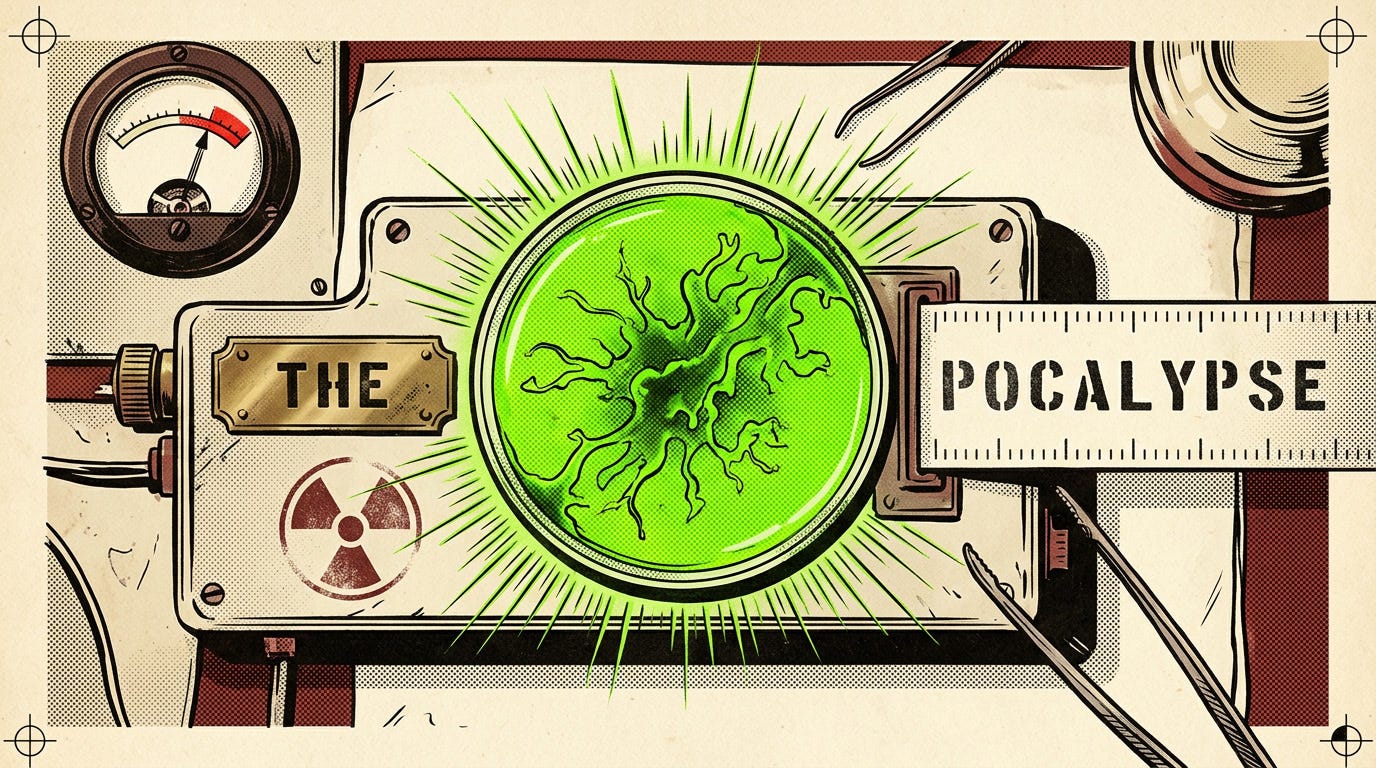
The header and the endmark came out of Leonardo, prompted in a back-and-forth until the machine in the picture said what the essay says: a radioactive specimen, an apparatus calmly measuring the end of the world. My eye, a model’s hand.
I disclose this not because anyone makes me, but because the essay is partly about who keeps their hands on the work as the tools get good. The honest answer here is that I did. The judgment stayed mine. The last human input was, too.
— CW