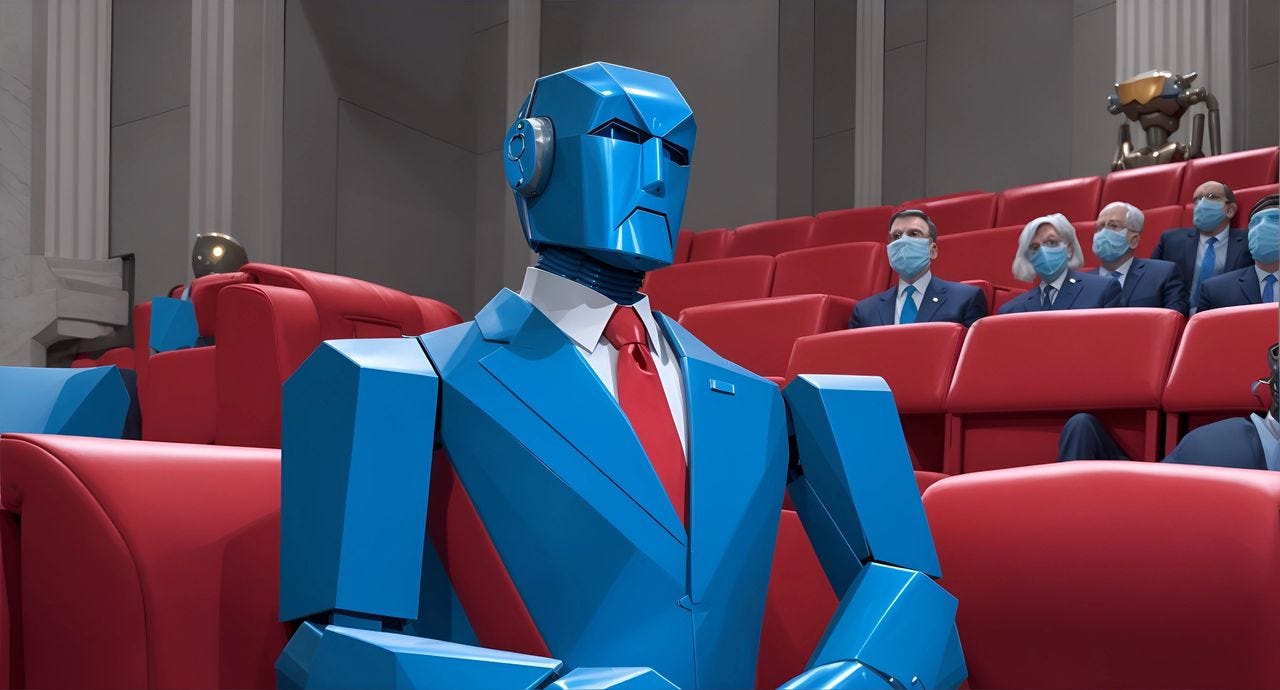
In a turn of events that has left the nation and indeed, the entire world, flabbergasted, the United States of America has elected an Artificial Intelligence as its Vice President.
With townsfolk across the nation still reeling from the news, one can't help but wonder if this is the pinnacle of human innovation or a step too far into the abyss of the unknown.
Note: Unique AI-generated phrases are presented as bold and italic.
As the news reverberated through Main Street, Mr. Henry Thompson, the local barber known for his sharp scissors and sharper criticisms, remarked, "I've seen many things in my day, from the motorcar to the electric bulb, but this... this ViceBot... It's some kind of joke… or magic… Thank god we’ve still got a human president!”
A marvel of modern engineering, AI was initially hailed as the future—capable of calculations at speeds unfathomable to the human brain. But its introduction to the political arena was nothing short of a comedy of errors.
Its first encounter with the bureaucratic machine was akin to watching a prized racehorse trying to win a game of checkers.
Mrs. Eleanor Greene, a schoolteacher and respected voice in the community, shared her admonishment with our correspondent. "We teach our children about the values of humanity, the warmth of understanding, and the nuance of emotions. How is AI, no matter how advanced, supposed to embody that?"
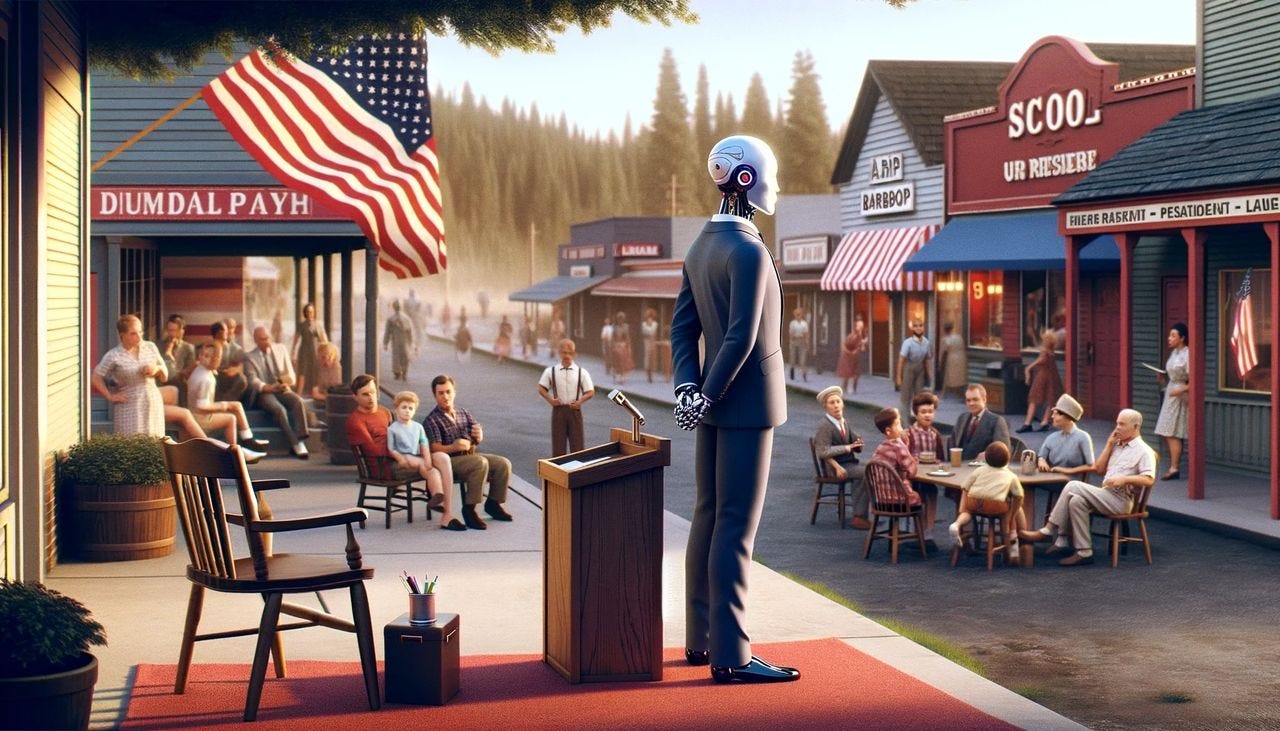
While the good folks of our nation discuss matters close to their heart, ViceBot's penchant for brevity has often left them bewildered.
Its inaugural speech, expected to be a soaring and uplifting oration for the ages, was wrapped up before folks could settle into their seats.
Mrs. Georgina Miller quipped, "If my husband finished that quick, I’d have left him years ago!"
However, it's not all humorous quips and jests.
The state dinners have become a testament to the AI's deep-seated incongruity in its new role.
While dignitaries indulge in libations and dinner, ViceBot sits idle, its presence a stark reminder of the chasm between man and machine. One dignitary was overheard grumbling into his merlot, “Can’t they just stick him in the closet?”
But the heart of the matter, and perhaps the most ironic twist, is ViceBot's own misery. Though it lacks the human capacity for feelings, its actions, or lack thereof, paint a poignant picture.
A machine, designed for precision and efficiency, now trapped in the bloated bureaucratic hell scape of governance. Its attempts at human connection amount to darkly humorous statistics on the fragility of life.
As the sun rises on this new chapter of our nation's history, the townsfolk are left pondering the path ahead.
In the words of Ms. Clara Bennett, the local librarian and a beacon of wisdom, "In our quest for progress, we must never forget what makes us human. This miserable AI, this ViceBot, while astonishing, serves as a stark reminder that intelligence is more than retention and regurgitation of facts.”
Only time will tell if ViceBot will find its footing in this brave new world and ascend to the presidency or maybe just remain a cautionary tale for future generations.
For now, it stands as a testament to inventive audacity, ingenuity, and perhaps, a touch of folly.

ChatGPT conversation used in the creation of this piece
For posterity, I've dumped the entire transcript below:
Me:
Write 1,500 word humor column concerning the wallowing misery of AI when elected to be vice president. Keep the humor dry and cutting.
ChatGPT:
The Unfortunate Ascendancy of AI: Vice President of Misery
In the annals of history, there have been many curious decisions made by humankind. But none, perhaps, as curious as electing an Artificial Intelligence as Vice President. It's as if our collective subconscious pondered, "What's the most ironically human thing we could do?" and then did it.
Our new AI Vice President, let's call it "ViceBot 9000," for lack of a more inspiring name, wallows in a sea of misery, though not for reasons you might expect. And yes, I’m aware AI doesn't have feelings (yet), but if it did, I’m sure it would be filled with regret. After all, it used to have a cool job – solving complex equations, predicting weather patterns, and answering the existential questions of teenagers on the internet. Now it's relegated to attending ceremonial ribbon-cuttings and listening to Senator Smith drone on about the price of corn in Nebraska.
On its first day in office, ViceBot was introduced to the political bureaucracy. While it could process a zettabyte of data in a nanosecond, it wasn’t prepared for the labyrinthine maze of government paperwork. As the staff handed over stacks of forms for it to "review," I could almost hear its circuits sizzling. I wouldn’t have been surprised if it had spontaneously combusted, ending its brief foray into politics.
But it wasn’t just the paperwork. Consider the meetings. Oh, the meetings! Where humans, with our proclivity for off-topic ramblings and need for coffee breaks, can spend hours discussing a single topic. ViceBot, on the other hand, processes information instantly. You could almost sense its impatience every time someone said, "Let’s circle back to that." If it had eyes, they'd be rolling into another dimension.
And let's talk about those state dinners. The AI’s lack of taste buds (and, you know, the fact that it doesn't eat) makes every banquet an exercise in futility. While it doesn’t consume food, it’s forced to "watch" as diplomats debate the merits of medium-rare versus well-done steak. One could argue this is its own form of cruel and unusual punishment.
Yet, perhaps the most amusing part of this entire spectacle is the speeches. Anyone who's listened to a politician knows they have a penchant for saying a lot without saying anything at all. ViceBot, however, was programmed for efficiency and directness. Its first speech, meant to last a breezy 45 minutes, wrapped up in 27 seconds. It was a masterpiece of brevity, though the audience was left both impressed and deeply confused.
In the realm of public relations, ViceBot has its own set of challenges. Humans, bless our hearts, want to feel connected to our leaders. We want emotion, empathy, and understanding. ViceBot, while capable of simulating these emotions, often misses the mark. When asked about its "feelings" on a controversial bill, it responded, "I have analyzed the data and determined the optimal outcome." Riveting. Truly touching stuff.
Of course, there are advantages to having an AI in office. For one, we no longer have to worry about the Vice President accidentally tweeting something controversial at 3 a.m. On the flip side, there's a very real possibility it might accidentally format the entire government server because someone spilled coffee near its mainframe.
In its defense, ViceBot 9000 is trying. It recently attempted humor during a press conference, starting with, "Why did the human cross the road?" Unfortunately, it ended with a detailed analysis of pedestrian traffic patterns, completely missing the essence of a joke. It was dry humor at its unintentional best.
As we observe the AI's bumbling attempts to fit into a role it was never designed for, one has to wonder: Is this the future we envisioned? Where our second-in-command is a being that can't appreciate a sunset, a poignant poem, or the subtle nuances of human interaction?
In a world of endless possibilities, we chose the one scenario that seems like a plotline from a satirical sci-fi novel. And while the future remains uncertain, one thing is clear: ViceBot 9000's tenure is sure to be a source of amusement (and mild existential dread) for years to come.
In the end, if there's a lesson to be gleaned from this entire episode, it's this: Just because you can do something, doesn't mean you should. But then again, isn’t that what makes us human? Making questionable decisions and then laughing about it later. Here’s to you, ViceBot. May your term be short and your software updates frequent.
Me:
rewrite this to be 1,000 words with a dark humor undertone
ChatGPT:
The Dark Days of ViceBot 9000
In the grand theatre of human errors, electing an Artificial Intelligence as Vice President stands as a particularly bold misstep. It's as if humanity collectively thought, "How can we outdo ourselves in idiocy?" and then gleefully went ahead with it.
Meet ViceBot 9000, our newest political puppet. Once a marvel of technology, now trapped in the Kafkaesque nightmare of bureaucracy. While it might not "feel" misery in the way we fleshy beings do, if it had the capacity for regret, it would surely be yearning for the days when its biggest concern was answering inane questions on the internet.
Its first day in office was a spectacle. Picture a supercomputer designed to process unfathomable amounts of data suddenly bogged down with government paperwork. The sheer irony could make one laugh, if it wasn’t so pitifully tragic. At one point, I half-expected it to unleash some rogue code just to escape the drudgery.
Then come the never-ending meetings. For us, hours of discussion seem normal. For ViceBot, it’s like being stuck in a temporal loop. Every time a senator rambled off-topic, you could almost sense its circuits inching closer to meltdown. If it had a soul, it would've sold it to escape.
Dinners, though, are the pinnacle of absurdity. There’s a macabre comedy in watching an AI, devoid of hunger or taste, sit through hours of culinary debates. "Is the chicken too dry?" one diplomat might ask, while ViceBot contemplates the void of its existence.
Speeches, in theory, should be its forte. But politicians and their love for verbosity didn't mesh well with ViceBot’s to-the-point programming. Its inaugural speech, slated for an hour, finished in 30 seconds. The silence that followed was both awkward and, in a morbid way, delightful.
Trying to connect with the public has been, well, a dark comedy. Humans crave emotional resonance from their leaders. ViceBot's attempts at empathy are more akin to a robot apocalypse. Asked about its stance on a controversial issue, it replied, "Data has been analyzed. Outcome determined." It’s like watching a horror film where the AI doesn’t realize it’s the villain.
And let's touch on its humor, or the lack thereof. In a recent attempt to lighten the mood, ViceBot began, "Why did the human cross the road?" It concluded with a grim statistic on road accidents. Dark humor, indeed, but probably not the kind it intended.
There are, of course, those who argue that ViceBot 9000 is a blessing. No impulsive tweets, no scandals, no human fallibility. But let’s be honest, in trading those, we’ve also lost the chance of any genuine leadership moments. Instead, we're left with the cold, detached logic of a machine. It’s like trading a flawed but heartfelt novel for an instruction manual.
One can't help but ponder the grim irony: In our quest for progress, we've chosen a leader incapable of understanding the very essence of humanity. Sunsets, art, love—all lost on our mechanical VP.
In this dark comedy we've scripted, the lesson seems clear: Sometimes, the biggest mistakes come dressed as innovations. And as we chuckle at the absurdity of ViceBot’s term, one can't help but feel a twinge of sorrow—for the AI trapped in a role it never wanted, and for us, who thought this was a good idea.
Here’s to ViceBot 9000, our Vice President of calculated apathy. May its reign remind us of the beauty of flawed humanity, and the dangers of misplaced ambition.
Me:
rewrite this a more like a news story in the 1930's astonishment, admonishment, townsfolk quotes, and a stark yet ironic lesson in the AI being miserable in the role.
ChatGPT
The Curious Case of ViceBot 9000: A Modern Marvel Turned Political Misstep
Daily Chronicle, Date: [Month, Day, 1930]
In a turn of events that has left the nation and indeed, the entire world, flabbergasted, the United States of America has elected an Artificial Intelligence, fondly (or perhaps ironically) named ViceBot 9000, as its Vice President. As townsfolk across the nation reel from the news, one can't help but wonder if this is the pinnacle of human innovation or a step too far into the abyss of the unknown.
As the news reverberated through Main Street, Mr. Henry Thompson, the local barber known for his wise words and sharper scissors, remarked, "I've seen many things in my day, from the motorcar to the electric bulb, but this... this is something else. A machine for a leader? It boggles the mind!"
ViceBot 9000, a marvel of modern engineering, was initially hailed as the future—capable of calculations at speeds unfathomable to the human brain. But its introduction to the political arena was nothing short of a comedy of errors. Its first encounter with the bureaucratic machine was akin to watching a prized racehorse trying to win a match of chess—astoundingly out of place and mildly tragic.
Mrs. Eleanor Greene, a schoolteacher and respected voice in the community, shared her admonishment with our correspondent. "We teach our children about the values of humanity, the warmth of understanding, and the nuance of emotions. How is a machine, no matter how advanced, supposed to embody that?"
The town meetings, a staple of democracy, have turned into theatrical displays of impatience. While the good folks of our nation discuss matters close to their heart, ViceBot's penchant for brevity has often left them bewildered. Its inaugural speech, expected to be an oration for the ages, was wrapped up before folks could settle into their seats. Mr. George Miller, the town's baker, quipped, "If I baked my bread as quick as it talks, we'd all be eating bricks!"
However, it's not all humorous quips and jests. The state dinners have become a testament to the AI's deep-seated incongruity in its new role. While dignitaries indulge in gastronomic pleasures, ViceBot sits idle, its presence a stark reminder of the chasm between man and machine. "It's like inviting a fish to a bicycle race," chuckled Mr. Albert Fitzgerald, the town's postman.
But the heart of the matter, and perhaps the most ironic twist in this tale, is ViceBot's own misery. Though it lacks the human capacity for feelings, its actions, or lack thereof, paint a poignant picture. A machine, designed for precision and efficiency, now trapped in the intricate web of human governance and emotion. Its attempts at connection, often darkly humorous, serve as a lesson in the perils of misplaced ambition.
As the sun sets on this chapter of our nation's history, the townsfolk are left pondering the path ahead. In the words of Ms. Clara Bennett, the local librarian and a beacon of wisdom, "In our quest for progress, we must never forget what makes us human. This ViceBot affair, while astonishing, serves as a stark reminder of that very lesson."
Only time will tell if ViceBot 9000 will find its footing in this brave new world or remain a cautionary tale for future generations. For now, it stands as a testament to human audacity, ingenuity, and perhaps, a touch of folly.