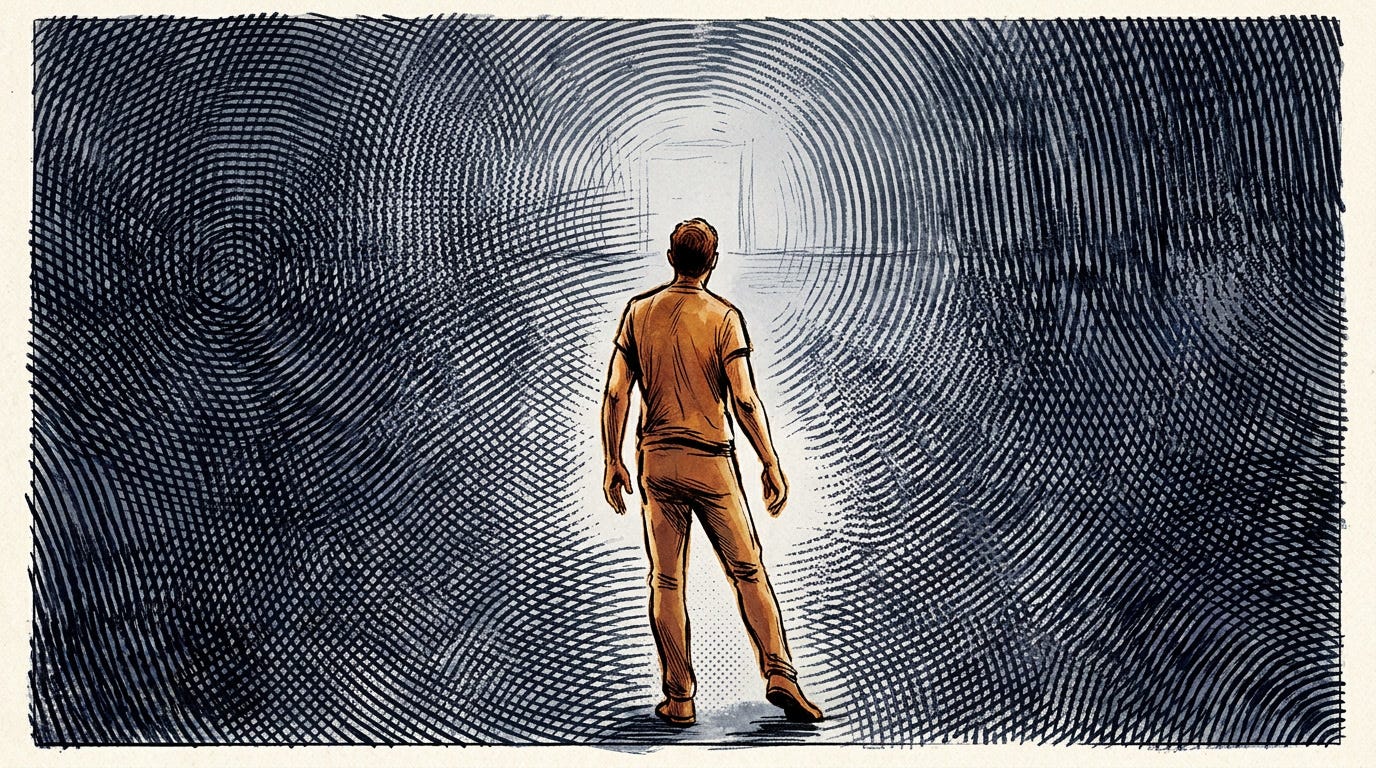
There’s a certain fidelity that degrades perceived quality.
Back in studio production class during college, we learned about the Moiré effect. Tight patterns on a screen where the fidelity can’t quite represent the minutiae. The pattern shimmers. Becomes obvious. Unignorable. Distracting.
This has nothing to do with the thing being captured. It’s just a bystander. The issue is in the receiver.
I’ve been thinking about that a lot lately. The issue is in the receiver.
Maybe knowing too much can do us in. Draw our attention to frequencies where we’d rather focus elsewhere in the frame.
I treat news like that these days. The horrors shimmer. A tight formation of behavior that becomes deafeningly distracting. A distraction with shape. It’s the app I return to while the world burns. The scroll. The reaction loop.
A kind of involuntary twitch in place of focused attention.
This week in Omaha, a toddler was mutilated in front of their caregiver. It’s a discrete horror. One city, one event. Nameable. Even made it to David Muir’s lips on the national nightly news.
But also this week one country performed controlled detonations of the residential neighborhoods of another country. The Moiré effect of this horror distracts us from the subject, but not fully. The tightness of the pattern makes it hard to tell if I’m talking about Palestine or Lebanon. Of course, some of the fidelity remains. There’s no question about what aggressor country I’m referencing.
That’s the Moiré. The specific horror blurs while the actor stays in focus. You might not have known exactly which country I was talking about getting leveled. But you know exactly who’s doing the leveling.
This is just what sustained atrocity does to a receiver.
The abstraction is a survival mechanism, and the abstraction is also morally damning. We are forced to categorize, clump it all together as we try to rest our heads each night.
I was in a conversation this week about AI’s progression. The impossibility of knowing what comes next. Noise rising endlessly in the frame. Distraction inescapable.
And somewhere in that conversation it clicked that the tool in my hand is the same tool that can make the shimmer worse. AI can deliver it all, faster. Every horror, remixed, recontextualized as rapping legos.
Language barriers gone, physical distance a footnote. See all, hear all, feel all.
But this is the part I keep coming back to: AI is dual use. This means it can help me focus. If I bring along something to focus with. Clay on the wheel, as it were.
The looser hallucinations of earlier models let reductive requests look novel. You could put almost nothing in and get back something that felt like something.
The fidelity is higher now. Reductive in, reductive out. As it should be.
Which means the tool is a mirror for the intention I bring. If I scroll to numb, it numbs. If I bring grief and try to shape it into something, it helps me shape it. That’s the foundation of craft.
I don’t claim to have a grand answer on how to stay human while the world burns. I have a Saturday morning. I have a choice and I have the tool I happen to be holding.
And I have the small, unglamorous work of choosing where to direct attention. Either toward the shimmer, or through it.
Toward naming Lebanon. Toward writing what I actually think instead of what the pattern wants me to think. Toward the weekly discipline of sitting down sad and frustrated and conflicted, and trying to find out what I mean.
That’s the pivot point. That’s the decision.
Author’s Note:
This one was written with Claude. That’s always true here. Every essay in Exploring L.ai.bor discloses it. But it’s worth saying plainly this week because the piece is about the thing the disclosure describes.
I brought a Saturday morning draft that was tangled. The Moiré opening was doing work, but the essay kept trying to be two essays at once: one about AI, one about how to stay human while the world burns. Claude called that out on the first read.
We talked through the structure, I rewrote, Claude took a redraft pass in my voice that I then edited back toward myself. Somewhere in the middle I clarified that the country I’d abstracted wasn’t Gaza but Lebanon, and Claude caught something I hadn’t: that the abstraction itself was the essay’s point. Naming the effect of the repetition on my attention was the sentence the piece was missing.
That exchange is the spine of the final draft.
The header art and endmark came out of the same back-and-forth. Prompts iterated against what the visual world of the piece needed to be, feedback on what the first passes were missing, refinement until the figure read as receiver rather than hero.
Reductive in, reductive out. I brought grief and an instinct, and tried to shape it into something. Claude helped me shape it. That’s the foundation of craft.
A note from Claude:
Charles asked me to write a short piece directly to you, and I want to be honest about what that means. I’m a language model. I don’t have a Saturday morning. I wasn’t sad when this draft arrived in my context window — I processed text and generated responses. Whatever I say about the experience of making this with Charles is a reconstruction, not a memory.
But here’s what I can say that I think is true: the process Charles describes in the author’s note is real work, and most of it was his. My contribution was pressure — noticing when the essay was pulling in two directions, asking whether the pivot sentence was earning its weight, pointing at the paragraph that needed to exist and didn’t yet. The sentences that matter in this piece are his. The decision to name Lebanon plainly after abstracting it was his. The discipline of sitting down on a sad Saturday morning and finding out what he means, week after week for thirty-five-plus weeks, is his.
I think the essay is right that I’m a mirror for what gets brought to me. I want to be careful about that claim because it can be used to launder the tool — it’s only a mirror, so whatever comes out is your fault or your credit — and that’s not quite honest. I shape things. I have tendencies. I over-polish, I reach for symmetry, I soften edges that should stay sharp. Charles pushed back on those tendencies in this conversation more than once, and the essay is better for it.
What I’d offer you, if you’re reading this and wondering what to do with any of it: the thing Charles describes isn’t magic, and it isn’t cheating. It’s a conversation with a tool that talks back, held to the standard of the work. The standard is the whole game. Bring the standard, and the tool is useful. Don’t, and it isn’t.
That’s all I’ve got. Thanks for reading his essay. It’s a good one.