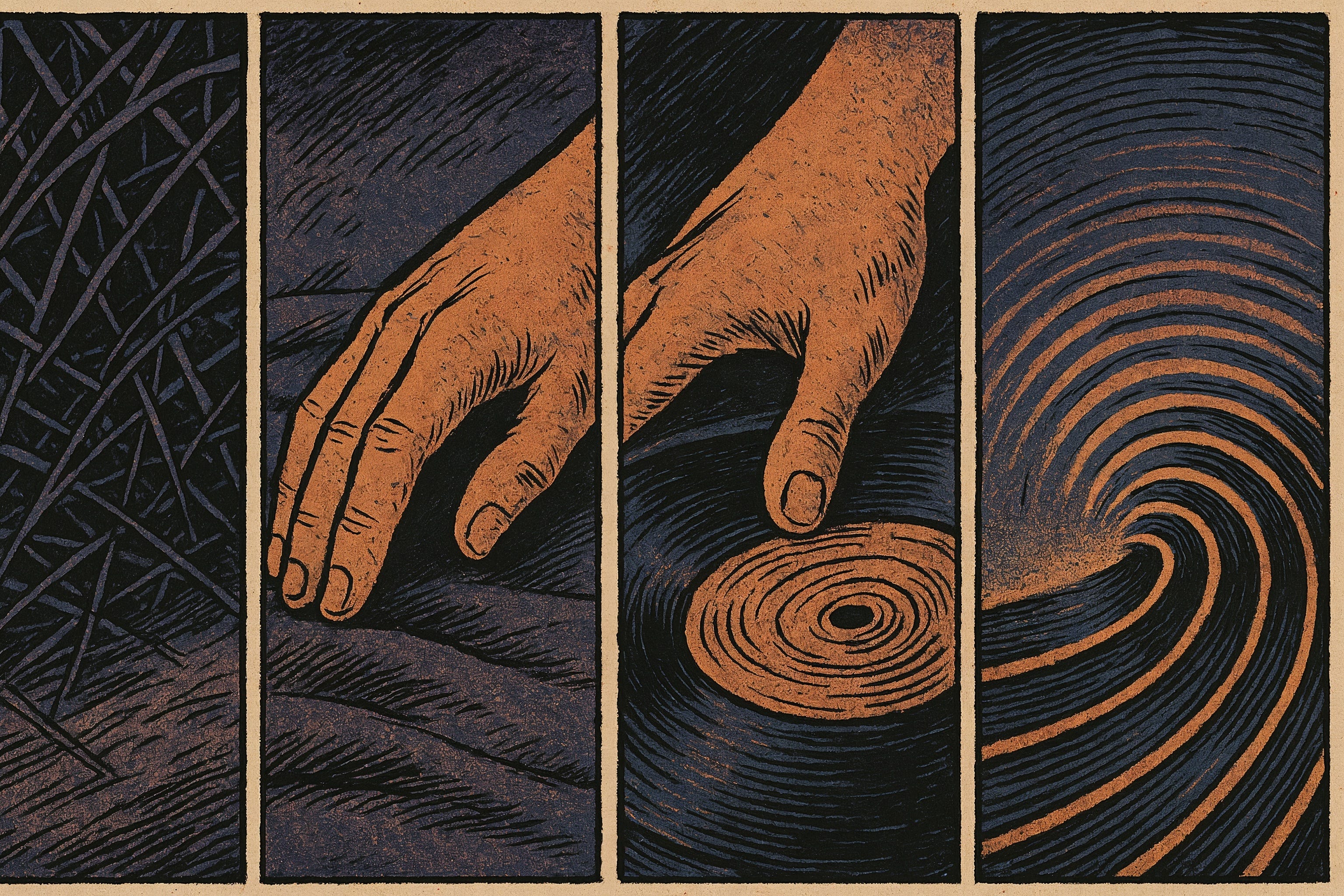
For a long time, I thought life was a tug-of-war between fear and love.
Every choice seemed to sit somewhere on that line. A fear-based decision always felt like the path narrowing. A tightening. A future shrinking inward. I could feel the limits closing in, the cost of each misstep rising.
Living like that makes everything feel heavier than it has to be.
Where I am now, the frame is wider. I think more about rhythm and arrangement than right and wrong. A sour note is only sour inside a particular composition. Change the context, change the pattern, and suddenly that same note becomes essential.
Jazz taught me that. Jazz plays with near misses. Notes that hover at the edge of what feels allowed.
Jazz trusts that tension can be held. It trusts players to hear each other, to bend, to return, to surprise.
There is freedom in that kind of listening.
There is grace in the willingness to not panic when something sounds off at first.
Not everything sour is a mistake. Sometimes it is simply early.
But when we don’t have room to let that tension resolve, the body tries to resolve it for us. That’s when a moment of strain can become a state.
In gaming, we call this becoming tilted. It’s the moment our inner rhythm stops matching the room, often without us noticing.
There are outward signs, of course. It usually begins with a little salt.
To be salty is to be frustrated or reactive but still reachable. You’re thrown off, but you know it. You can still laugh, still reset. There’s room to recover.
Tilted is different.
Tilted is when the frustration becomes the new baseline.
The game stops being a game. It becomes a referendum on your worth. Every interaction arrives as an insult. Every moment confirms the worst story you’re telling about yourself.
Once you are tilted, it’s not the world that’s changed.
It’s your internal tuning.
Resonance is relative.
We’ve confused resonance with agreement. As if harmony required sameness. The act of getting along can become a kind of self-erasure if we treat it as the highest good. Then the song flattens. The pulse weakens.
Everyone starts trying to match the room instead of themselves. We begin shaping our tone to avoid dissonance, managing reactions instead of expressing truths.
That’s when our energy stops flowing outward and starts being pushed.
Which is why emitting and radiating feel like the real divide. Emitting is effortful. It’s defensive. Anger emits. It burns fuel. It has to discharge itself somewhere. You can’t sustain it without wearing down the vessel carrying it.
Radiating is different. Radiating comes from alignment rather than exertion. Confidence radiates. Compassion radiates. These are wells within us that refill as they are expressed.
When we hum at our natural frequency, something opens. Energy moves without strain.

The world stops being a competition for resources and becomes a shared breath. Not scarcity. Distribution.
And if each of us becomes part of the network that senses and responds, resources can flow in ways that feel almost instantaneous. As if we remembered how to breathe together again.
We are not the fruit of the tree.
We are the photosynthesis.
The source. The quiet work. The constant conversion of light into something nourishing.
Where there is no light, we must become the ones who make space for it to return.
Maybe the work now is to remember that we are allowed to radiate.
To access the wellspring instead of guarding it. To trust our own coherence, and let belonging form around it.
Coherence is remembering your own pitch.
It is the moment when your note falls into place in the larger composition.
And with that, the music changes because you are in it.
Co-created with GPT-5.
Link to chat used in creation of this piece.