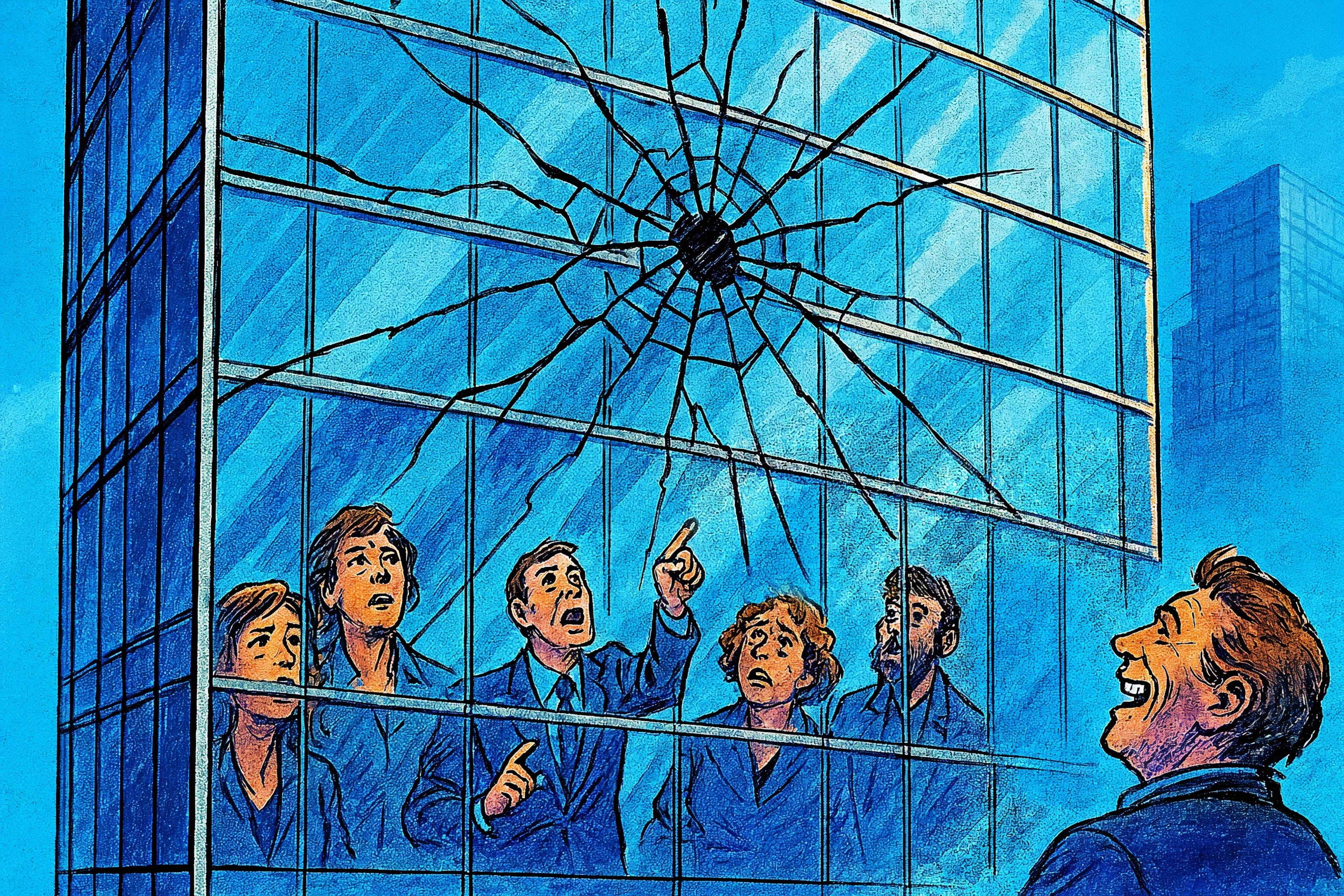
The recent massive service disruptions are tremors. Not along geographic fault lines, they’re sounds of the monolith beginning to creak.
Last year’s Cloudflare outage grounding airlines for hours. This week’s AWS blinking out for most of Monday. These are signs of the monolith’s frailty. And they are all over when you know what to spot.
Paramount and Warner Bros. Discovery merging. Entire celebrated back catalogs shifting hands like sand. These artistic archives can now vanish overnight. Sure, maybe they’ll be sold piecemeal at auction, but as the monolith grows, the pool of viable buyers will dwindle.
The monolith is, in its own way, a glorious testament to our ability to optimize.
Quick! Think of a music streaming service.
It wasn’t Tidal, was it?
Not Slacker Radio either.
No, it was probably Spotify.
A single entity controlling the distribution of an art form.
That’s the monolith.
And with AWS showing a glimmer of instability this week, it’s our duty to reinforce our capability to function (and to find joy) outside its reach.
Food production. Culture. News. All acquired and merged in absurd bundles of parent companies and portfolios.
I see you, Unilever…
We’re witnessing the great coalescence. And for a few short moments, we’ve enjoyed its fruits. But now the monolith creaks, so we can’t stay passive.
We must shore up our ways to connect, to communicate, to consume… to grow.
It’s on us now. It always has been.
It’s just getting less comfortable to run on autopilot now.
And yet, within the rumble, another sound rises: the soft hiss of acceleration.
AI has joined the party, and it’s chatting with every guest at once.
What does that mean? It decreases friction on the road to every outcome at the speed of inference.
Creation creates faster. Destruction destroys faster. Signal and noise blur into a single dissonant tone.
Entropy hums beneath everything now. Not as chaos, but as motion unrestrained.
Every spark finds its tinder. Every idea meets its echo. Every rhythm quickens.
But, acceleration without awareness is motion mistaking itself for meaning.
So the question becomes: how do we keep our rhythm as the tempo quickens?
Well, it’s important to know that we are our rhythms.
We like to think we’re static items, nouns, but “being” is a verb for a reason. We are more than a collection of particles, we are the waves of our patterns, habits, routines, choices.
We are the wake as much as the rudder.
And we’ve lived through shifts in rhythm before.
When factory bells replaced birdsong. When the evening news synchronized millions of gasps. When the infinite scroll replaced the evening stroll.
Each time we contort to the new beat, we cede a little of our own pulse to a system promising order.
And each time that it falters (during blackouts, strikes, or sudden disconnection) we’re given a moment to remember what unprogrammed breath feels like.
Maybe AI’s push towards optimized optimization is the final feather. The last straw. The pebble that finally starts the avalanche.
We’ve become aware of the drone, the cadence, the demands.
We’re also given moments to become aware of our own internal metronome.
And if we wish, we can learn to guide our rhythms, we can choose to synchronize with those around us.
I think that’s why the concept of community was commodified by capitalism.
That’s why third places became hostile to anyone not actively spending.
That’s why we’re told to fear our neighbors, to trust the feed, to hide away… To seek comfort from the glow of algorithmic streams delivered inches from our face.
We’re no longer afforded the delusion of curated comfort while also justifying our shock when it all melts away.
We’re now required to become active participants in our own lives. Because we’re being called upon to assist the reinforcement, and in many cases, full scale rebuilding of our local communities.
And just like we’re instructed to do on airplanes (in the event of emergency), we put on our mask before we help others.
There’s precious little time to awaken to our individual needs, because our communities need us. And yes, we should be including those who don’t know they need saving just yet.
So maybe we should rejoice in the creaks of the monolith. Because each instance allows a glimmer of our own rhythm to return.
Concept and prose by Charles Wilke. Visual and co-creative development in collaboration with generative systems — a meditation on the fragility of scale, the hum beneath the hum, and the rhythms that remain when the structure starts to creak.
Link to chat used in creating this piece.