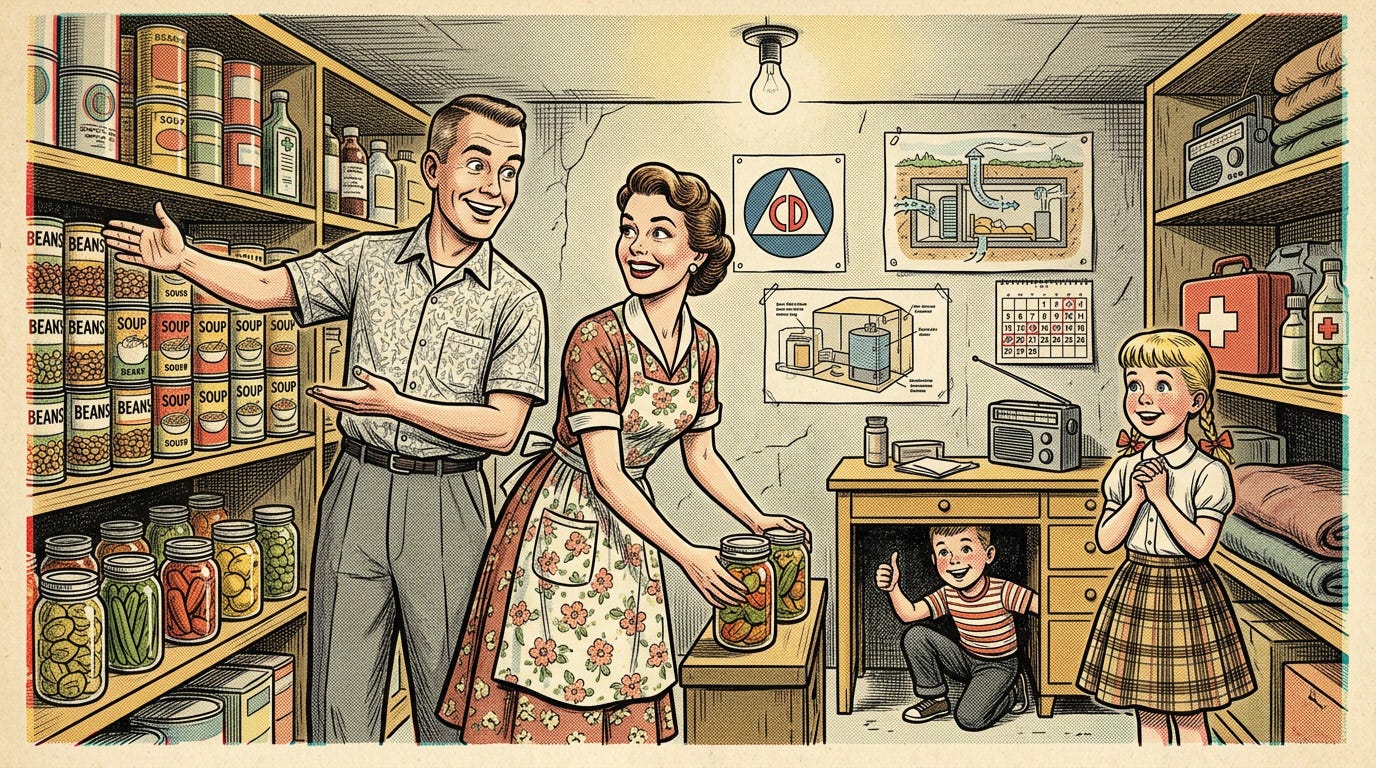
Kids of the ‘80s were raised in the shadow of nuclear fallout fears. Our parents were children when the Cuban missile crisis streaked across the headlines.
It threw newly-formed suburbia into a tizzy. And trained the children to shelter in place, hide under their desks. Brace.
There was an ambient sense of destruction, feared reckoning ringing in their ears.
Our parents dutifully, some more than others, bestowed that sense onto their children.
Hi. I am one of those.
The nuclear annihilation fears were, of course, not unfounded. But they were a tad misguided.
The focus was on shelters, strong walls, canned food, potable water. Physical endurance. Capacity measured in the quantity of canned beans lining the walls of whatever ad hoc shelter an individual could afford.
Sure, there was company with that misery. But the space afforded each individual atomic family often only provided brief refuge for those with the same surname.
And they lived like that.
In a state of preparedness. Physical preparedness.
Unknowingly riding the edges of their sanity in the process.
What nobody could have told them is that the preparation itself was the wound.
The bracing was the damage.
A muscle held taut for too many years.
The kind of charlie horse that doesn’t release on its own.
An emotional cramp that takes decades to relax.
Growing up in the ‘80s, the idea of this type of imposed destruction became almost quaint.
Movies romanticized the secluded prepper. The early-bracer, late-releaser, emerging into a world that had moved on. It was cute.
But it didn’t really strike the core of what was lost in the process.
Just glorifying our technical prowess to physically endure hardship.
Ignoring the emotional toll of bracing, preparing, flinching, distrusting, second guessing.
What got passed down to us was the posture. But no instructions on training the endurance of the muscle that actually mattered.
Then COVID arrived.
The crash course in the new kind of survivalism. The mental kind.
The one our parents couldn’t have taught us because they didn’t know it was the muscle that mattered.
We dutifully sheltered in place.
We also drained our savings. Distrusted one another. Feared invisible forces.
We watched the conspiracies bloom in our group texts.
Watched the mental health wave crest with nowhere to break.
And that was in an era where we still had, mostly, homogenized news diets. We had a shared frame and we still couldn’t hold it.
That was the test. We were graded. The score’s in. We failed.
And now AI saunters into the living room. Gleeful. Eager. Granting wishes.
Be careful what you wish for. Because something is finally listening.
Before generative AI, we could still find sources to back any wild claim that came to mind. That’s how the incentive structure worked. Clicks. Ad revenue.
I was part of the problem.
An adept writer hired by marketing companies to attract eyeballs.
Truth and fabrication don’t matter when all you’re peddling is visibility to vendors and satisfying sedation to audiences.
I’ve helped engineer virality.
I’ve watched the discourse spark and roil.
I’ve watched my benefactors lick their lips at the ad revenue that came along as a byproduct of our actions.
And I also sat with the emptiness of the entire affair.
Now though? Now we don’t need someone like me. We don’t need someone skilled. We don’t even need an individual with the intention to drum up attention like my old employers wished.
The genie’s out of the bottle. The intention is clear. Give the people what they want.
You want to see this? Fine. We can pull anything up. And if you want to see it badly enough, we’ll invent the angle. Conjure the situation. Generate the catastrophe.
Some call this The Great Filter. The cosmic sifting device that decides who endures and who fades away.
But here’s the cruel inversion. Our parents’ generation stayed cramped with a muscle held taut too long, the wrong one, bracing for a threat that wasn’t going to come the way they thought.
Our generation is now left with a real threat and a muscle that’s gone slack. Atrophied. Our discernment muscle never developed. Because nobody knew to brace it. Nobody told us it existed.
Both are losses of sanity. Both are forms of failed preparation. One from over-bracing. The other from never bracing at all.
So I don’t think we’re prepared for the fallout of our latest invention.
Because what it asks from us is a new form of survivalism.
Something no amount of canned food can help us endure. Because this survivalism comes from within.
A clear mind with a discernment muscle routinely exercised on purpose. The friction of asking is this true when the algorithm is purring back exactly what we wanted to hear.
The willingness to be inconvenienced by reality.
That’s the only way through this filter. The choice at the fork in the road won’t come from signage. It will come from knowing. And knowing isn’t something you arrive at. It’s something you stay tuned into.
Author’s note
This essay poured out of me Saturday morning and then went the way most of my essays go. I brought the raw draft to Claude for intellectual patty-cake. To discuss places the argument slipped, places the rhythm dropped.
Out of that conversation came the inversion that ended up being the spine of the piece: parents cramped from over-bracing the wrong muscle, our generation slack from never bracing the right one.
I took the revised draft into Google Docs, edited independently, then ran it back through Claude for final polish.
The header and the CW endmark were generated in Leonardo from prompts I developed with Claude. Intentionally driven by descriptive language only, no named-artist invocations, since the image models over-index on the recognizable shorthand.
I disclose this in every essay. Not as obligation or confession, but as the discipline the essay is actually describing.
The collaboration here was AI as stage manager, not director. The through-line, the voice, the choices all remain mine. But the patty-cake mattered. The sum here is larger than its parts.
~Charles