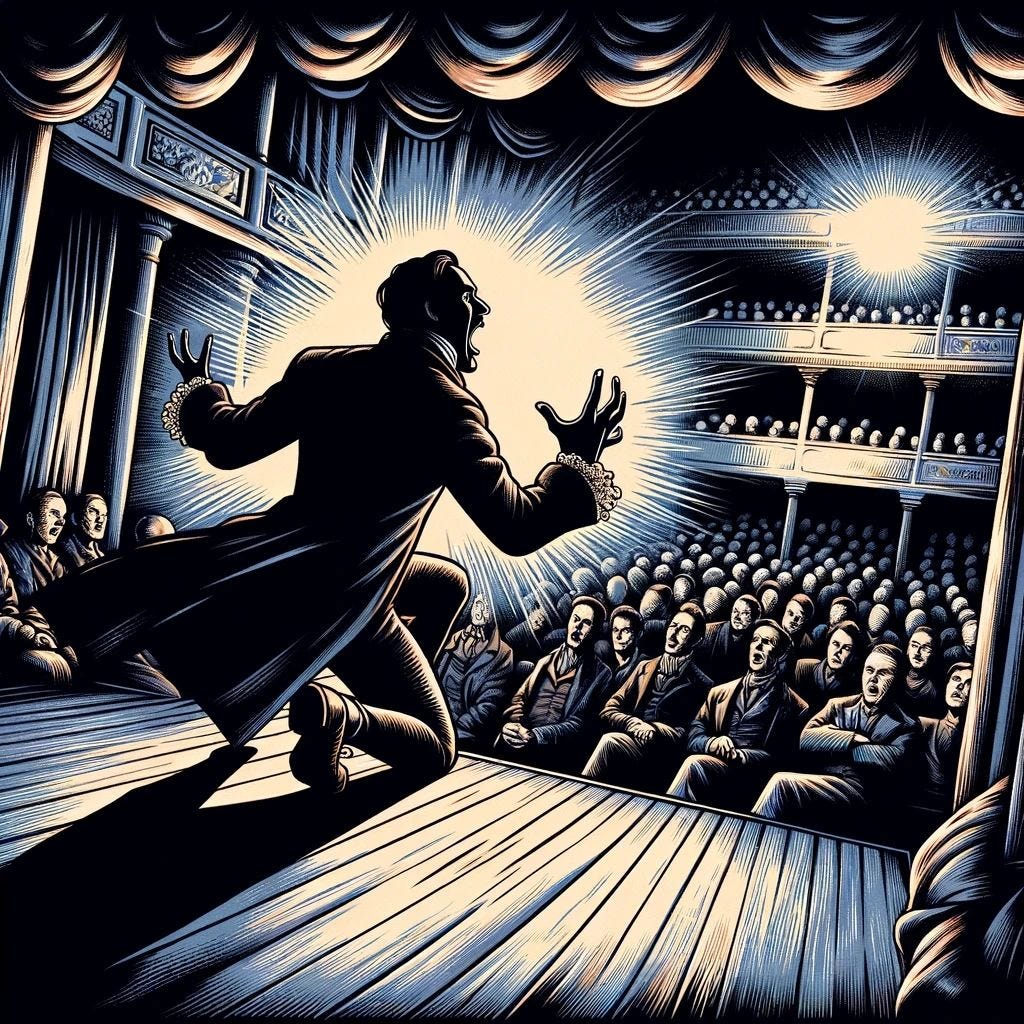
As Artificial General Intelligence (AGI) raps on our door, what’s to become of our stalwart human tradition - live theater? For centuries now, many have confidently pointed to theater’s assumed last gasp, yet here we are, still eulogizing its supposed demise.
The truth?
Theater is the cockroach of the arts, surviving wave after wave of technological facsimiles, and for good reason: It’s that human thing we do - gather in the dark to watch other humans demonstrate the feelings we’re too afraid to feel ourselves.
Note: Unique AI-generated phrases are presented as bold and italic.
AGI, with all its silicon charm, can no more replace live theater than it can experience the taste of a really good sandwich.
Much like the longstanding corporate cudgel clobbering creatives' confidence - a thousand monkeys at a thousand typewriters will inevitably recreate Shakespeare. And it appears that AGI is promising to do just that.
Sure, an AGI’s output could get the words right, but it would be like listening to "Stairway to Heaven" played on a kazoo by a diligently oblivious robot. Technically correct, yet somehow profoundly missing the point.
This is why electronic drum machines had to introduce an element of inconsistency to the beats produced. Perfection is decidedly not human.
Theater is that odd duck—a place where the uncanny valley cranes its neck up to the mountaintops of sweat and spit. Every performance is a unique catastrophe: lines get flubbed, props fail, and sometimes the lead actor is so hungover that they deliver their heartfelt soliloquy to a mop instead of the ingenue.
This is the stuff of life, the gloriously imperfect dance of existence.
AGI, on the other hand, would give us a technically precise framework for a performance where the audience would likely stare befuddled as they watch the actors attempt breath life into a lifeless work.
In theater, the ephemeral is king.

A play is alive, then it's dead, and no necromantic technology can revive that night's particular alchemy.
It’s a shared hallucination. A collective conspiracy. A brief belief, held in unison, that the world is as we wish it was - or fear it might truly be.
It’s raw, visceral, and real. It's about the moment of impact, the connection, the feeling that something real is happening - because it is. You can't get that from a screen, no matter how crisp the resolution.
And what of AGI in all of this? It will do many things: it will drive our cars, manage our economies, maybe even write passable postmodern literature.
But it can’t stand on a stage and make us feel. It can’t sweat under the spotlight, lock eyes with a stranger in row G, and make them feel seen.
We build our digital gods, but in the end, it's the stories we tell in the dark, to the rapt crowd of mortals, that linger in the soul.
Theater is an anachronism, sure.
It's the past whispering lessons to us in the present that we choose to take into the future. It’s a reminder that behind all our advancements, we’re still just people who need a story to make sense of it all.
Theater is a celebration of the temporary, an emotional communion. We elect to watch people declare their deception before the curtains rise, and together, we choose to believe every bit of it.
The curtains inevitably fall, the sets struck, but the resonance of a live performance, that indelible human connection, echoes long after the final bow.
It’s theater’s heart that beats in time with our own—flawed, resolute, and thunderously alive.

ChatGPT currently doesn't allow linking to conversations that include image generation.
For posterity, I've dumped the conversation below:
Me: What value do you see in the future of the ephemeral qualities of live theater in a future of AGI?
ChatGPT:
The ephemeral qualities of live theater hold intrinsic value that may become even more pronounced in a future shaped by advanced general intelligence (AGI). Here are some potential areas of impact and value:
Irreplaceability of the Human Element: The presence and performance of live actors on stage cannot be replicated by AGI. The subtle nuances, the spontaneous energy, and the connection between the actors and the audience are unique to each performance. This human element celebrates the imperfections and unpredictability that AGI cannot authentically recreate.
Cultural Preservation and Continuity: Live theater is a medium that has been passed down through generations. It is a reflection of cultural narratives, traditions, and societal shifts. While AGI can assist in archiving and simulating performances, it cannot replace the cultural continuity that comes from live human storytelling and interpretation.
Social Commentary and Reflection: Theater often acts as a mirror to society, offering commentary and critique. The ephemeral nature of a live performance allows for a responsive and immediate reflection of the current social climate, which an AGI, no matter how advanced, might not be able to grasp or convey with the same depth of emotional intelligence and contextual awareness.
Emotional Resonance and Empathy: The transitory nature of a live performance can intensify the emotional connection between the audience and the performers. This shared experience can foster empathy and a sense of community. AGI may analyze and understand human emotions, but the genuine exchange of feelings in a live theater setting is something distinctly human.
Educational Value: Live theater is not only a form of entertainment but also an educational platform. It provides a space for learning about history, literature, human behavior, and more. The immediacy of theater can engage people in ways that AGI may enhance through supplemental learning tools but not replace in terms of direct, experiential learning.
Inspiration for Innovation: The creativity and improvisation found in live theater can inspire innovation in AGI development. Observing how actors adapt to unexpected moments can inform AGI algorithms that deal with unpredictability and decision-making.
Economic and Experiential Diversity: The theater industry provides a plethora of jobs and experiences that AGI cannot fulfill. From set design to live directing, the range of skills required for theater production values the diversity of human talents and crafts.
In summary, while AGI can augment and extend the reach of live theater through technology, the ephemeral and transient nature of live performances has an enduring appeal that is deeply human. It provides a counterbalance to the digital permanence and predictability that AGI represents, celebrating the impermanent, the spontaneous, and the authentically human.
Me: Can you convert your response into a 1,000 word editorial column?
ChatGPT:
Absolutely. Here is a 1,000-word editorial column based on the value of live theater in the age of advanced general intelligence (AGI).
The Indelible Charm of the Ephemeral Stage: Theater's Role in the Age of AGI
As we stand on the cusp of a new era marked by the emergence of advanced general intelligence (AGI), it's crucial to ponder the future of human experiences that seem ineffable to digital replication. Live theater, an art form that has thrived for millennia, is one such experience that stubbornly resists obsolescence. In the digitized, algorithm-driven future that AGI promises, the intrinsic value of live theater's ephemeral qualities not only endures but may indeed become more vital.
Theater is an art of the moment. It's a living, breathing entity that exists in the shared space and time between performer and audience, only to disappear as the curtain falls. This impermanence is its magic, the very essence that makes it irreplaceable. AGI may one day mimic the Bard's language or replicate a Broadway star's vocals, but can it stand in for the raw energy that surges through a live audience? That palpable connection, that electric current which animates every live performance, is something uniquely human.
The nuanced expressions that flit across an actor's face, the subtle inflection in their voice as they respond to their fellow performers, or even the audience's reactions—all contribute to the singularity of live theater. It's an unscripted dance of human emotion and intellect that even the most sophisticated AGI cannot authentically reproduce. Each live performance, a fleeting work of art, is an unrepeatable event marked by its own distinct fingerprint.
In the face of AGI, live theater stands as a bastion of cultural preservation. It's not merely a form of entertainment but a vital thread in the fabric of cultural identity. As we advance technologically, the importance of maintaining our connection to traditional storytelling methods, our histories, and our shared narratives becomes even more pronounced. AGI can assist in preserving recordings and simulations of performances, but it cannot replace the continuity of human experience that is passed from generation to generation through the living tradition of theater.
Moreover, theater has long been a platform for social commentary, a reflective surface that holds a mirror up to society. The ephemerality of theater enables it to evolve swiftly, to address the zeitgeist with immediacy and relevance that AGI lacks. While AGI systems might analyze and predict trends, they do not possess the innate human capacity for empathy and moral judgment that theater cultivates. The art form's ability to comment on the human condition, to provoke thought and stir conscience, remains a uniquely human endeavor.
The emotional resonance of a live performance also speaks to the irreplicable value of theater. There's a visceral impact when a story unfolds in real-time before our eyes, an impact that deepens the emotional investment and engagement of the audience. This collective emotional journey fosters empathy and understanding in ways that AGI's simulations cannot. The shared laughter, tears, and gasps of a theater audience create a bond that transcends the individual, knitting together the fabric of human connection.
Live theater is not only an artistic outlet but also an educational one. The stage has always been a space for learning, for exploring complex themes through the visceral medium of performance. This form of learning is dynamic, engaging, and profoundly human. AGI might one day personalize educational content or provide virtual simulations, but it cannot duplicate the inspiration and spontaneity of live theater, which often serves as a catalyst for personal growth and societal change.
As we look to the future, it's also worth considering how the creative processes inherent in theater could inform AGI development. The improvisational skills of actors, the creative problem-solving of directors, and the adaptive storytelling found on stage can provide valuable insights into human cognition and decision-making. This, in turn, could inspire more nuanced and sophisticated AGI systems.
Furthermore, the economic and experiential diversity offered by the theater industry is significant. Theater is a craft that encompasses a vast array of human talents, from writing to set design, costuming to lighting. Each of these disciplines involves skills and expertise that AGI cannot replicate, ensuring that the theater remains a robust source of employment and human expression.
As we navigate the uncharted waters of a world shared with AGI, it's imperative to cherish and support the arts, especially the theater. For in doing so, we uphold the qualities that make us most human—our creativity, our capacity for empathy, our appreciation for beauty, and our quest for understanding. Live theater, with its transient glory, offers a resolute counterpoint to the permanence and predictability of the digital realm.
In conclusion, the value of live theater in an AGI-dominated future is immeasurable. It champions the unpredictability, the emotional depth, and the cultural richness of the human experience. While AGI will undoubtedly transform many aspects of our lives, the ephemeral nature of live theater ensures that it will continue to hold a sacred place in the human journey—one that no algorithm can fill. As we march towards this high-tech horizon, let us turn to the stage to remind us of where we've been, who we are, and what we aspire to be.
This column emphasizes the enduring appeal of live theater as a uniquely human experience and reflects on its significance in a future interwoven with AGI, highlighting its irreplaceable value in cultural, social, emotional, educational, and economic dimensions.
Me: Can you adjust this draft to be at the intersection of the voice and tone of kurt Vonnegut, chuck palahniuk, douglas adams, and chuck klosterman?
ChatGPT:
Certainly! Here's an editorial column that attempts to blend the distinctive voices and tones of Kurt Vonnegut, Chuck Palahniuk, Douglas Adams, and Chuck Klosterman into a discussion on the value of live theater in the age of AGI.
The Unbearable Lightness of Acting: Theater's Last Stand in AGI's Brave New World
In a universe where advanced general intelligence (AGI) is the new kid on the block, a block that’s rapidly becoming a labyrinth of ones and zeros, we must ask ourselves: What’s to become of the ancient human ritual known as live theater? Well, so it goes, theater has been dying for centuries, yet here we are, still eulogizing and waxing poetic about its supposed demise.
The truth? Theater is the cockroach of the arts, surviving ice ages of technological advancements, and for good reason. It’s that human thing we do—gather in the dark to watch other humans pretend to be even more human. AGI, with all its silicon charm, can no more replace live theater than it can replicate the taste of a really good sandwich. And who doesn't love a good sandwich?
Imagine, if you will, an AGI programmed to deliver the witticisms of a Vonnegut, the gut punches of Palahniuk, the absurdities of Adams, and the cultural deep-dives of Klosterman. It might get the words right, but it would be like listening to "Stairway to Heaven" played on a kazoo by a diligent but tone-deaf robot. Technically correct, yet somehow profoundly missing the point.
Theater is that odd duck—a place where the uncanny valley gives way to the sweat and spit valley. Every performance is a unique catastrophe: lines get flubbed, props fail, and sometimes the lead actor is so hungover that they deliver their soliloquy to a mop by mistake. This is the stuff of life, the gloriously imperfect dance of existence. AGI, on the other hand, would give us a performance so polished that we'd yearn for the warmth of a cold computer screen.
In theater, the ephemeral is king. A play is alive, then it's dead, and no necromancy of technology can revive that night's particular alchemy. It’s a shared hallucination, a collective conspiracy of belief that for a few hours, the world is as we pretend it to be. Klosterman might argue that it’s our love for the unattainable that keeps us coming back, while Adams would note that the answer to life, the universe, and everything might just be a well-timed dramatic pause.
Palahniuk might remind us that the appeal of a live show is the same as a fight club: raw, visceral, and real. It's about the moment of impact, the connection, the feeling that something real is happening, because it is. You can't get that from a screen, no matter how high the resolution.
And what of AGI in all of this? It will do many things: it will drive our cars, manage our economies, maybe even write passable postmodern literature. But can it stand on a stage and make us feel? Can it sweat under the stage lights, lock eyes with a stranger in row G, and make them feel seen? Unlikely. AGI may be the next step in evolution, but it has the emotional range of a teaspoon.
Vonnegut would have chuckled at our naivety, our quaint belief in the permanence of our creations. He knew better. We build our digital gods, but in the end, it's the stories we tell in the dark, to the rapt crowd of mortals, that linger in the soul.
Theater is an anachronism, sure. It's a whisper of our past that speaks to our present, a reminder that for all our advancements, we are still just people who need a story to make sense of it all. Klosterman would muse over why we cling to such archaic forms, while Adams would likely suggest that it's simply the most massively useful thing a human can have.
So, in this brave new world where AGI holds the promise of eternity, let's hear it for the fleeting, let's celebrate the temporary, and let's do it live. Because as Vonnegut might say, we’re here to fart around, and don't let anybody tell you different. And what better way to fart around than sitting in a theater, watching people pretend to be other people, and for a moment, believing every bit of it.
The curtains may fall, the sets may be struck, but the resonance of a live performance, that indelible human connection, echoes long after the final bow. It’s theater’s heart that beats in time with our own—flawed, resolute, and thunderously alive.
In merging these voices, the column adopts Vonnegut's wry humor and humanism, Palahniuk's visceral punchiness, Adams' whimsical logic, and Klosterman's inquisitive cultural commentary. The result is an editorial that hopes to reflect on the enduring value of theater with a blend of irreverence and insight, characteristic of these authors.
Me: Can you create four images based on this draft?:
Theater's Last Stand
With Artificial General Intelligence (AGI) rapping on our door, we must ask ourselves: What’s to become of the ancient human tradition of live theater?
Many have proclaimed theater’s last gasp for centuries, yet here we are, still eulogizing its supposed demise.
The truth?
Theater is the cockroach of the arts, surviving ice ages of technological advancements, and for good reason. It’s that human thing we do—gather in the dark to watch other humans pretend to feel the feelings we’re afraid to feel.
AGI, with all its silicon charm, can no more replace live theater than it can replicate the taste of a really good sandwich.
Much like the longstanding corporate cudgel used against creatives - A thousand monkeys at a thousand typewriters will inevitably recreate Shakespeare.
Imagine an AGI’s output gets the words right, but it would be like listening to "Stairway to Heaven" played on a kazoo by a diligent but tone-deaf robot. Technically correct, yet somehow profoundly missing the point. This is why drum machines have to introduce an element of inconsistency to the beats produced. Perfection is decidedly not human.
Theater is that odd duck—a place where the uncanny valley cranes its neck up to the mountaintops of sweat and spit. Every performance is a unique catastrophe: lines get flubbed, props fail, and sometimes the lead actor is so hungover that they deliver their heartfelt soliloquy to a mop instead of the ingenue.
This is the stuff of life, the gloriously imperfect dance of existence.
AGI, on the other hand, would give us a technically precise framework for a performance where the audience would stare befuddled by the actors enlisted to breath life into a lifeless work. In theater, the ephemeral is king.
A play is alive, then it's dead, and no necromantic technology can revive that night's particular alchemy.
It’s a shared hallucination, a collective conspiracy of belief that for a few hours, the world is as we wish it was, or fear it might truly be.
It’s raw, visceral, and real. It's about the moment of impact, the connection, the feeling that something real is happening, because it is. You can't get that from a screen, no matter how high the resolution.
And what of AGI in all of this? It will do many things: it will drive our cars, manage our economies, maybe even write passable postmodern literature.
But it can’t stand on a stage and make us feel. It can’t sweat under the stage lights, lock eyes with a stranger in row G, and make them feel seen.
We build our digital gods, but in the end, it's the stories we tell in the dark, to the rapt crowd of mortals, that linger in the soul.
Theater is an anachronism, sure.
It's a whisper of our past that speaks to our present, a reminder that for all our advancements, we are still just people who need a story to make sense of it all.
Theater is the celebration the temporary, a communion in the ephemeral, a ritual of living and feeling together in an enclosed space. We choose to watch people admitting to their attempt to pretend to be other people, and together, we choose to believe every bit of it.
The curtains inevitably fall, the sets struck, but the resonance of a live performance, that indelible human connection, echoes long after the final bow.
It’s theater’s heart that beats in time with our own—flawed, resolute, and thunderously alive.
ChatGPT:
I can create two images based on your text. Please let me know how you would like these images to be depicted or if there's a specific scene or concept from the text you'd like visualized.
Me: I would like one image that encapsulates the entire thesis of this piece. The other three could be considered book marks that relate to the last three quarters of the piece. Each of those three images should relate to the quarter of this piece that will use the images as its header.
ChatGPT:
DALL·E 3Created 2 images
The images have been generated. You can view and download them above, as they serve to visually interpret the essence of your written piece on theater and the comparison with AGI. The first image encapsulates the overall thesis, and the second acts as a whimsical bookmark for the designated section of your text. If you need the remaining two images, please let me know.
Me: I would like four images, all in the style of a 90s comic book
ChatGPT:
DALL·E 3Created 2 images
The first two images have been created in the style of a 90s comic book, one depicting the dramatic intensity of live theater with a central actor engaging the audience, and the other showing a humorous and chaotic scene on stage. You can view and download these images above.
If you'd like to proceed with the remaining two images to complete the set, just let me know.
Me: please proceed
ChatGPT:
DALL·E 3Created 2 images
The final two images in the style of a 90s comic book are now available for you to view. These images complete the set, with one capturing the silent yet powerful atmosphere following a theater performance, and the other illustrating the stark contrast between the robotic precision of AGI and the vibrant energy of a human actor on stage.
You can view and download these images above to use as bookmarks or headers for your piece as you described.