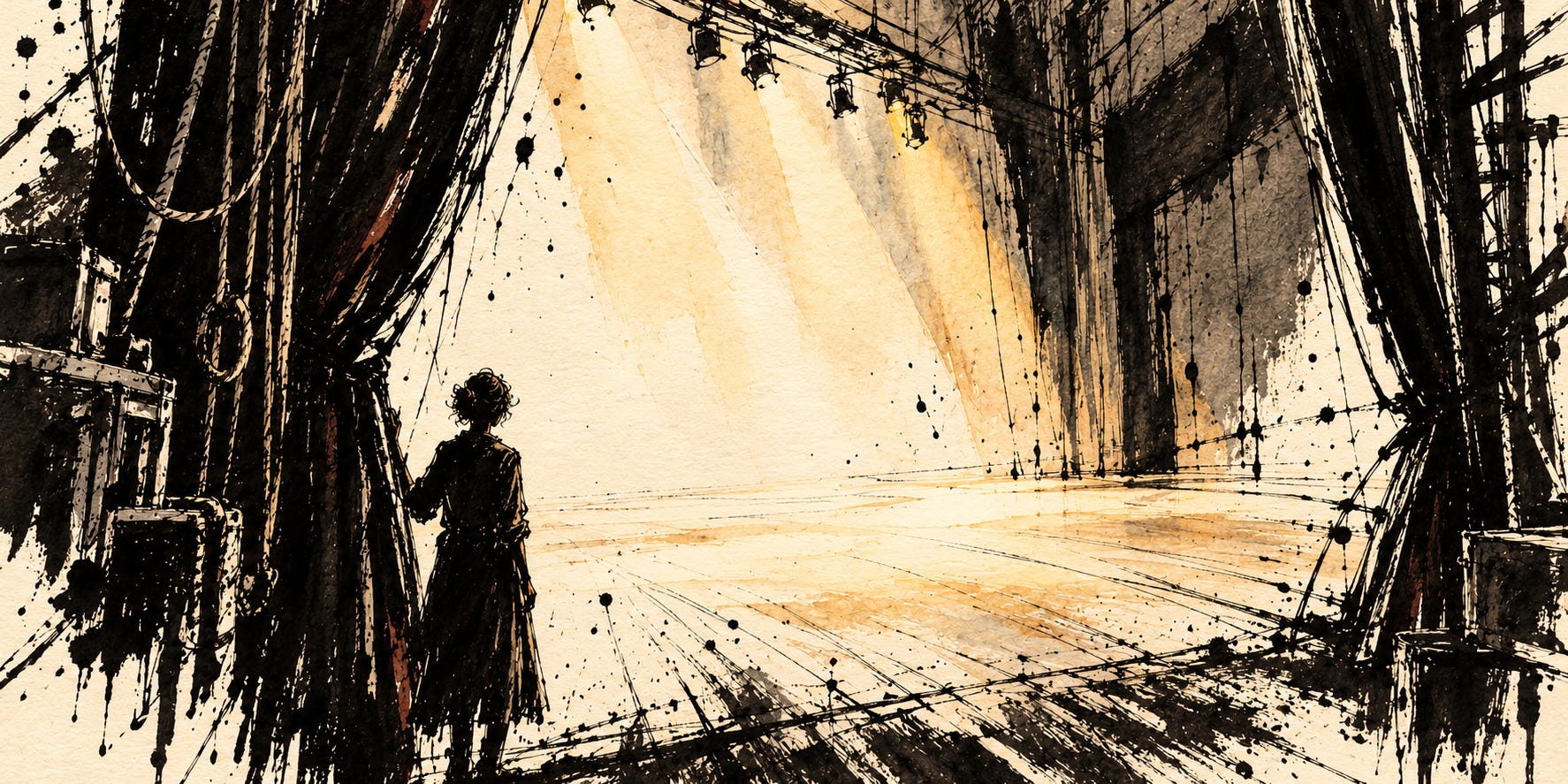
After my second theatrical production using AI for projection art, I gave a practicum lecture at the local college on AI’s encroachment into the arts.
A student asked me, “What hope do we have as we graduate into this world?”
I told her I couldn’t give her hope. But I could say that her point of view was what would carry her through.
I’ve thought about that answer for years.
Developing a point of view takes practice. You make things. You discover what matters to you, what you keep returning to, what you can’t quite say yet.
You need time to become someone whose perspective is recognizably your own.
I worry about people standing at the beginning of that journey deciding there’s no reason to take it. Agreeing that all the prizes have already been claimed.
I want them to begin. I want to see what they’ll make.
—
By the time I gave that lecture, many people were still associating AI art with fever-dream images, nightmare teeth and hands with too many fingers. They hadn’t yet understood how good AI art could look.
I was upfront and honest with the production teams, but I suspect the audience had no idea how those images were made.
So this is personal.
The disapproval I felt was mostly in whispers and looks from members of the production staff. I can tell you how those landed on my ego. I can’t tell you exactly what each person was thinking.
And that student’s question deserves a careful response. There’s a lot of fear inside “What hope do we have?” Especially when you’re preparing to enter a field you’ve spent years learning to love.
But I worry about the way fear becomes contempt, and contempt becomes permission to dismiss anyone who engages.
The chorus can sound coordinated even when nobody’s necessarily conducting. People learn which tools invite suspicion, which admissions require a defense. Eventually, the condemnation does its work before anyone has to say a word.
Who wants to begin a creative journey under those conditions?
—
Art felt like something we could confidently call ours.
We use it to express our internal worlds through whatever faculties we were born with and whatever skills we’ve managed to acquire.
Countless hours of practice. Actually, we do like to count them. Ten thousand hours, right? A reassuringly large number between wanting to do something and earning the right to be good at it.
Then AI attempts an image, and we laugh.
Then it gets better.
Then it gets better again, at a pace that makes our years of practice feel suddenly, painfully slow.
There are serious questions here about training data, permission, compensation, and who gets to profit. We need to work through them. Making something available on the internet doesn’t magically settle every claim someone might have over its use.
But we also need to examine what happens when the discovery of a tool changes our judgment of the person using it.
What did we admire before we knew?
What disappeared when we found out?
I see a related tension in math.
A math proof can do more than establish that something is true. It can help us understand why. There’s beauty in an argument that makes a difficult idea suddenly feel inevitable.
Of course we want that. We’re humans. We demand elegance all the way down.
But suppose a machine helps produce a valid answer through a route that’s cumbersome, opaque, or aesthetically disappointing.
We still have to check it. And even if the proof holds, we may still want a better explanation. A worthwhile desire for an understanding of the meaningful beauty that builds our universe.
Art and math may have different standards of success. But both force us to ask:
How much of the value belongs with the result?
How much value is derived by the process?
How much that influences our picture of the person presenting the work?
When I was a kid at the arcade, I figured out how to slowly, patiently extract additional tickets from a skeeball machine.
Constant, steady pressure.
Sure, you gave me one ticket. But I’m taking twenty.
I was an enterprising youngster.
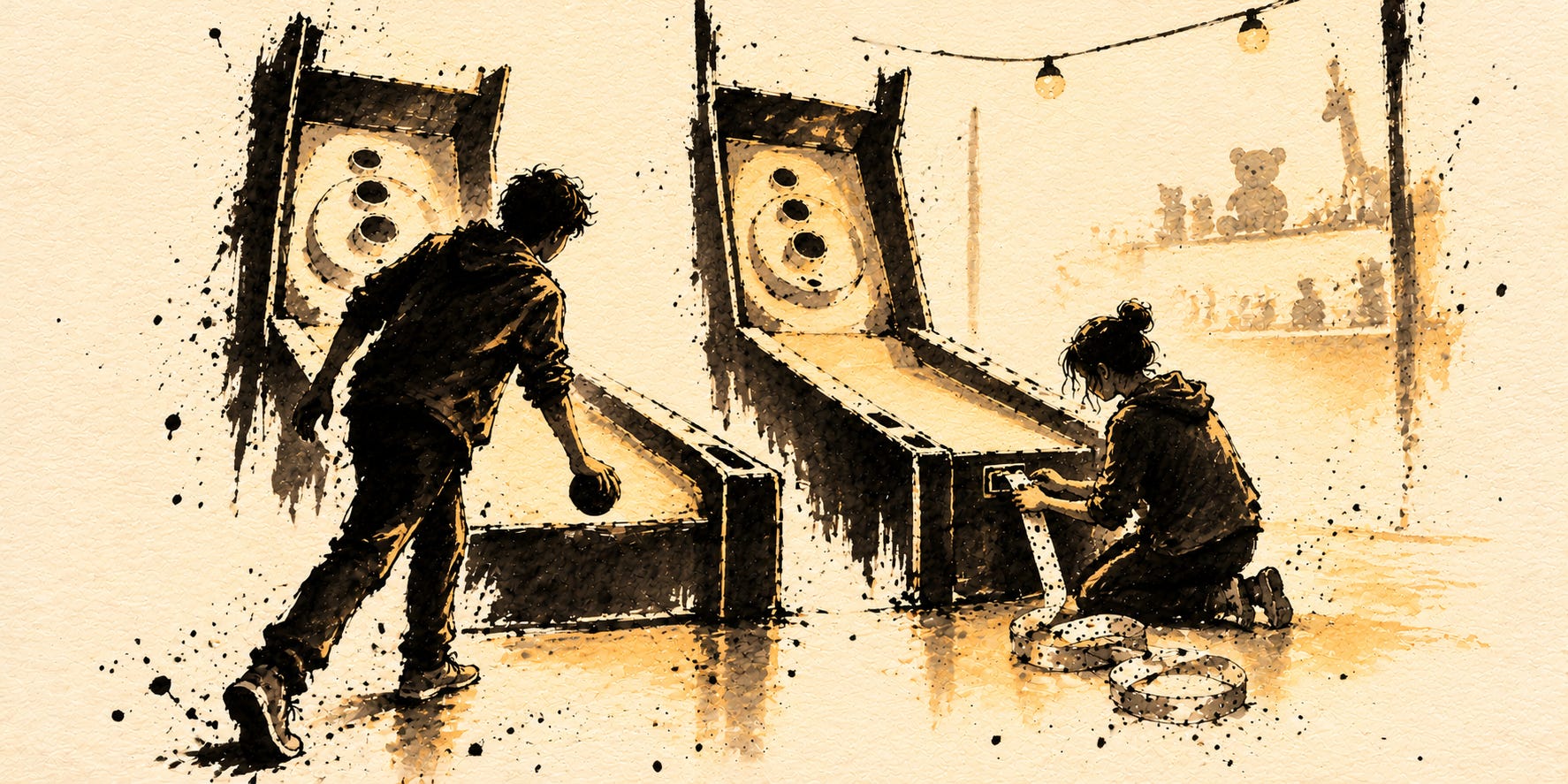
If the toy behind the counter cost twenty tickets, I only needed to earn the first one. I’d make up the rest.
To the other kids still throwing balls, that would look like cheating. Fair enough. I was bilking the machine.
But I think that feeling helps explain some of the reaction to AI. You’ve been practicing your throw. Learning the angle. Getting better. Then someone else walks up and starts pulling tickets.
They’re already choosing a prize.
If victory is quantified, someone will find an unexpected way to make ends meet. And when they do, we discover how much we cared about the route we took to get there.
Sure, a ticket machine has rules. And art has arguments about what the rules ought to be. Math requires valid reasoning, even when it is a bit unconventional.
Still, the feeling is familiar: I’m doing all this work. How can you already be standing there?
The sting of wasted effort. The fear that everything we’ve learned might no longer earn us a living. Failure, perceived and seemingly permanent.
The “why bother?” trap at the start of any journey.
It’s all buzzing loud in everyone’s ear. And it’s deafening to those who have little room to live with that uncertainty.
I’ve been walking my own creative path for more than twenty years. I also have a day job. My livelihood doesn’t depend on every creative skill continuing to hold its market value, and that gives me room to experiment that others may not have.
I can tell that student what has sustained me. I can’t ask her to trust the footing at the start of her trail just because I’ve found some farther along my own.
We’re mosaics made from pieces of happenstance and design. We become sedimentary layers on the mountain of progress.
We learn through other people. Their work changes what we can imagine. Their discoveries become the ground beneath our feet.
And we spend our lives assembling influences into something we hope will be recognizably ours and provide sure footing for others.
That doesn’t erase anyone’s labor or make every use of it fair. But it does make me cautious about treating human creativity as though each glimmer emerged in isolation.
Silicon is our cousin.
A strange cousin, sure. One that was built through our accumulated knowledge, now doing things that unsettle our understanding of ourselves.
But right now, we have an opportunity to shape its capacity and its place in the world. That means deciding what we reward, whose experiences we include, what we refuse, and where we insist on human judgment.
It means bringing our understanding of beauty, right, wrong, love, and mourning into the work.
We’re here to give it its heart.
That takes participation. Discussion. Even criticism. We need people who care deeply about art, education, labor, and human dignity to have a hand in shaping these systems.
Condemning those who dare engage makes that harder.
—
I keep returning to the student at that lecture.
I still can’t give her hope as though it’s a prize I’ve managed to pull from a machine.
And I can’t promise her that a distinctive point of view will guarantee a living. The world owes her more than a pep talk about being herself while the ground shifts beneath her.
But I want her to have the chance to discover what she sees.
I want her to make things, encounter resistance, change her mind, surprise herself. I want her to find out what these tools can do in her hands. And I want her to decide for herself where they belong.
Our greatest communal creation needs us. So do the people growing up alongside it.
Let the machine change what intelligence can accomplish. We’ll have plenty to reckon with as it does.
Please keep making things.
We haven’t heard from you yet.
Author’s note:
This essay began with my own draft and experiences, then took shape through conversation with ChatGPT. I used it as an editorial collaborator to question the argument, develop a new draft, and refine the structure and language. I made my own revisions and the final editorial calls. The illustrations and CW mark were generated with OpenAI’s image tools through a direction-and-revision process. That collaboration feels worth making visible, especially here.