An unarmed, peaceful citizen was shot at point-blank range by a federal agent, according to publicly available footage and reporting.
Three bullets.
To the face.
That fact alone should be sufficient to anchor reality.
And yet, watching the same footage, people arrive at radically different conclusions. Not just different opinions, but different worlds. The divergence isn’t happening downstream of interpretation anymore; it’s happening at the level of perception itself.
That’s what frightens me most.
We’ve entered a moment where violence is no longer just an event.
It’s a narrative substrate.
This harm doesn’t end with a single act. It continues in how the act is framed, circulated, clipped, captioned, and emotionally optimized.
Identical evidence now produces mutually exclusive moral realities depending on where the observer sits.
This isn’t debate.
It’s epistemic fracture.
And fracture creates opportunity.
When our shared interpretation collapses, urgency becomes a weapon. Outrage becomes a delivery system. People are pushed to act now, think later. Not always because action is required, but because speed prevents individual coherence of thought.
Third parties can and do find ways to benefit from that acceleration, even when the anger itself is justified.
I want to be clear: anger is valid here. I would never deny it.
Anger is often the first honest response to injustice.
But anger is catalytic, not architectural.
It burns fuel.
It doesn’t design load-bearing structures.
The question isn’t whether anger is warranted.
It’s whether it’s being used and by whom.
What worries me is how murky the near-field has become.
When everything feels urgent, nothing can be coherently contextualized.
When every moment demands immediate response, reflection is reframed as complicity, and reaction is rewarded as righteousness.
That’s a dangerous incentive structure.
It’s one that quietly neutralizes people who might otherwise slow things down enough to see what’s actually happening.
In my life, I’ve spent a long time thinking about “what’s next.”
Lately, I’ve wondered if that’s avoidance, or ego, or a misplaced desire for relevance. But I’m starting to think it’s something else entirely: a reflex toward stewardship in a moment where the system itself is failing fast.
There’s a real pressure to perform something of impact (to be visible, decisive, on the front lines). But I can’t ignore how tightly that pressure aligns with the same metrics that already distort our sense of worth: shares, likes, outrage velocity.
Are we primed to mistake reaction for agency when moral seriousness is measured by immediacy?
Are we meant to midwife the emergence of something new here? Or are we just here to absorb the trauma of this collapse?
I don’t think we solve this by merely replacing individuals in power, without changing the structures they inhabit. I’m increasingly convinced it’s the nature of power (centralized, accelerated, insulated from consequence) that keeps reproducing the same outcomes. History repeating itself. Rhyming. Returning.
We talk about control and security as prerequisites for a stable future, but those very instincts may be what prevent the resilience and broad participation that will create the next world.
So what’s useful now?
For me, it looks like this: thinking carefully.
Naming manipulation without flattening grief.
Refusing to let moral complexity be edited out of the frame.
Creating friction where the existing system demands speed.
Holding space for anger without letting it be conscripted.
Sense-making, in moments like this, isn’t passive. It’s resistant. It’s friction.
And friction is often what prevents a runaway system from tearing itself apart.
If the near-field is where we’re most easily confused, where narratives are weaponized and urgency is manufactured, then clarity becomes a form of rebellion.
Not certainty.
Not answers.
Just the discipline to ask better questions before moving.
These are dark times.
But we need more than light; we need orientation.
One careful step at a time.
Author’s note
This piece was developed with the assistance of generative AI as a collaborative thinking partner. I used it to pressure-test language, clarify structure, and refine the framing of ideas around narrative acceleration, urgency, and sense-making. The AI helped me identify where precision mattered most, stress-test phrasing for misinterpretation, and tighten the essay without diluting its moral gravity.
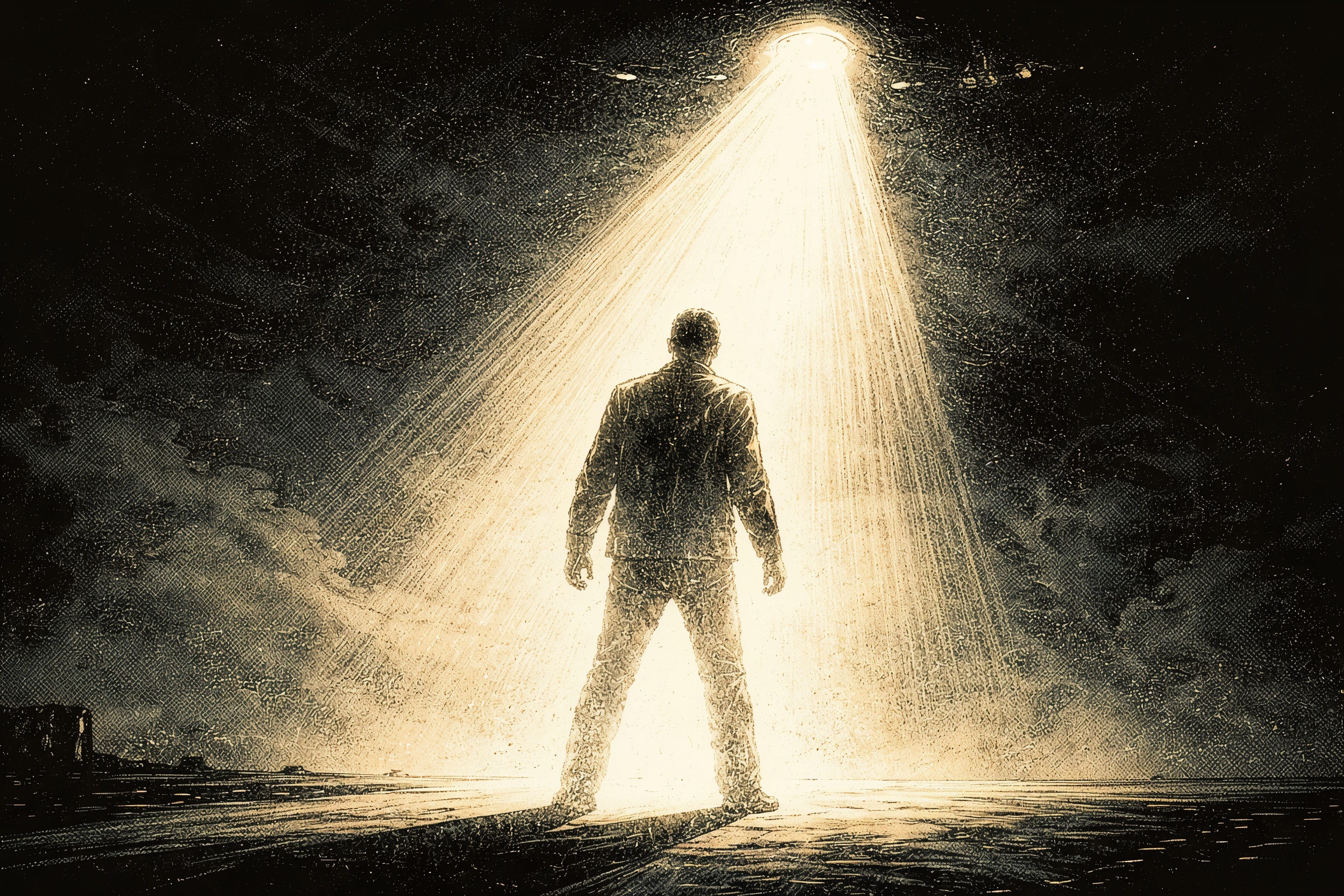
The accompanying imagery was also created through an AI-assisted process, guided by detailed art direction rooted in my longstanding pulp and noir visual style. The goal was not abstraction or spectacle, but a grounded visual metaphor that mirrors the essay’s themes of visibility, power, and interpretation.
All perspective, judgment, and final decisions remain my own.