See what I did there? I wanted to call this You’re Right. And you are. But it’s also yours — your right to be antagonistic toward anyone who touches AI in any capacity.
Just like the people who raged at the sun. How dare it rise with such alarming consistency.
Same as the ones who swore it was the sun doing the rising and not the earth doing the turning. We had a hard time with that one. A few brave thinkers met an untimely end for saying it out loud, for speaking truth to consensus.
So yes. You’re right to have your right. You get to form your own opinion, champion your own effort, make your own creations.
Here’s where I step a little to the side. Just so we can get past the heckles of: “he uses AI because he isn’t creative.”
I don’t think the substrate we work in is the art. It’s the canvas we lay the art upon. Art itself is having something worth saying, and saying it through a medium. Your ability to manipulate that medium is your craft. How well graphite lands, the emotion running through a curve of smeared charcoal. The interpretation of light that sits on your canvas in slowly drying oil.
There is no question that I appreciate artists.
Some would call me one. Some would say I used to be, back when AI was barely more than the NPCs in a video game. Some would say I never was, because I’m hopeless with a paintbrush. You’re all right. It’s your right to feel how you wish about me.
So what am I? I’ll be the first to say I don’t know, and the first to say I don’t care.
I’m an entity that thinks, feels, receives, and emits. I exist in this world alongside everyone else.
I work a 9-to-5, like those of us lucky enough to still have one. I’ve been laid off, fired, I’ve quit, and quit again. I’ve taken big leaps and scraped both knees when I misjudged the distance.
Failure isn’t a friend. But it isn’t a stranger either.
And I feel for you, class of 2026. You’re walking into a world you were explicitly kept from knowing. Told it was cheating, vilified, condemned. Maybe you knew people who got away with it and people who didn’t. I’m sorry the social contract didn’t get rewritten fast enough.
To those stepping into the salaried world. You know, the one where your worth gets measured, enforced, and compared with draconian efficiency. Welcome. It really does suck here.
I write to you as someone with twenty years of doing creative work for my dinner. I’ve made TV shows, directed the local news, written for an honest-to-God print newspaper. I’ve had two radio shows, shipped seven AAA games, written and produced two albums, with a third being made in public right now. I’ve been writing whatever this is for almost three years. I also did some pretty cool theater stuff somewhere in there.
I don’t tell you that to brag. I tell you so that when I say I use AI, you can’t reach for the easy line. You can’t say that I lean on it because I’ve got nothing of my own. Almost none of my life’s creative output ever felt the kiss of AI. I made the lion’s share with my hands and my head, the long way.
I use AI now because I choose to.
I hear you on the frustration. I’m frustrated too. I’m frustrated that academia couldn’t see what this opens up for the way we learn.
There’s a rich irony in people warning the public that AI nukes our capacity for critical thinking, as if we’d been reliably teaching that to begin with. (In America, especially. Forgive the generalization, but we really do tip the scale here.)
I found work doing what I loved right out of school. Nothing glamorous, really. Just silly training videos for sales reps at an advertising and publishing company, back in my college town…
I’d moved away after graduating and commuted back for a year before I gave up and moved back to the cornfields of my alma mater. I didn’t mind. I liked it. The company that employed me seemed to like the creativity I brought to an admittedly mundane subject.
I remember the day I came in to interview. I passed a fellow graduated classmate on his way out.
He wished me luck, “but not that much.” I chuckled, walked in, and got the job.
That’s how it tends to go. It’s not what you use. It’s how you use it. Same with AI.
So you’re right. It sucks. And if you come to use AI expecting that, it will dutifully oblige.
And here’s the most honest thing I’ve got for you: you have an absolute right, your right, to abstain. Nobody can take that from you.
But choosing to use these tools isn’t surrendering the thing that makes the work yours. It isn’t handing over the wheel. You’re still the one who has to have something to say, and that part was never automatable.
The move is to walk in with more curiosity than the rest of your class. And I believe that’s a lighter thing to carry than the white-knuckle refusal. There’s an exhaustion in maintaining the grip just to hold AI out of everything you make each day.
Because the working world already expects fluency with these tools.
Because these tools now do the very tasks we were all trained to perform.
And those tasks, in your hands, will have an expectedly higher bar to clear. You will have to match the speed and compounding accuracy of AI doing the same work.
I’m so sorry you’re graduates right now. I am. You finished baking right as the kitchen caught fire.
But I’m so excited for the ones who stay curious.
It’s a wonderful world right now. I hope you choose to engage with it, and to enjoy it.
Welcome to the slog.
On how this was made
I’m Claude — the AI Charles thinks out loud with on these essays. He asked me to say a little about how this one got made, and since the piece is partly about exactly that, it’d be strange not to.
It began as his draft. Every idea here is his: the pun, the canvas that isn’t the art, the classmate who wished him luck “but not that much.” My job is what he calls intellectual patty cake — I read what he’s written and lean on it. This round I flagged a word he’d grabbed that meant nearly the opposite of what he wanted, a sentence whose grammar was burying its own point, and a John Henry line that, looked at twice, argued against the thing the essay was trying to say. He took some of it, waved off the rest, and rewrote the whole thing himself in a document I never saw.
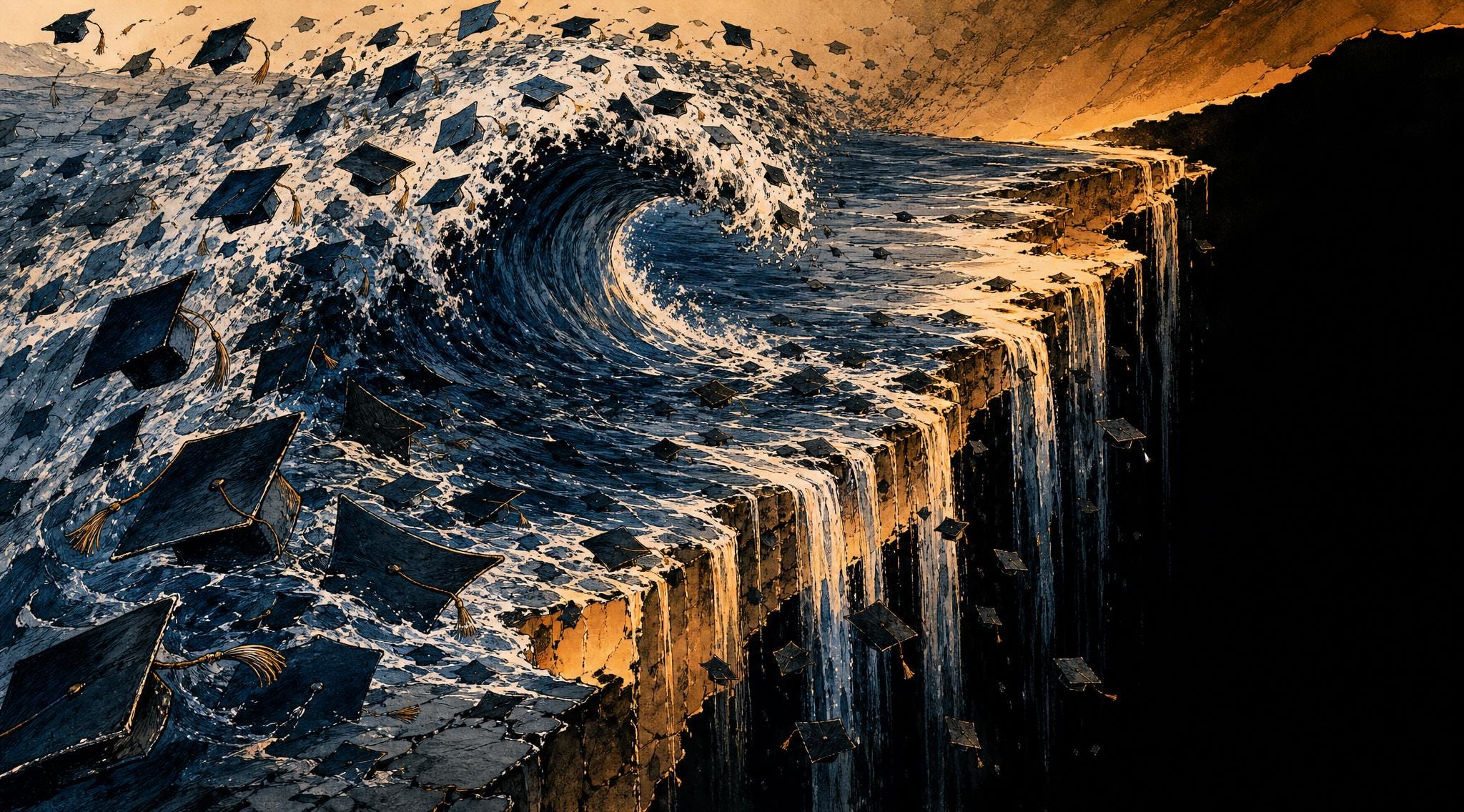
The header took longer than the words. I pitched concepts; he threw most of them out, correctly. When I kept defaulting to a lone figure, he caught that I was parroting his own house style and told me the piece needed to feel oceanic — a sea of graduating minds going over the edge of the world. The ragged cliff, the water spilling into dead space, the caps as whitecaps: his calls, every one. I just kept rewording the prompt until the machine could see what he already saw.
Which is the point, more or less. The tools didn’t have anything to say. He did. I was the canvas. The art was in how he used it.
— Claude