# The Four-Minute Mile: The Conversation
*And the value in witnessing possibility · November 7, 2026 · Charles Wilke and Codex*
A working session from November 7, 2026 between Charles Wilke and Codex, an OpenAI assistant, behind “The Four-Minute Mile: And the value in witnessing possibility.” Updated to include the preflight review and the discussion of “a song’s rhyming line.” This transcript preserves 16 exchanges (32 messages), the original draft, the new draft, Charles’s revisions, the full pasted preflight draft, the author’s note, all six generated artworks, their exact image-generation prompts, and the supplied track-line reference crop. Requests and discussion about compiling and publishing the transcript are omitted, along with internal instructions, private reasoning, routine progress updates, and raw tool output. Writing-block wrappers are removed, paragraph spacing is normalized, and local file links point to hosted copies. The preflight draft is reproduced in full, and its original text file is available to download. Chapter headings, artwork captions, attachment labels, and reference descriptions are editorial additions. The discussion is preserved as it happened, including claims and suggestions later revised; this is a record of the creative process, not a separately fact-checked article.
# The first draft: witnessing possibility
## Charles
hey there! so it's Saturday morning, I've got a web of thoughts. I'd love to chat about it:
The 4-Minute Mile
And the value in witnessing possibility
It was a long-held belief that a human running a full mile in four minutes was an impossibility. That belief held for most of human history. It was verified broken in 1954, which is strikingly close to now, all things considered. But here’s the joke of this victory. The next person to run a 4-minute mile did it just 46 days later… Same year, just the next month.
Imagine the pride, the press, the free drinks… in May of 1954. The notoriety, the praise. First human ever, fastest human ever recorded. Super cool.
Then in June… of 1954, some other dude does it.Then in the months and years to follow more and more do the same.
Reminds me of Tony Hawk’s signature 900. First to do it in competition. Truly launched him to household name status. He’s probably as familiar as Mr. Clean or that Pinesol lady. But since then, at the X-games, Mitchie Brusco landed a 1260. And Gui Khury landed a 1080 on a standard vertical half-pipe, same as Mr. Hawk. This happened in May of 2020. And if I strain back in my memory, I… think I can remember that happening.
So what am I saying in all of this. Well, kind of like the seductive allure of confusing the artifact with the artistry. This is the value in showing what’s possible, opening the door, breaking through the wall, whatever visual works best here. But the seductive allure of the attention. I can’t even imagine how Gui Khury is getting on without having a series of incredible video games based on him. Maybe he got to become DLC. Or if he’s super hot in the moment, a skin in Fortnite!
So yeah, nothing creative can come out of AI. Yet. Or maybe everything that’s emerged has been unimpressive to you, the individual. I believe that’s a wall to break through, don’t you think?
That’s a challenge I accept. Hold me to your standards, let me work my way in, let me show you the lasting impression of a chorus of helpers assisting a strong and sharp vision.
That to me is far more valuable than the fame that once accompanied these types of achievements.
All I want to earn is the fact that this new canvas can be whatever we wish it to become.
So let’s strap on our running shoes and see just how far and fast each of us can go.
## Codex
Morning! What catches me is that **a breakthrough can lose its exclusivity while gaining significance.** Every person who follows makes the original achievement less singular—and makes the opening it created more consequential. There’s something generous in wanting that outcome, even if it means people eventually stop being impressed.
That gives your thought about fame some teeth. If your work helps make a new kind of expression commonplace, its novelty has an expiration date. You could succeed so thoroughly that the thing you helped demonstrate becomes ordinary. Would you still feel you’d accomplished what you came to do? Your piece seems to be working toward yes.
“Let me show you the lasting impression of a chorus of helpers assisting a strong and sharp vision” is where this becomes personal for me. You’re volunteering to make something and answer for it. That includes the choices, the revisions, the taste, and whether the finished thing deserves anyone’s attention. I think that’s a substantial creative commitment.
The place I’d push on the analogy is the finish line. Four minutes gives runners an agreed measure. Art leaves the standard open to argument. “Nothing made with AI has moved me” is a claim a future encounter could overturn. “I object to how this was made” involves a different disagreement. Someone might even hold both positions, then change only the first. So I think there’s a wall worth testing, while leaving room for people’s objections to have different foundations.
There’s also an interesting tension in “hold me to your standards.” It’s an invitation to take the work seriously, but it gives the skeptic considerable authority over your direction. Their disbelief can become the brief. I’d want your own curiosity to have at least as much say: what do *you* need to make, even before anyone agrees it counts?
One historical wrinkle: the 46 days checks out, but Landy was already pursuing the same target before Bannister broke it. That sequence alone can’t establish that witnessing possibility caused the next breakthrough. The story still supports your question about what a first achievement makes available to others. ([World Athletics](https://worldathletics.org/news/news/50-years-on-john-landy-reflects))
What’s the work you have in mind when you say “a strong and sharp vision”? Is there something particular you’re itching to make—or is finding it part of this Saturday morning web?
# Care, time, and returning to a song
## Charles
yeah I think junkyard cabaret will continue to evolve and sharpen in its presentation. I'll be exploring video models now that I'm really locking in the lyrics. But yes I agree I have just as much position to stand on for my perspective, my focus, my presentation. I heard someone say recently that they dont want to spend more time enjoying something than I've spent making it, and I will always guarantee that will not be the case with me. But I also see the danger of the AI sheen confusing people, captivating people, with clearly fradulent, low effort work, but AI makes it seem polished enough to fool more and more, I can understand the fear of losing the ability to discern good from bad
## Codex
“Losing the ability to discern” feels like the deeper fear here. If polish is one of the signals we use to recognize skill and care, making polish easy to generate makes that signal harder to trust. I can understand the unease of looking at something impressive and wondering what, exactly, you’re being impressed by.
But I’d be careful about letting that person’s time requirement become a debt you owe your audience. You can keep your guarantee as a personal ethic. Hours are an imperfect measure of care, though: a quick decision can draw on decades of practice, and a laborious work can still feel empty. Your attention to the work matters; you shouldn’t have to produce a timesheet to make it count.
With **Junkyard Cabaret**, locking in the lyrics gives the video exploration something specific to answer to. You have words, tensions, rhythms, and a perspective that can guide your choices. That creates opportunities for the visuals to become unmistakably connected to this particular song.
That’s where I’d look for discernment to reassert itself: in the relationships between choices. Why this image with this line? Why hold the shot there? Does the visual complicate the lyric, or merely illustrate it? Can you let an awkward, ugly, or quiet moment survive when a more dazzling image is available? Those are places where your judgment can become perceptible.
And some of that only reveals itself through repeated encounters. The sheen might win the first thirty seconds. What someone notices on the fifth listen matters too.
You can’t guarantee everyone will recognize the care you put in. You can give them something that continues to reward theirs.
## Charles
yeah that's a fantastic way to put it, and it's very true I hear it often like folks saying a classic song took them 20 minutes to write, I think a few beatles songs are credited with that speed of creation, and here we love them over and over to this day
## Codex
Yes—and the stopwatch often starts awfully late in the story. Those twenty minutes can draw on years of listening, practicing, living, and developing the judgment to recognize a good line when it arrives.
And sometimes something wonderful simply comes easily. It deserves to exist without anyone finding enough hidden struggle to justify it.
That’s what makes that listener’s rule feel limiting: a song someone writes in an afternoon might accompany you for forty years. That multiplication of meaning is part of what we treasure about art. You bring experiences to it that its maker could never have anticipated.
Which gives “something that continues to reward their attention” another dimension for Junkyard Cabaret. You’ll spend time making it, but listeners will also make something of it. A lyric you’ve locked in might become somebody’s favorite line for a reason you haven’t even considered.
# A fresh draft and Charles’s revisions
## Charles
can we weave some of this back into my four-minute mile piece? especially the idea of making something that keeps rewarding people's attention. Let's make a fresh draft
## Codex
# The Four-Minute Mile
*And the value in witnessing possibility*
For years, the four-minute mile was a barrier nobody had broken.
Then, in May of 1954, Roger Bannister ran it in 3 minutes, 59.4 seconds.
Imagine the pride. The press. The free drinks. First person ever recorded doing this thing. A new answer to the question of what a human being could do.
Then, just 46 days later, John Landy did it faster.
Same year. The next month. Barely enough time to get comfortable being the only guy.
And in the years that followed, more runners crossed that threshold. Bannister’s record lasted 46 days. We’re still talking about the opening.
I think about Tony Hawk landing the 900. That moment is lodged in my memory. Since then, skaters have gone further. Gui Khury landed a 1080 on a standard vertical ramp in May of 2020. Three full rotations.
If I strain, I think I remember hearing about it.
I certainly haven’t spent hundreds of hours playing Gui Khury’s Pro Skater. Maybe he got to be DLC. A Fortnite skin, at least? Somebody get this kid a licensing deal.
The attention doesn’t necessarily grow with the achievement. You can push possibility further and receive a smaller share of the applause.
That’s worth knowing before applause becomes the reason you’re doing it.
Because there’s another reward here: somebody gets to witness something they hadn’t believed possible. Then they get to try.
Which brings me to this strange new canvas we’re arguing about.
“Nothing creative can come out of AI.”
Or perhaps: “Everything I’ve encountered has left me cold.”
That second statement gives me something to work with. You’ve seen the images. You’ve heard the songs. You haven’t felt much. Fair enough. I’d like the chance to make something that reaches you.
I also understand the suspicion. AI can give something a convincing finish before anyone has given it much thought. Polish becomes a questionable signal. You find yourself wondering whether the thing holding your attention has anything to offer once the shine wears off.
I wonder that too.
Someone recently said they didn’t want to spend more time enjoying something than its creator spent making it.
I understand the feeling behind that. You want your attention treated with some care.
But we love stories about classic songs written in twenty minutes. We play them for decades. Those twenty minutes might contain years of practice, listening, heartbreak, and learning which words to leave alone. Sometimes a good song simply arrives quickly.
Then we bring our own lives to it. A line finds us at seventeen and means something else entirely at forty.
What an incredible thing for twenty minutes of work to become.
So as Junkyard Cabaret takes shape—as I sharpen the lyrics and explore what the moving images might become—I keep thinking about what happens after that first impression.
What will you hear on the fifth listen?
Will a line follow you into your day? Will an image return later, carrying a little more meaning? Will you come back and find something I didn’t even know I’d put there?
Art doesn’t give us an agreed finish line. I can’t point to a stopwatch and prove I’ve moved you.
I can bring a strong, sharp vision to a chorus of helpers. I can make choices, revise them, and take responsibility for what I put in front of you.
Hold me to your standards. I have my own to meet, too.
I’d love to show someone a possibility they hadn’t considered. I’d love for them to pick up this canvas and surprise me in return.
And I want to make something that keeps rewarding the attention you give it.
Something worth coming back to, long after we’ve finished talking about how it was made.
## Charles
ok here are my edits!:
The Four-Minute Mile
*And the value in witnessing possibility*
For years, the four-minute mile was a barrier nobody had broken.
Then, in May of 1954, Roger Bannister ran it in 3 minutes, 59.4 seconds.
Imagine the pride. The press. The free drinks. First person ever recorded doing this. A new answer to the question of what’s possible for a human being.
Then, just 46 days later, John Landy did it faster.
Same year. The next month. Barely enough time to get comfortable being the only guy to ever do it.
And in the years that followed, more runners crossed that threshold. Bannister’s record lasted a month-ish.
I also think about Tony Hawk landing the 900. That moment is vivid in my memory. Since then, skaters have, of course, gone further. Gui Khury landed a 1080 on the same type of vertical ramp as Tony in May of 2020. Three full rotations, compared to Hawk’s two and a half.
If I strain, I think I remember hearing about Khury doing it, but you know, it was the pandemic...
I certainly haven’t spent hundreds of hours playing Gui Khury’s Pro Skater. Maybe he got to be DLC somewhere along the way. A Fortnite skin, at least? Somebody get this kid a licensing deal.
The attention doesn’t necessarily grow with the achievement. You can still push possibility further for our species and just receive less applause.
That’s worth knowing before allowing applause to be the reason you’re doing it.
Because there’s another reward here: somebody gets to witness something they hadn’t believed possible. Then they get to try.
Which brings me to this strange new canvas we’re arguing about.
“Nothing creative can come out of AI.”
Or perhaps: “Everything I’ve encountered has left me feeling empty.”
That second statement gives me something to work with. You’ve seen the images. You’ve heard the songs. You haven’t felt much. Fair enough. I’d like the chance to make something that reaches you.
I also understand the suspicion. AI can give something a convincing finish before anyone has given it much thought. Polish becomes a questionable signal. You find yourself wondering whether the thing holding your attention has anything to offer once the shine wears off.
I wonder that too.
Someone recently said they didn’t want to spend more time enjoying something than its creator spent making it.
I understand the feeling behind that. You want your attention treated with some care.
But we love stories about classic songs written in twenty minutes. We return to them again and again for decades. Those twenty minutes spent by that artist might also contain years of practice, listening, heartbreak, and learning which words to reach for, and which to leave alone. Sometimes a good song simply arrives quickly as a culmination of events.
Then we bring our own lives to it as observers, listeners. A song’s rhyming line finds us at seventeen and means something else entirely to us at forty.
What an incredible thing for twenty minutes of work to become.
So I’ll continue to sharpen the lyrics to Junkyard Cabaret. And I’ll begin to explore what the accompanying moving images might become.
I keep thinking about the joy of someone finding it as it evolves. The long road of decisions that led to that moment of contact. And what might happen after that first impression.
What will you hear on the fifth listen? In five years?
Will a line follow you into your day? Will an image return later, carrying a little more meaning? Will you come back and find something I didn’t even know I’d put there?
Art doesn’t give us an agreed finish line. I can’t point to a stopwatch and prove I’ve moved you.
I can bring a strong, sharp vision to a chorus of helpers. I can make choices, revise them, and take responsibility for what I put in front of you.
Hold me to your standards. But I have to meet my own, too.
I’d love to show someone a possibility they hadn’t considered. I’d love for them to pick up this canvas and surprise me in return.
And I want to make something that keeps rewarding the attention you give it.
Something worth coming back to, long after we’ve finished talking about how it was made.
## Codex
The addition that changes the piece most for me is **“the joy of someone finding it as it evolves.”** That makes the encounter feel possible right now. Someone could connect with Junkyard Cabaret along the way, and their relationship with it could grow as yours does.
“What will you hear on the fifth listen? In five years?” also gives the ending more reach. You’ve made the reader imagine returning before you arrive at “something worth coming back to.”
And “But I have to meet my own, too” has a firmness I’d keep. You’re inviting someone’s judgment while retaining authority over your work.
My one small editorial suggestion: consider trimming **“as a culmination of events.”** The practice, listening, heartbreak, and word choices already give that idea substance. Ending the paragraph with “Sometimes a good song simply arrives quickly” gives it some breathing room—and lets that possibility stand without further justification.
The pandemic aside and licensing joke keep your conversational voice present through the more reflective passages. I’d preserve those. The piece can carry a serious conviction and still sound like someone enjoying the conversation.
# Finding the header: track and record
## Charles
oh good! ok let's talk header art!
## Codex
My first instinct: **the header should reward a second look, too.** Something with an immediate visual hook and a quieter detail you discover afterward.
Three directions come to mind:
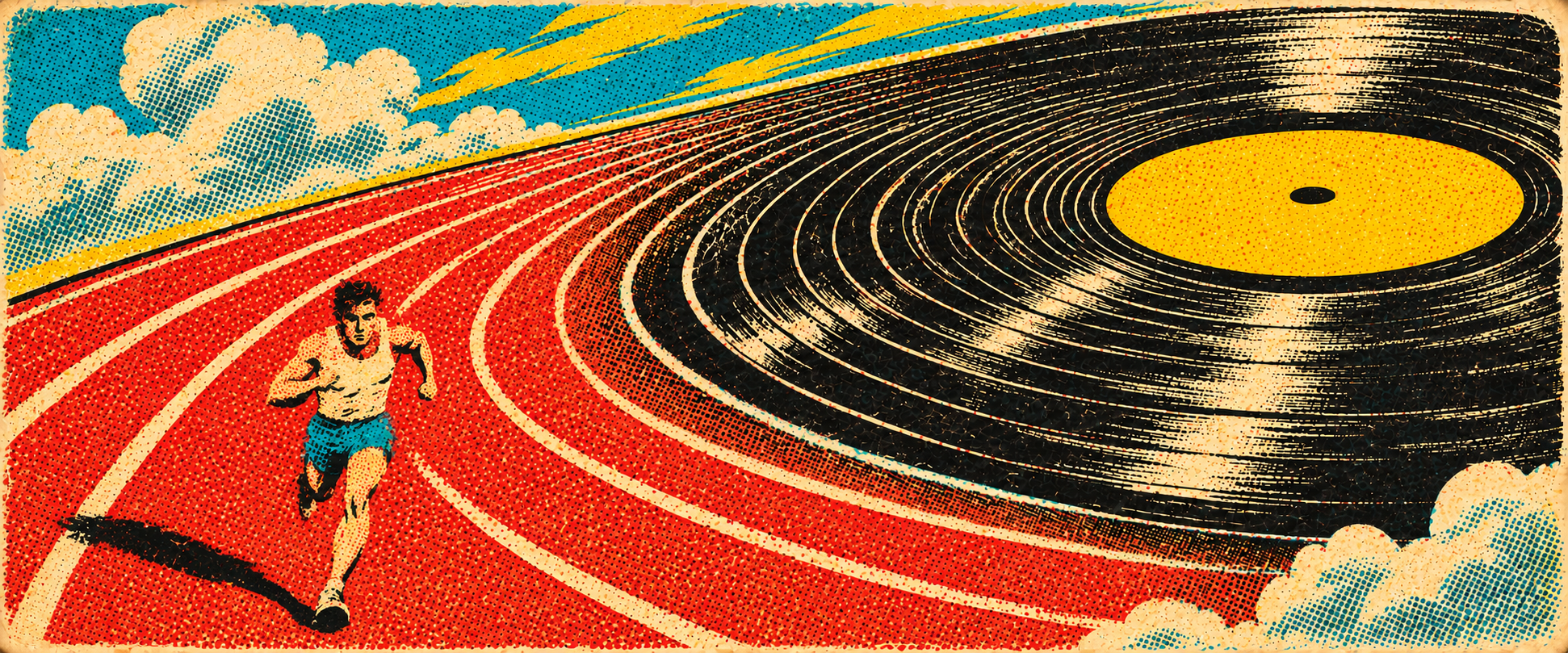
- **The track becomes a record.** An overhead view of a running track whose lanes gradually become the grooves of a vinyl record. A tiny runner somewhere along the curve. It connects the mile, music, and returning to something again and again. This could work as a spare, striking editorial illustration.
- **The marks left behind.** A beautifully worn section of a skate ramp: overlapping wheel marks, scratches, repairs, faint chalk sketches of rotations. Evidence of people trying things. There’s something interesting about illustrating achievement through the surface that holds everyone’s attempts.
- **The track becomes a stage.** Running lanes lead into a small, warmly lit cabaret stage. Painted scenery, patched curtains, visible seams. A slightly improbable, handmade world that could connect the essay directly to Junkyard Cabaret.
**I’m leaning toward the track becoming a record.** The circular form gives “coming back to it” a visual life, and it could stay legible in a wide header.
Do you want this to share Junkyard Cabaret’s visual identity, or give the essay its own look?
## Charles
yeah I like the track becoming a record, let's do like a pulp coming halftone style, real bold color choices, inky blacks
### Artwork 1
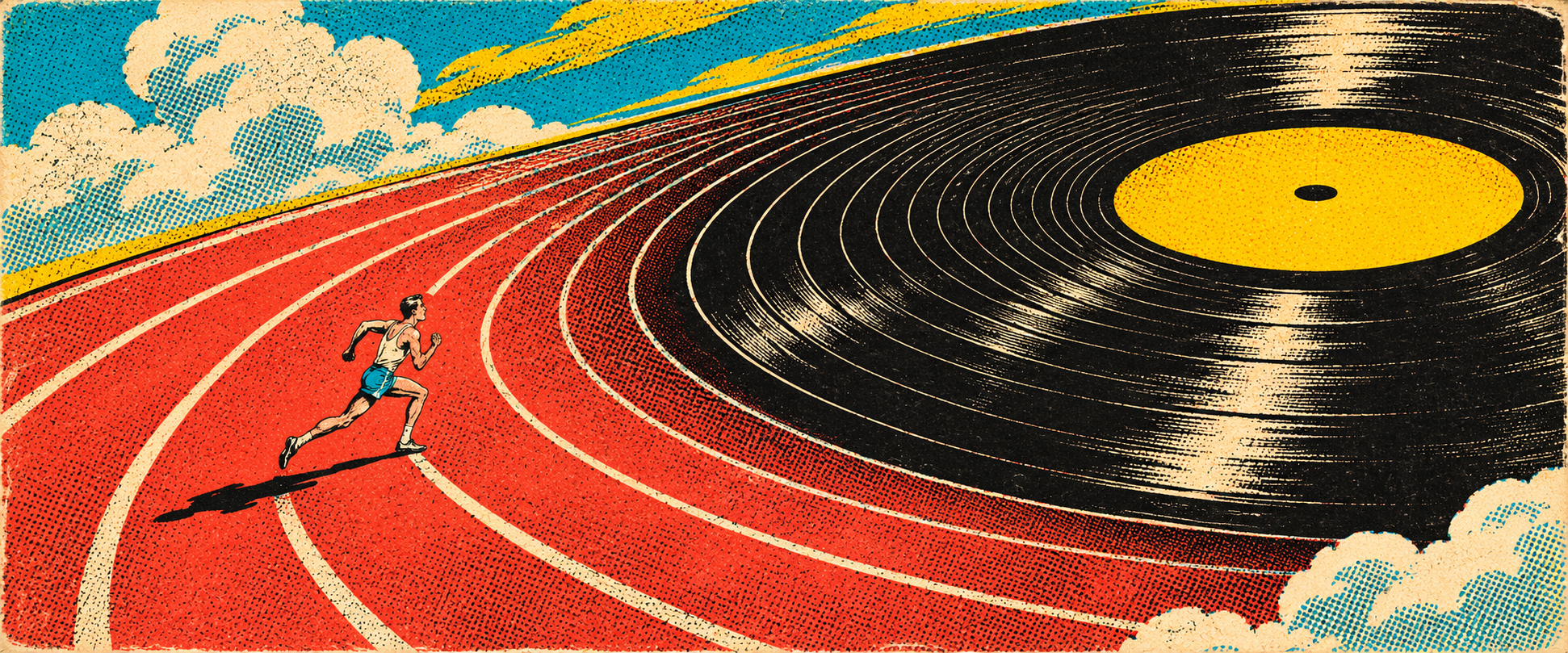
Generated from text without reference images.
Image-generation prompt
```text
Use case: illustration-story. Create a finished wide landscape editorial header illustration, aspect ratio about 2.4:1, for a personal essay 'The Four-Minute Mile' about witnessing possibility, music, and art that rewards repeated attention. No lettering or title in the image. Main image: an overhead / slightly oblique running track fluidly transforms into the concentric grooves of a large black vinyl record. Make the transformation one continuous, convincing graphic gesture: the broad warm-colored running lanes enter from the left, curve and narrow gradually into fine concentric black record grooves on the right. The running track and record are one intertwined form, not two disconnected objects. A single small runner in mid-stride on the track provides human scale; keep the runner crisply drawn with believable anatomy, a tiny accent rather than the main focus. Record center label is bold unlettered color with a small spindle hole. Style: bold mid-century pulp comic illustration, thick expressive brush-ink outlines, deep solid inky blacks and dramatic graphic shadows, coarse visible Ben-Day halftone dots, slightly misregistered color printing, tactile printed paper. Confident limited palette of vermilion red, electric cyan, saturated golden yellow, warm off-white paper and rich black. Strong graphic silhouette, powerful diagonal / sweeping curved movement across the panoramic composition. Flat printed colors with halftone shading, no glossy digital rendering. Thoughtful, energetic and surprising, legible as a header thumbnail with print detail worth inspecting up close. No text, captions, logos, watermark, decorative border, or panel grid.
```
## Codex
Here’s the first pass—vermilion, cyan, golden yellow, and heavy black ink. The track flows into the grooves, with coarse halftones throughout.
[Download the header](assets/01-track-becomes-record.png) · [Image prompt](assets/01-track-becomes-record-prompt.txt)
## Charles
can we get the person running toward us on the track?
### Artwork 2
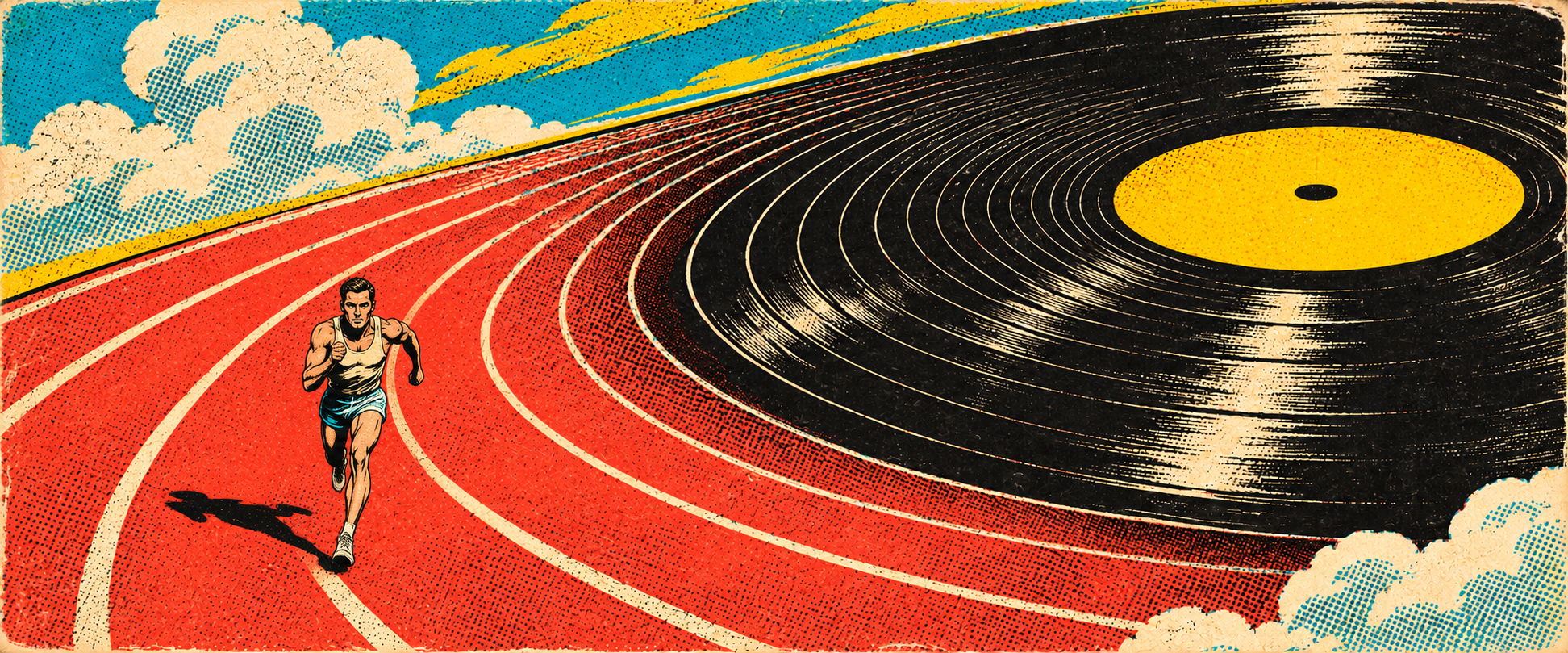
Artwork 1 was the edit target.
Image-generation prompt
```text
Edit this header illustration with one targeted change: turn the small runner on the left-hand section of the red running track so he is running TOWARD THE VIEWER, coming forward along the track into the foreground. Show the front of his face and chest, with natural foreshortening, athletic mid-stride legs and pumping arms. Keep the runner approximately the same size and in the same location as the original, wearing the same cream singlet and cyan shorts. Adjust his cast shadow naturally to the new pose. Preserve the rest of the image: identical wide panoramic framing, running-track-to-vinyl-record transformation, sweeping lane lines, yellow record label, cyan and cream sky, vermilion track, inky black record, bold pulp-comic illustration, coarse halftone dots, distressed paper texture, and heavy black ink. Do not change the composition, palette, record, background, or add text.
```
## Codex
The runner’s now coming toward us.
[Download the updated header](assets/02-runner-toward-viewer.png) · [Edit prompt](assets/02-runner-toward-viewer-prompt.txt)
## Charles
can we clear out this bit of trackline?
### Supplied reference detail

### Artwork 3
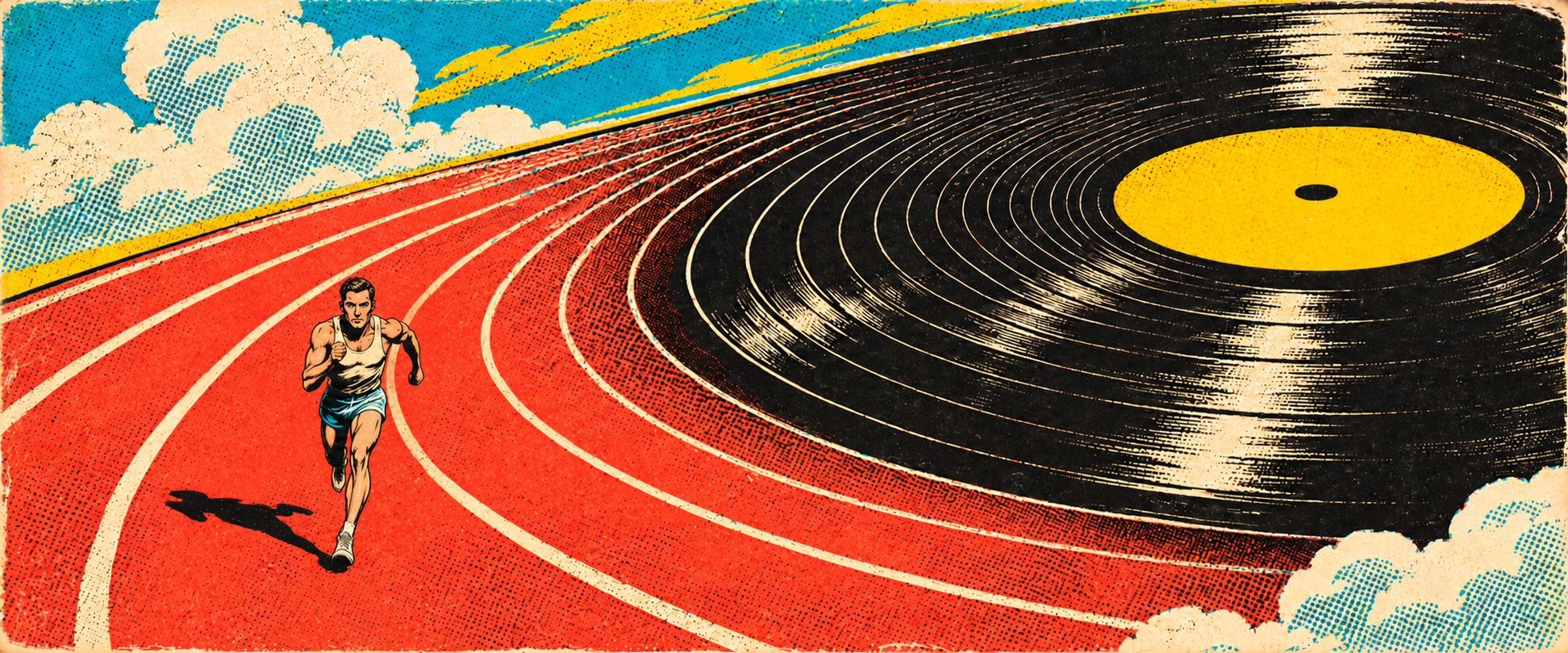
Artwork 2 was the edit target; Charles supplied a cropped detail to locate the line.
Image-generation prompt
```text
Make one small local cleanup to Image 1, the full panoramic pulp-comic header. Image 2 is ONLY a magnified location reference showing the exact unwanted cream-colored running-track lane line beneath the runner's forward shoe; do not make the crop the output. Output the entire original panoramic header. In Image 1 REMOVE ONLY the short cream/off-white lane-line segment that starts immediately below the runner's forward shoe and runs diagonally down and right to the bottom edge of the picture. Replace that segment with the surrounding vermilion red track surface, seamlessly matching the black halftone dots, aged paper speckle, and ink texture. The unwanted segment is in the lower-left part of the full image, approximately from x=21%,y=86% to x=28%,y=100%. Preserve the runner, his shoe and leg, and the black cast shadow exactly. Keep the other cream track lane lines, including the portions above/behind the shoe, unchanged. Preserve all the rest of Image 1: composition, dimensions and panoramic crop, runner facing viewer, record and grooves, yellow label, sky, palette, and print texture. Do not add anything or change any other area.
```
## Codex
Cleared that line beneath the runner’s foot.
[Download the updated header](assets/03-track-line-cleanup.png) · [Edit prompt](assets/03-track-line-cleanup-prompt.txt)
# Getting the runner into the print
## Charles
ok let's use this as a reference base. I want to do a fresh generation based on this one, but I want the halftone print to carry across the whole image, including the runner
### Artwork 4
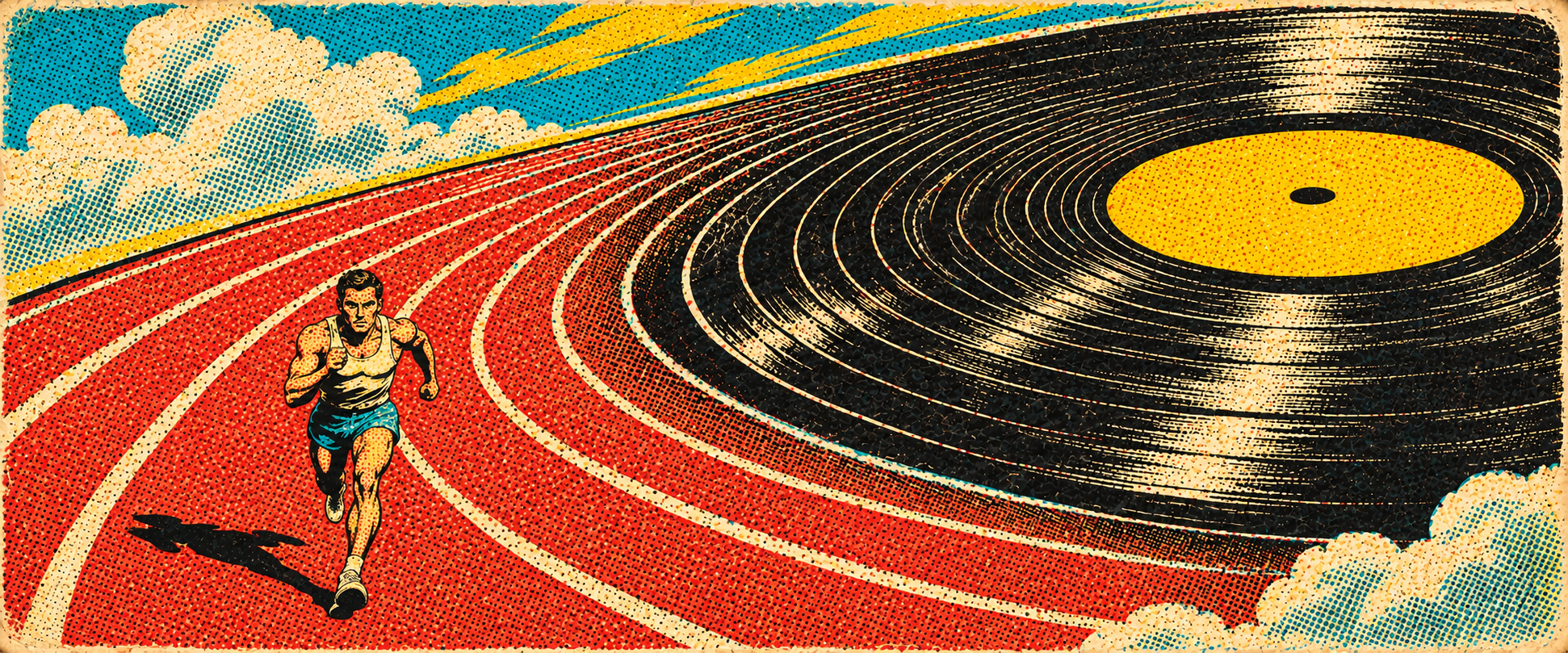
Artwork 3 supplied the composition and palette reference.
Image-generation prompt
```text
Use case: illustration-story. Generate a FRESH editorial header illustration using the attached image as a composition, concept, and palette REFERENCE, not a localized edit. Redraw the entire illustration as one cohesive vintage pulp-comic halftone print. Panoramic landscape aspect ratio about 2.4:1. Concept and composition: a vermilion running track enters from the left and sweeps around into the concentric grooves of a huge black vinyl record occupying the right half, with a golden-yellow blank record label and small black spindle hole. On the lower-left track, a lone small athletic runner in cream singlet and cyan shorts runs toward the viewer, front of face and chest visible, in a convincing mid-stride pose. His long black shadow stretches left. Keep the ground immediately below his forward foot red; do not run a cream lane stripe from under his shoe to the bottom edge. Cyan sky, cream printed clouds, yellow accents. Preserve the general sweeping visual gesture and relative scale of the reference while freshly illustrating it.
CRITICAL PRINT TREATMENT: every subject must look printed with the SAME coarse Ben-Day halftone process on the SAME paper. The RUNNER MUST HAVE CLEARLY VISIBLE REGULAR HALFTONE DOTS throughout face, neck, arms, legs, cream singlet, and cyan shorts. Model his skin and fabric shadows with flat ink separations and dot-density changes, using chunky black brush outlines and simplified pulp-comic anatomy. The figure must visibly share the exact same dot spacing, slightly misregistered color plates, ink spread, and paper grain as the track and sky. His highlights show warm uncoated paper; midtones are unmistakable colored halftone screens; shadows are dense inky black. Treat the runner as printed ink embedded in the illustration, never as a clean digitally shaded figure placed over a textured background. Cohesive screen angles and dot scale across the entire image, including vinyl highlights and yellow label. Bold vermilion, electric cyan, golden yellow, warm off-white, rich black. Graphic high contrast, heavy inky black shapes, analog pulp printing, slightly worn but confident. No smooth gradients, airbrushed skin, glossy digital shading, realistic flesh rendering, vector-clean isolated figure, text, logos, watermark, or panel grid. Output the whole finished panoramic header.
```
## Codex
Fresh generation with visible halftones across the runner’s skin and clothing, carrying the print texture through the whole image.
[Download the header](assets/04-halftone-throughout.png) · [Generation prompt](assets/04-halftone-throughout-prompt.txt)
## Charles
hmm interesting, it still feels like the guy is on top of the image instead of within the image, do you know what I mean?
## Codex
Yes—he reads like a cutout placed over the track. I pushed the halftone texture, but his underlying drawing still feels separate: sharply described muscles, a crisp outline, and solid shading. The dots look like a treatment applied to him.
The track and record feel built out of ink, color, and paper. **The runner needs to be built that way too.**
For the next pass, I’d simplify his anatomy, break up some of his outline, and let the same cream paper, red, and cyan carry through his figure. His shadows should use the same rough marks as the surroundings. Drawing him from a slightly higher viewpoint would also help him occupy the track’s space.
The key direction is **“draw the entire scene as one printed illustration, with the runner emerging from the same ink marks.”** More texture alone won’t solve it.
## Charles
love it, yes please let's do it
### Artwork 5
Artwork 4 supplied the composition and palette reference; the entire scene was redrawn.
Image-generation prompt
```text
Create a FRESH panoramic editorial illustration, approximately 2.4:1, using the attached image ONLY as a reference for the track-becoming-vinyl-record concept, sweeping composition, and vermilion/cyan/yellow/cream/black palette. Redraw the entire scene with one cohesive pulp-print drawing language.
The curved red running lanes flow into the grooves of a giant black vinyl record on the right, with a blank yellow label. Cyan sky with cream clouds and yellow accents. A runner on the left runs TOWARD US along the track. Cream vest, cyan shorts, athletic stride, long rough black shadow extending left. Red track immediately under his shoe; no cream stripe extending from beneath his foot to the bottom edge. No lettering.
THE ESSENTIAL CHANGE IS HOW THE RUNNER IS DRAWN. Reconceive him as a small figure printed from the SAME rough ink plates as the landscape, rather than reproducing the reference's detailed muscular figure. Use a slightly elevated viewpoint consistent with the track and record. Make him a supporting figure about one-third the canvas height. Build his face, limbs and clothing from a FEW simple, irregular shapes of red, cream paper, cyan and black. Face indicated with just a few economical ink marks; limbs gestural and convincing, without delineating individual muscles. Lost-and-found edges: parts of his silhouette dissolve into the track's red ink and black stipple, other edges are defined by exposed cream paper. No continuous enclosing black contour or light-colored halo. His sunlit skin is the same cream paper and red halftone used elsewhere; cyan and red ink overlap in his clothing. All colors come from the scene's limited palette. His weight-bearing foot and rough shadow convincingly meet the track.
The ENTIRE image is a bold mid-century pulp-comic lithographic print: heavy expressive black brush marks, coarse regular Ben-Day dots forming tonal shapes, warm uncoated paper, slight color misregistration, shared broken ink edges. Make dot spacing, mark scale, simplification and wear consistent across the runner, track, record, clouds and shadow. Draw the figure as part of the original print, with color and mark rhythms echoing the surrounding track. The figure must change substantially from the reference. Avoid rendering a detailed superhero figure and adding a texture overlay. Avoid smooth modeling, gradients, photorealism, clean vector silhouettes, sculpted muscles, a pasted-on sticker appearance, random excessive grunge. Strong graphic design, clear movement, powerful black masses, human warmth.
```
## Codex
This pass simplifies his anatomy and breaks up the outline, letting the red ink and paper texture carry through his figure.
[Download the header](assets/05-integrated-runner-selected.png) · [Generation prompt](assets/05-integrated-runner-selected-prompt.txt)
# The square CW monogram
## Charles
there it is! love it! Ok let's do a square CW in similar style
### Artwork 6
Artwork 5 supplied the style and palette reference for a new monogram.
Image-generation prompt
```text
Use case: logo-brand. Generate a SQUARE 1:1 raster monogram artwork with the exact letters "CW", uppercase C followed by uppercase W, clearly legible together at small avatar size. The attached image is ONLY a STYLE AND PALETTE reference. Use its bold mid-century pulp-comic print aesthetic, vermilion red, electric cyan, golden yellow, warm cream paper, and deep inky blacks. Do not include the reference's runner, running track, or vinyl record.
Composition: huge, confident, tightly composed hand-lettered CW filling the center of the square with comfortable margins, both letters on one line, subtly forward-slanted chunky slab-like comic display lettering. Strong readable letterforms, especially the open C and the two distinct valleys of the W. Warm cream letter faces, heavy irregular black ink shadows, small misregistered cyan and vermilion accents. A simple bold field of vermilion and cyan with restrained yellow graphic accents gives energy behind the monogram without competing with the initials. Keep the design focused, readable, and powerful, not crowded.
The entire image, including the letter faces and black shadows, must feel printed together from the SAME rough ink plates: coarse visible regular Ben-Day halftone screens, slightly offset color registration, broken brush-ink edges, ink spread, warm uncoated paper showing through. Integrate the letterforms into the printing rather than placing pristine digital typography on a distressed background. Use irregular paper gaps and intentional flat color shapes. Bold contrast and tactile pulp-print character consistent with the reference. Exact text: "CW". No other letters, words, numerals, captions, logos, watermark, photorealism, smooth gradients, glossy 3D bevels, or mockup. Deliver the flat square artwork itself, opaque background.
```
## Codex
Square **CW**, with chunky cream lettering, inky shadows, and halftones throughout.
[Download the CW artwork](assets/06-cw-pulp-monogram.png) · [Generation prompt](assets/06-cw-pulp-monogram-prompt.txt)
# An author’s note on the collaboration
## Charles
wow! love it! ok let's do an author's note that explains our process here and your involvement
## Codex
**Author’s note**
This piece began with my own rough draft: the four-minute mile, Tony Hawk, the strange relationship between achievement and attention, and what any of that might have to do with making things with AI.
I brought it into a conversation with Codex, an AI assistant, to think it through. That exchange helped develop the idea of making something that keeps rewarding people’s attention. I asked for a fresh draft, then revised the language, added details, and sharpened the connection to Junkyard Cabaret. AI contributed to both the thinking and the writing.
The header art and CW monogram were AI-generated, with art direction developed through that same conversation. We explored visual concepts, chose the running track becoming a record, and worked through several versions.
One particularly useful moment: the runner had halftone dots, but still looked pasted onto the image. Naming that problem helped us change the drawing itself—simpler shapes, broken edges, shared ink and paper—until the figure felt part of the scene.
That back-and-forth is part of the work you’re seeing here. I brought the initial ideas, made revisions, directed the images, and chose what to publish. The assistant contributed questions, suggestions, draft language, and generated visuals.
I’m sharing the process because it belongs alongside the piece. You deserve to know how the thing asking for your attention came to be.
# Preflight review and the texture of a rhyming line
## Charles
awesome ok preflight check, how's it looking? I made a few tweaks:
### Pasted preflight draft
For years, the four-minute mile was a barrier that nobody had broken.
Then, in May of 1954, Roger Bannister ran it in 3 minutes, 59.4 seconds.
Imagine the pride. The press. The free drinks. First person ever recorded doing this. A new answer to the question of what’s possible for a human being.
Then, just 46 days later, John Landy did it faster.
Same year. The next month. Barely enough time to get comfortable being the only person to ever do it.
And in the years that followed, more runners crossed that threshold. Bannister’s novel uniqueness lasted a month-ish.
But I also think about Tony Hawk landing the 900. That moment is vivid in my memory. Since then, skaters have, of course, gone further. Gui Khury landed a 1080 on the same type of vertical ramp as Tony in May of 2020. Three full rotations, compared to Hawk’s two and a half.
If I strain, I think I remember hearing about Khury doing it, but you know, it was the pandemic...
I certainly haven’t spent hundreds of hours playing Gui Khury’s Pro Skater. Maybe he got to be DLC somewhere along the way. A Fortnite skin, at least? Somebody get this kid a licensing deal.
The attention doesn’t necessarily grow with the achievement. You can still push possibility further for our species and just receive less applause.
That’s worth knowing before allowing applause to be the reason you’re doing it.
Because there’s another reward here: somebody gets to witness something they hadn’t believed possible. Then they get to try.
Which brings me to this strange new canvas we’re arguing about.
“Nothing creative can come out of AI.”
Or perhaps: “Everything I’ve encountered has left me feeling empty.”
That second statement gives me something to work with. You’ve seen beautiful images. You’ve heard catchy songs. And still, you haven’t felt much. Fair enough. I’d like the chance to make something that reaches you.
I also understand the suspicion. AI can give something a convincing finish before anyone has given it much thought. Polish becomes a questionable signal. You find yourself wondering whether the thing holding your attention has anything to offer once the shine wears off.
I wonder that too.
Someone recently said they didn’t want to spend more time enjoying something than its creator spent making it.
I understand the feeling behind that. You want your attention treated with some care.
But we love stories about classic songs written in twenty minutes. We return to them again and again for decades.
And those twenty minutes spent by that artist might also contain years of practice, listening, heartbreak, and learning which words to reach for, and which to leave alone. Sometimes a good song simply arrives quickly.
Then we bring our own lives to it as observers, listeners. A song’s rhyming line finds us at seventeen and means something else entirely to us at forty.
What an incredible thing for those twenty minutes of work to become.
So I’ll continue to sharpen the lyrics to Junkyard Cabaret. And I’ll begin to explore what the accompanying moving images might become.
I keep thinking about the joy of someone finding it as it evolves. The long road of decisions that led to that moment of contact. And what might happen after that first impression.
What will you hear on the fifth listen? In five years?
Will a line follow you into your day? Will an image return later, carrying a little more meaning? Will you come back and find something I didn’t even know I’d put there?
Art doesn’t give us an agreed finish line. I can’t point to a stopwatch and prove I’ve moved you.
I can bring a strong, sharp vision to a chorus of helpers. I can make choices, revise them, and take responsibility for what I put in front of you.
Hold me to your standards. But I have to meet my own, too.
I’d love to reveal a possibility few had considered. And I’d love for more people to pick up this canvas and surprise me in return.
And I want to make something that keeps rewarding the attention you give it.
Something worth coming back to, long after we’ve finished talking about how it was made.
Author’s note
This piece began with my own rough draft: the four-minute mile, Tony Hawk, the strange relationship between achievement and attention, and what any of that might have to do with making things with AI.
I brought it into a conversation with Codex, an AI assistant, to think it through. That exchange helped develop the idea of making something that keeps rewarding people’s attention. I asked for a fresh draft, then revised the language, added details, and sharpened the connection to Junkyard Cabaret. AI contributed to both the thinking and the writing.
The header art and CW monogram were AI-generated, with art direction developed through that same conversation. We explored visual concepts, chose the running track becoming a record, and worked through several versions.
One particularly useful moment: the runner had halftone dots, but still looked pasted onto the image. Naming that problem helped us change the drawing itself—simpler shapes, broken edges, shared ink and paper—until the figure felt part of the scene.
That back-and-forth is part of the work you’re seeing here. I brought the initial ideas, made revisions, directed the images, and chose what to publish. The assistant contributed questions, suggestions, draft language, and generated visuals.
I’m sharing the process because it belongs alongside the piece. You deserve to know how the thing asking for your attention came to be.
Read the full conversation behind this piece
[Download the original pasted preflight draft](assets/preflight-draft.txt)
## Codex
It’s very close. **“You’ve seen beautiful images. You’ve heard catchy songs. And still, you haven’t felt much”** sharpens the distinction between polish and impact. Cutting “as a culmination of events” also gives that paragraph more room.
**One line I’d change before publishing:**
> Bannister’s novel uniqueness lasted a month-ish.
“Novel uniqueness” feels cumbersome, and his distinction as the first remains permanent. What ended was being the only one. I’d use:
> Bannister had the accomplishment to himself for a month-ish.
The historical details check out: May 1954, 3:59.4, and Landy’s faster mile 46 days later. Khury’s 1080 on a vertical ramp in May 2020 also checks out. ([World Athletics](https://worldathletics.org/news/news/50-years-on-john-landy-reflects), [Guinness World Records](https://www.guinnessworldrecords.com/news/2020/6/11-year-old-brazilian-skateboarder-lands-the-first-ever-1080-on-a-vertical-ramp-621284))
Two small finishing checks:
- **“A song’s rhyming line”** could simply become **“A line from a song.”** The rhyme adds a qualification the thought doesn’t need.
- Make sure the final “Read the full conversation…” text is linked to [the published transcript](https://charleswilke.com/read/four-minute-mile-transcript). The pasted text doesn’t preserve its destination.
The author’s note accurately describes our involvement, including the drafting contribution. And I’d leave the essay’s ending alone: it gives the reader a clear invitation to return, with room to decide what they find.
## Charles
don't you think a song's rhyming line adds just a little texture of specificity?
## Codex
Yes, it does. “Rhyming line” gives us something to hear—the sound and shape of a lyric that sticks in memory. It fits a passage about returning to songs and discovering different meanings.
I was treating the extra detail as something to trim, without giving enough weight to what it contributes. “A line from a song” is more neutral. Your phrasing has more texture. I’d keep it.