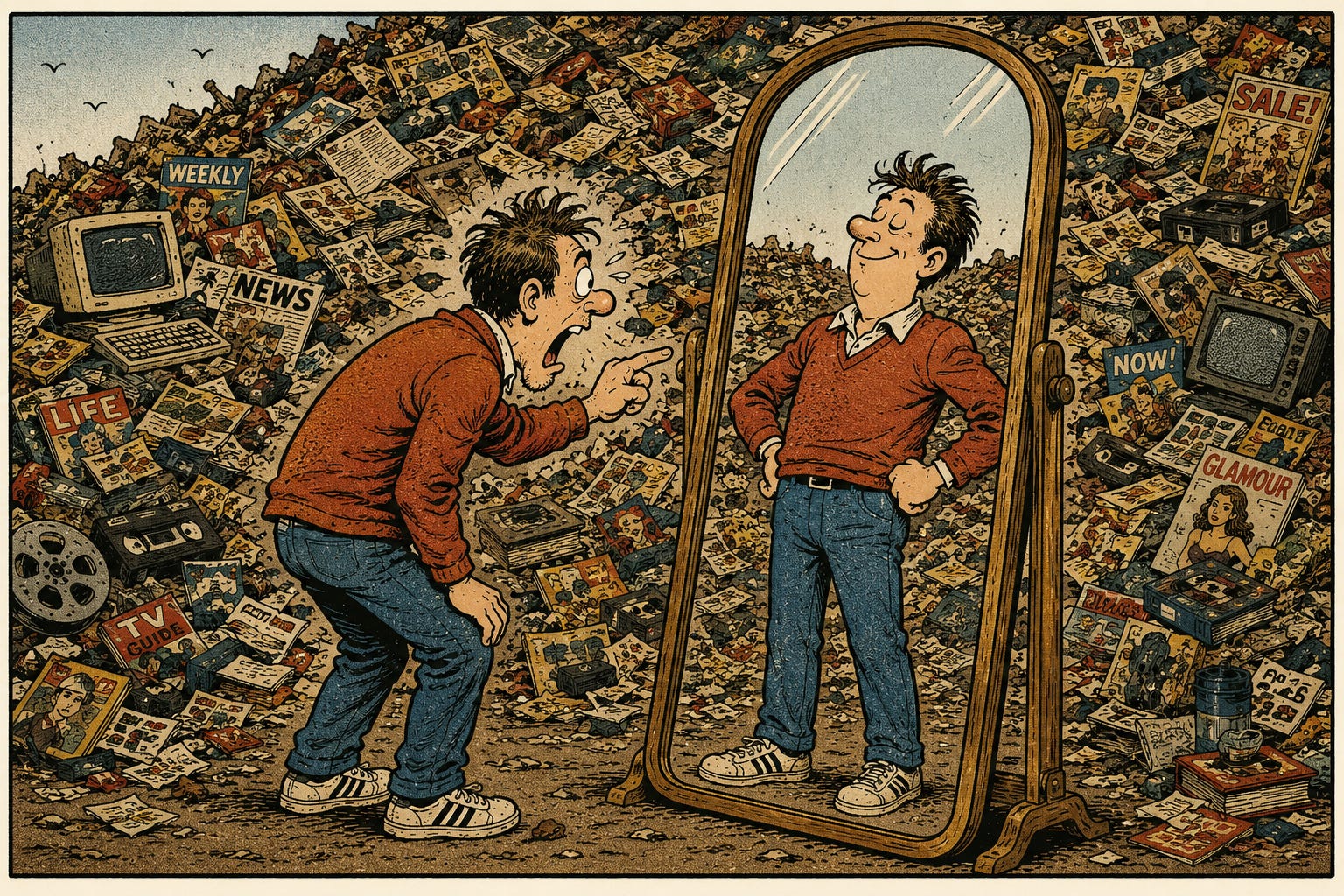
I think back frequently to the content factory days of my career.
For years, I was expected to pump out anywhere from three to seven articles a week. The caliber, quality and editorial perspective of those pieces waxed and waned. Some were written in haste. Some I anticipated and celebrated. Most were completely forgotten. Some, I’m sure, were never read at all.
I wrote about Trump. I wrote about solar panels, mortgages, dating apps and various Life Alert-type systems for the elderly. I wrote event guides for Los Angeles and commentary pieces about pop culture. I investigated accounting errors with the LADWP. Hell, I once ambushed a student association president with a face-to-face interview about misappropriation of funds and sweetheart no-bid deals.
Same hands. Same brain.
Wildly different amounts of intention.
I can’t say whether any of those things qualified as art. I can’t say how much of it moved the needle. I’ve had content go viral and dealt with the headaches that followed. I once attracted the attention of Jon Ronson, who marveled at our ability to publish garbage that somehow became news.
And all of this happened before generative AI gasped into existence.
Long before a chatbot could produce a passable article in seconds, the internet had already built an economy that required human beings to behave like little chatbots.
Tuesday needed content published.
Whether anyone actually had anything worth saying on Tuesday was beside the point.
More pages for Google to index. More posts for people to share. More headlines to click. More explainers. More recaps. More product comparisons. More corporate thought leadership. More episodes. More newsletters. More things filling empty slots in a CMS because an editorial calendar said those slots should not remain empty.
AI didn’t invent content without intention.
We did.
And I think that complicates the panic over what we’ve come to call AI slop.
There’s a popular chronology developing around generative AI that goes something like this:
Human beings made meaningful things.
Then the machines arrived.
Then the slop began.
This is an appealing story. It gives us a clean before and after. It gives us something external to blame. Somewhere in the recent past lies a lost internet composed of thoughtful essays, carefully considered photographs, lovingly illustrated webpages and meaningful interpersonal exchange.
Then somebody turned on the AI image generators and ruined everything.
Come on.
We spent decades building systems designed to make humans manufacture garbage at scale.
SEO mills. Content farms. Engagement bait. Affiliate websites. Algorithmically optimized headlines. Nine-hundred-word articles answering questions that required eighty words. Corporate blogs created because somebody’s quarterly strategy deck contained the phrase thought leadership.
None of this means the people producing those things lacked creativity.
I was one of them.
Sometimes the conveyor belt produced real journalism. Sometimes it produced something funny or beautiful or genuinely useful. Sometimes somebody cared deeply about what went into the box.
Sometimes the box simply needed to be fed.
Human-made and intentional have never been synonyms.
Yet increasingly, we seem to be treating them as though they are.
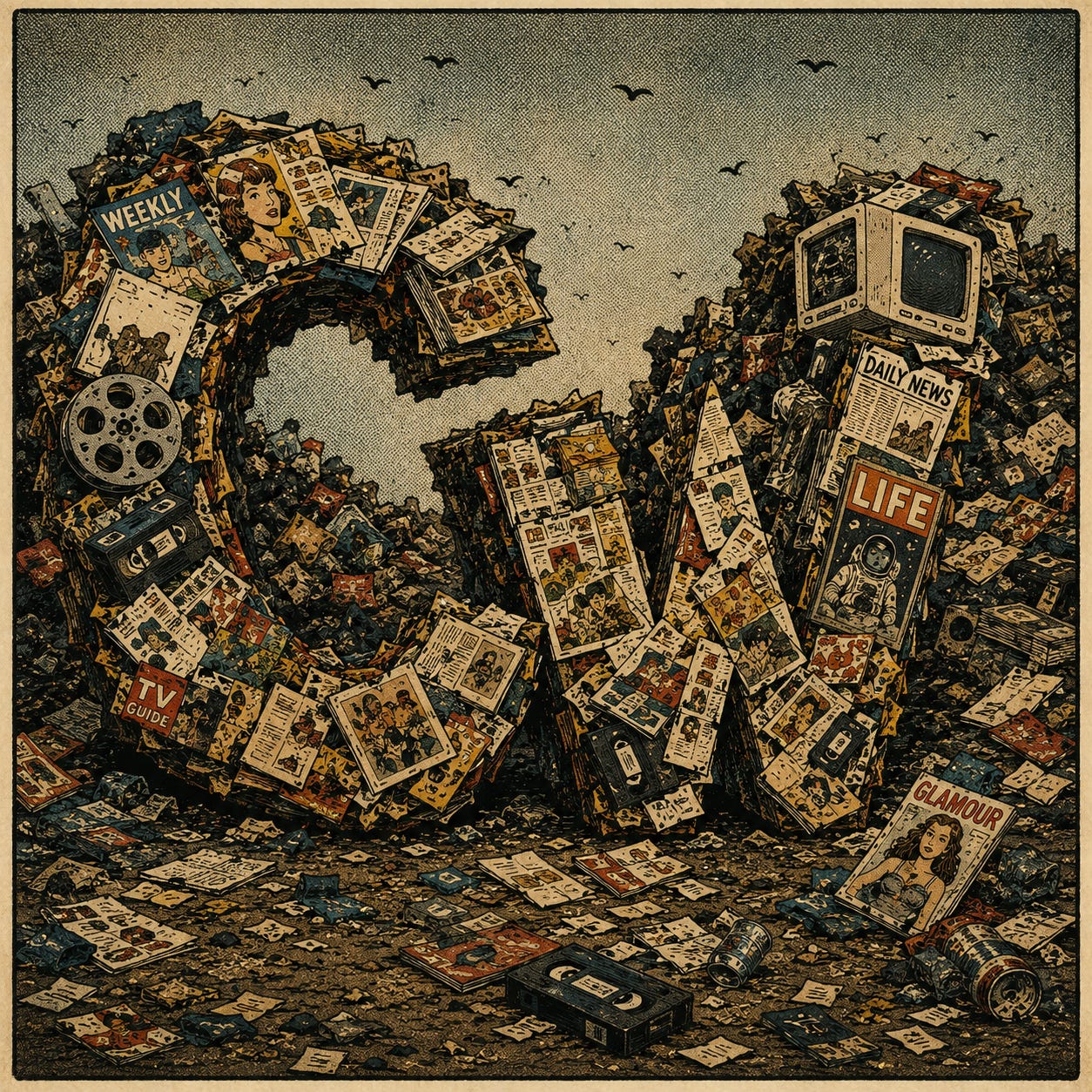
Maybe that is part of what I mean by slopulism.
Not slop itself, but the belief system accumulating around it.
The conviction that our degraded cultural condition began with generative AI, and that sufficiently human production might restore whatever we believe existed before.
There is another possibility.
Maybe AI didn’t create the landfill.
Maybe it learned how to metabolize it.
I keep thinking about Back to the Future Part II.
In the first movie, Doc Brown needs something approaching a miracle to power the DeLorean. Plutonium will do it. So will a perfectly timed bolt of lightning, provided you happen to know precisely where and when it will strike.
By the second movie, there is Mr. Fusion.
Doc opens a garbage can.
A banana peel. Some leftover beer. Whatever happens to be around.
Trash goes in.
Fuel comes out.
It’s an absurd little gag about future abundance, but it increasingly feels like a useful metaphor for what happened to the internet.
For decades, we generated an unimaginable amount of cultural exhaust.
Articles. Blog posts. Government documents. Recipes. Forum arguments. Product descriptions. Fan fiction. Journalism. Academic papers. Captions. Reviews. Tutorials. Comments. Pornography. Abandoned personal websites. Corporate copy. Carefully considered essays and completely disposable horseshit.
Individually, these things had wildly different meanings and wildly different values.
Together?
Fuel.
I sometimes joke that work like mine became the Gerber baby formula of the emerging AI models. The nutrient mush that helped them take their first generative steps.
Garbage in, garbage out, they say.
Usually correctly.
But Mr. Fusion proposes that garbage might not remain garbage once something learns how to extract useful material from it.
So is generative AI a kind of recycling?
Can it take this landfill of compulsive creativity and rearrange those remnants into something worthwhile?
Can garbage become a beautiful mosaic?
Sure.
Sometimes.
It can also become shiny garbage.
So I’m not particularly interested in arguing that AI transforms trash into treasure.
We still haven’t determined whether what comes out is compost, fuel or merely a more efficiently distributed form of trash.
I wrote recently about the growing scarcity of taste.
When execution becomes abundant, I argued, the value of human contribution moves upstream.
Attention.
Intention.
Discernment.
Judgment.
Taste.
A generative system can make the image, but it can’t tell you why you needed that image.
It can produce a hundred options. Taste is what rejects ninety-nine.
It can generate the sentence. Discernment notices that the cleaner sentence is somehow less true.
The machine defaults toward the mean.
That was the argument.
But there is another question hiding inside it.
What if the mean is us?
That’s where I think the discussion of slop becomes much more uncomfortable.
Generative models were trained on the things we made.
Not merely our masterpieces.
Us.
The weird whole of us.
Our Pulitzer winners and our SEO articles about patio furniture.
Our scientific papers and our fandom arguments.
Our reporting and our marketing funnels.
Our careful sentences and our empty Tuesday content slots.
The machine doesn’t experience the hierarchy of meaning that accompanied those things when we created them.
It sees patterns.
And when those patterns are synthesized at enormous scale, perhaps what we’re seeing is something human beings have never previously had the opportunity to confront:
The visible average of our own cultural production. Or, more simply, the boring beige of humanity.
For most of the internet’s history, we encountered culture serially.
This webpage.
That article.
This photograph.
That Tumblr post.
That banner ad.
That corporate blog.
That DeviantArt drawing.
We never really stood far enough away to see the whole pile at once.
Generative AI can do something closer to that.
It compresses our accumulated conventions and hands them back to us.
The pleasant lighting.
The familiar composition.
The reassuring cadence.
The suspiciously polished whimsy.
The predictable rhetorical turn.
The cinematic image we’ve somehow seen ten thousand times without ever seeing this particular one before.
And our reaction is:
Jesus Christ. Look at this slop.
Well.
Where did it learn that?
This isn’t an argument that human culture is secretly garbage.
That would be both cynical and boring.
The average human sentence isn’t Shakespeare.
The average photograph isn’t transcendent.
The average song isn’t the song that changes your life.
Most things humans make have always been ordinary, derivative, functional, rushed, compromised, imitative, commercial or simply fine.
That’s okay.
The statistical average of human creative production should never have been confused with the boundary of human creativity.
But when an extraordinarily powerful averaging machine reproduces that center with frightening ease, we sometimes look at the result and declare that creativity itself is dying.
Maybe that’s backwards, though.
Maybe AI slop isn’t primarily a preview of our machine-made future.
Maybe it’s the first legible composite image of our human-made past.
Which would make our disgust with it a much more interesting indictment of where we’ve been than where we’re going.
The machine inherited our modularity.
Our genres.
Our formulas.
Our habits.
Our shortcuts.
Our assumptions about what a professional photograph looks like, what marketing copy sounds like, how an inspirational essay should resolve, how a movie poster should compose itself, what kind of phrase belongs on LinkedIn.
Artificial intelligence didn’t invent these conventions. It inherited them.
And then it became exceptionally good at recombining them.
That’s why so much machine output feels strangely familiar even when it depicts something nobody’s ever made before.
It’s new material assembled from old expectations.
But again, we were already doing this.
Long before any AI model could instantly generate endless streams of articles, the content economy spent twenty years telling human beings:
More.
More.
More.
Then we invented something unbelievably good at more.
And recoiled at the result.
None of this lets generative AI off the hook.
Scale changes things.
The ability to generate ten million pieces of garbage without requiring ten million bits of human labor changes things.
The economics change.
Fraud changes.
Spam changes.
Propaganda changes.
The ability to bury human communication beneath an effectively infinite supply of plausible synthetic material is not simply the content factory happening faster.
There are genuinely new problems here.
But if slop existed before the machine, then generation itself can’t be the pathology.
Something else’s gone missing.
Which brings me back to intention.
Maybe the opposite of slop isn’t human.
Maybe the opposite of slop is care.
Did somebody choose this sentence instead of merely accepting the first plausible one?
Did somebody reject twelve images because the technically prettier versions felt emotionally wrong?
Did somebody notice the strange hand?
Did somebody decide that the obvious ending was dishonest?
Did somebody have a point?
Those seem like more useful questions to me than whether a machine touched the work somewhere along the way.
Because paying a human to manually type nine hundred forgettable words about mortgage refinancing doesn’t imbue those words with spiritual value.
And using a generative system to interrogate, challenge, rearrange or visualize an idea doesn’t automatically evacuate intention from the result.
A human can be present in the production process without bringing much humanity to it.
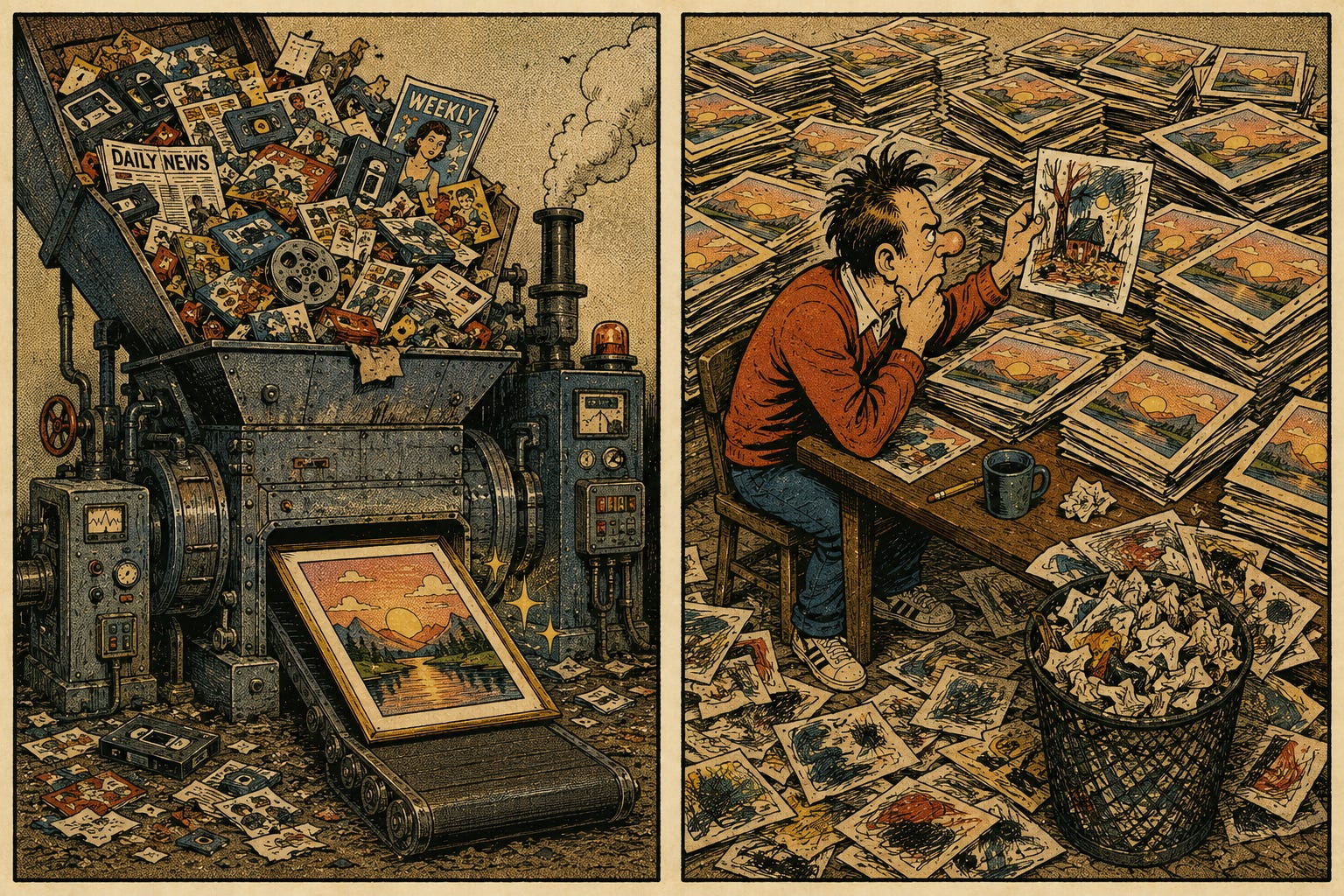
Generative systems create an almost comical abundance of things to reject.
Which means the strange consequence of infinite production may be that the creative act moves increasingly toward refusal.
No.
Not that one.
Again.
Less polished.
More peculiar.
That sentence is smarter but this one is truer.
Remove the thing everyone expects.
Leave the mistake.
Stop.
That seems less like the death of human creativity to me than a migration of it.
The tool gets better at execution, so the human contribution shifts toward deciding what deserves to exist.
Production used to carry enough friction to impose a limit.
Now production approaches infinity and attention remains painfully finite.
Maybe taste was always quietly downstream of those economics.
Maybe we’re only now noticing because the machine finally made the imbalance impossible to ignore.
We filled the internet with everything we could make.
Now the machine can make nearly anything from what we left behind.
Maybe slopulism is what happens when we mistake our reflection for our replacement.
Author’s note
This one began as a Saturday morning brain dump: an old memory of working in content factories, a landfill metaphor, Mr. Fusion, and a nagging suspicion that maybe what we call AI slop tells us as much about the culture that trained these systems as it does about the systems themselves.
I brought that mess to ChatGPT and used it the way I increasingly prefer to use these tools: not to hand me an argument, but to push on one I was already trying to understand.
We went back and forth on the distinction between human-made and intentional, connected the idea to my earlier piece about the scarcity of taste, argued over whether the landfill became fuel, compost or simply shinier garbage, and eventually arrived at the question that became the spine of the piece: What if the mean is us?
From there, I wrote, cut, rewrote and pushed back. ChatGPT challenged places where the metaphor stopped making sense, pointed out where I was repeating an argument I’d already made elsewhere, and helped me recognize when the essay had finally found its ending.
The illustrations came from the same conversation. We developed the Sunday-comic visual language together, starting with the idea of a man outraged by what he sees in a mirror while refusing to turn around and look at the landfill behind him. I directed and iterated on the concepts; ChatGPT helped translate them into the images accompanying the piece.
Which feels appropriate.
An essay about whether AI erases human intention was made through a process in which intention was the entire point.