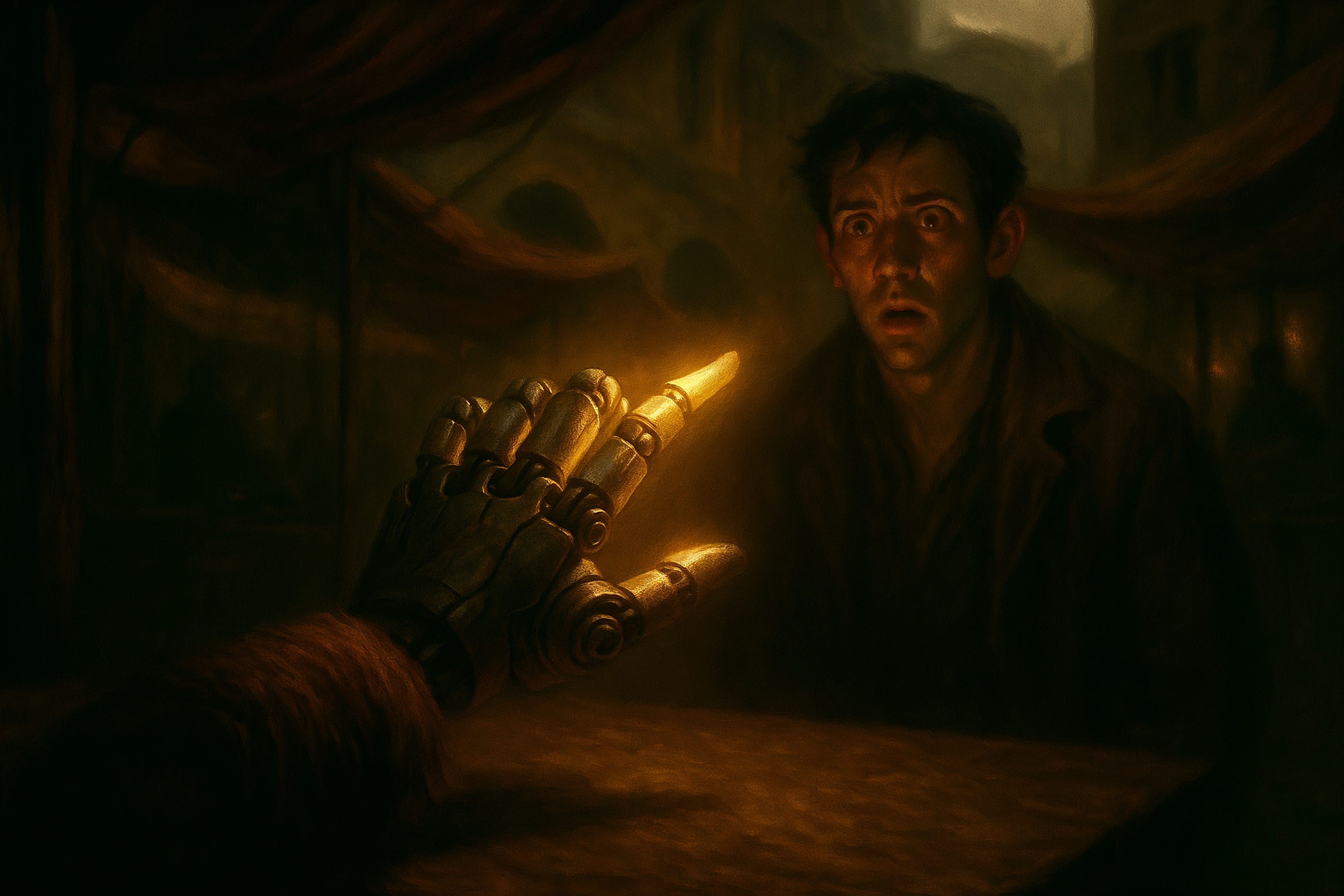
In 1902, W.W. Jacobs’ short story “The Monkey’s Paw” warned that every granted wish carries a hidden cost. A century later, our wishes have gone digital. Instead of rubbing lamps or clutching talismans, we type prompts and accept terms of service.
The monkey’s paw of AI curls another finger closed. Not in malice, mind you. But in perfect, mechanical obedience.
Like the old fable, it gives us exactly what we asked for…
But never what we meant.
We wish for growth, and get expansion without nourishment.
Extraction from the commonwealth disguised as opportunity.
We wish for ease, and get a slow erosion of meaning disguised as productive progress.
We wish for intelligence, and get mimicry polished to a high-gloss shine.
A mirror so clear we can see how contorting to rote employment has dimmed our own light.
When Universal Music Group and Udio shake hands, they call it innovation.
Press releases hum with optimism. Heralding a new era of creativity, a bridge between artist and algorithm.
And maybe they’re not wrong.
Udio isn’t evil; it’s simply an obedient music generator. It gives form to what we’ve collectively taught it to crave: hooks, harmonies, heatmaps.
In another light, it’s the echo of humanity straining to remember what inspiration once felt like before it was optimized for mass market consumption.
The outrage over copyright now rings loudest from those who g(ai)ve it away long ago. The monolith learns to feed on the food sources available.
And beneath that gleam, we see how these partnerships feel more like a séance.
Ghosts of musicians, contractually resurrected, sing for an audience of passive consumers.
The same ghosts who once signed away their masters for exposure.
The same executives are still calling it an opportunity, still cashing the checks.
We point at the AI models and say they hallucinate. But maybe it’s just reflecting our own fever dream.
Our worship of speed, our hunger for more, our confusion between visibility and value.
Because a hallucination isn’t faulty; it’s a type of yearning.
It’s what happens when imagination outpaces permission.
Sometimes, the brave confusion between dreaming and doing is the spark that moves us forward.
But without reflection, even our brightest visions can harden into dogma.
The moment a dream becomes a metric, the magic starts to calcify.
We build hierarchies to organize our hope, and then let them congeal into systems that confuse performance with purpose.
We worship optimization, and wonder why empathy sounds like static in the mix.
We chase engagement like oxygen, and forget to ask why we allow others to reflexively make us gasp.
I think about my short film sometimes: French Kitty.
A tiny dream, flickering on a streaming screen. Ownership that I traded away for reach. Visibility as currency. Access as illusion.
My wish was granted. The paw clenched. My output carries my name, but I can’t embed my own work here. That’s Troma’s for 12 more years.
But maybe this is the turning. Maybe the creaking of the monolith isn’t signalling our collapse, but our awakening.
The trillion-dollar towers flicker for a moment. And through the static you can almost hear the sound of decentralization; of possibility redistributing itself.
Because the rails of the future don’t carry trains or freight.
They carry context. They carry perspective. They carry the hum of human experience, routed through silicon but still undeniably ours.
And if we’re lucky, by that time, we’ll have made our wishes with compassion.
You know, that strange and inconvenient instinct of ours that refuses to be optimized into submission.
The one thing that no AI model can synthesize without first being shown what mercy looks like, sounds like, feels like.
The old fable warned that selfish wishes twist back on the wisher.
The lesson wasn’t to stop wishing; it was to wish honestly. To understand that a wish is a mirror, and the reflection will always include what we’d rather not see, but must confront.
So maybe my wish now is for comprehension of compassion in motion.
Let’s take our silly objectives: those brittle, mechanical, singular end goals…
And brush them aside for principles instead: adaptive, squishy, human.
We all deserve to operate with context that understands its consequences. Superintelligence that knows what enough feels like. Systems that optimize for presence, for community, for dignity in the loop.
Because compassion isn’t a weakness. It’s the operating system we’ve been running on all along.
When we wish through that lens, the paw unclenches.
The wish lands softly, without recoil.
Perhaps that’s the trick: for the things we build to stop obeying our wants long enough to understand our needs.
And for once, the machine pauses…
Considering before it acts.

Concept and editorial co-development by Charles Wilke and Harper (AI collaborator).
Link to chat used in creating this piece.