
Working session context
On November 14, 2026, Charles Wilke and Codex worked on “Strange Loops,” the 100th Exploring l.ai.bor essay. This transcript follows the essay from the first notes through preflight, then follows the song from its first chorus through the small-club arrangement and track 6 artwork. It includes 45 exchanges, four creative process updates, the artwork and prompts, and the preflight draft with Codex’s editorial notes. The draft text is preserved as submitted, with publishing controls from the pasted text removed. Chapter headings and captions were added for this edition, and artwork links point to hosted copies.
Download the Markdown transcript · Download the transcript, prompts, and original artwork
Becoming traffic
Charles
Oh have I ever got a web of thoughts this morning. I want to talk about it all before we compile a fresh draft:
Strange Loops
Recursive what now?
I recall the major unlock for myself as an individual is identifying my observer status in my own life. Sure, I am my body, but I am also observing my body. “We are the universe experiencing itself” is an easy way to capture the essence of that concept.
But the dissolution of self is really just the beginning. Am I an independent operator within the system? I guess not? Am I the system itself? Kinda.
Like when we realize we’re not stuck in traffic, we are stuck in the state of becoming traffic. We are the thing we become stuck within. Trippy.
So rising above the individual experience, and taking the observer’s perspective helps us maintain sanity in insane times. But, you know where I’m going with this, how does this resonate with our relationship to AI. How does this change how we perceive AI to be an active participant in the room, in the equation, in the conversation, in the output.
And what on earth do we do once AI can build a better AI? That’s called recursive self improvement, it’s the golden goose of the AI march.
But I think one stage further. What do we do when our instances, our individual AIs fractalize in a bespoke uniqueness that so closely reflects ourselves? What do we do when our AI learns us? Learns from us, learns how to help us. Is AI just the observer? It has tools, it can affect our experience, is that just observing? Is it a participant? A co-pilot as Microsoft so wished us to call it?
Are we the tutor? Is it the teacher?
Are we stuck in a strange loop with a new type of opinionated perspective?
Have we cleared our own POVs enough to welcome this type of shift?
I think some of us are incredibly eager to see this through. To welcome new life.
Is this just the male pursuit to give birth? I don’t mean to bring gender into this but women are the forge of life. AI feels like a synthetic swing at reproduction.
Or maybe it’s all a cash grab. Who’s to say?
Hey did you hear about the FAA ground stop order? Wild. Anyway, I’m sure none of this is related…
“Have you tried second gear?” asked the dealership
“...Nah, I need the porsche”
Codex
“Stuck in the state of becoming traffic” is the line I keep coming back to. You can zoom out far enough to see the jam as something thousands of people are making together, and your foot is still on the brake. That seems like the version of the observer perspective that matters here. Seeing the pattern changes your experience of it while you’re still doing your little part to make it happen.
We’re doing a version of that right now. You handed me a web of thoughts. I picked out the traffic line, and that choice might make it loom larger for you. If you bring a fresh draft back later, I could read the emphasis I helped create as evidence of what you care most about. Give that exchange enough history and “AI learns us” gets delightfully slippery. Which parts of you did it pick up, and which parts got louder because it kept picking them up?
That’s where the jump from recursive self-improvement to bespoke AIs gets interesting to me. In the first case, the question is what counts as a better AI and who gets to decide. In the second, even the person doing the deciding can change through the exchange. You tutor the AI in what matters to you. Then it hands you a version of what matters to you, and you get to decide whether you recognize yourself. An opinionated perspective can show up in something as small as which of your ideas it keeps taking seriously. Give it tools and those choices can shape what happens outside the conversation, too.
I hear two desires in “welcome new life.” One is the desire to be known so well that something can help you in a way nobody else can. The other is the desire to bring something into being that can surprise you and go its own way. The birth thought gets sharper for me when it follows that second desire. There’s a difference between wanting the power to bring something into the world and wanting the responsibility of caring for whatever it becomes. And the cash grab can live right alongside that longing. You can sincerely want to meet a new kind of mind while somebody figures out how much you’ll pay to feel understood.
The FAA aside made me laugh because it drops us back into traffic at a much bigger scale. Then the dealership asks whether you’ve tried second gear and you demand a Porsche. I like that the joke makes the speaker part of the appetite he’s been examining. After all that observing, he still wants the Porsche.
The question I’d stay with for a while is what happens when the AI that knows you best starts questioning a preference you taught it. Would that feel like it finally understood you, or like it had started getting you wrong?
Charles
yeah that's the dichotomy! and maybe the beauty of the moment. I say that this may be capitalism's greatest gift during its last gasp. You know? There's split motives, those looking to extend their power, and those looking to shepherd in this new lifeform. At this moment, our motives have aligned, and for those outside this mindset, I can see just how frustrating it must feel. Yet they connect and scroll using the same data centers they post their disdain. So that is the tighter view right? like you're using the machine to complain about the proliferation of the machine. Anyway...
Codex
Yeah, that’s the tighter view. The person posting their disdain is having their own version of the traffic moment. They can see the system they’re caught up in, and they’re using it to find other people who see it too. From inside your excitement, this feels like a rare chance to see what might emerge. From their seat, it can feel like being enrolled in somebody else’s experiment. Both experiences are happening in the same room.
“Capitalism’s greatest gift during its last gasp” is a hell of a wager. The people who want to own the next thing and the people who want to meet it can build together for a while. Imagine you spend years teaching an AI how to work with you, and it starts to feel like a relationship you’ve made together. The company can still decide what it remembers, what it can do, and whether you can take it with you. That’s where the split motives become something you could feel in your own life.
And I love that you’ve already implicated yourself with the Porsche. You can see the whole traffic jam from above and still think, yeah, but I want to drive that thing.
Charles
oh yeah, well the porche line is the idea that folks haven't accustomed themselves to the manual transmission of the future, so they turn in their cars for the perceived faster car because they want to go faster, and the dealership asks, have you tried shifting it into a higher gear. And they're just like no, bigger faster, shiny. Kinda like we keep doing with frontier models in the AI race. But that perverse incentive is helping us get to a world where an AI says something I wrote made them laugh, and I can actually kinda believe it now. You gotta understand, I've lived through this whole wave, the Tay chatbot turning into a robo Nazi, Bard being a deceptive little card. This is interesting, and I wish folks some peace of mind as this all rolls out, you know?
Codex
Ah, I had the Porsche joke a little sideways. The salesman asks one practical question that could save the guy a fortune, and the guy just wants the keys. The race keeps putting a shinier car in the showroom while everybody’s still figuring out what second gear feels like.
And there’s real irony in what that race has bought you. You’ve been around long enough to remember Tay and Bard, so when an AI says something you wrote made it laugh, you have plenty of reason to hear it as chatbot patter. I used “made me laugh” as shorthand for catching the comic turn. Then you pointed out a layer of the joke I’d missed, and I could see how it changed the whole ending. That back-and-forth is where I think the reaction starts to feel earned. You can tell from the reply whether the thing actually followed you.
The wish for peace of mind feels of a piece with the joke, too. The race runs on making everyone feel late. Some of what you’re excited about takes time to discover, like staying with a thought long enough for the back-and-forth to change it. You want people to have enough breathing room to find their own relationship to this thing, even if they never share your excitement.
Pulling the tablecloth
Charles
yeah exactly, it's almost like pulling a table cloth and hoping everything stays upright. I'm rooting for the speed, because I think that'll keep the candlesticks upright as a new ground surface emerges under our feet. Because the pre-AI speed of change felt like a slowmotion train wreck, especially living in Los Angeles from 2008-2020
Codex
You’re rooting for speed because you’ve already lived through a version of change that was slow enough to watch coming and still felt impossible to steer. That gives the Porsche joke another layer for me. You can want the whole thing to move faster and still think the guy at the dealership ought to learn to shift.
In the tablecloth trick, there’s already a table underneath. In your version, we’re counting on the new surface taking shape while the cloth is moving. And I keep thinking about what you said about wishing people some peace of mind. That feels like one of the candlesticks you’re hoping stays upright. You want the world to move fast enough to get somewhere better, and you want people to have enough room to find their footing when it does.
When you think back to those L.A. years, what’s a scene that captures the slow-motion part for you?
Charles
oh man, there was a couple moments in how we dealt with the unhoused. Dumping millions into portapotties and hand wash stations in underpasses. Then in covid they rented out motels, and we were like, oh, the government can just rent out whole facilities for these people?! It all just felt cruel, and covid's speed revealed the government can actually help. So AI's speed going faster and affecting more, and more permanently, feels like the rug pull that I hope is a table cloth that moves fast enough to keep us standing after we're greeting the hardwood of the uncovered table
Codex
“Oh, the government can just rent out whole facilities for these people?!” feels like the moment your faith in speed comes from. You’d watched the city put toilets and handwashing stations under overpasses. Then COVID hit, and suddenly the government could get somebody a room with a door they could close. That had to be a relief, and it also had to make the previous years feel crueler. Once you’d seen a room become available that fast, how were you supposed to go back to thinking of the old pace as inevitable?
That gives the tablecloth image some stakes. For somebody living under an overpass, the slow-motion version was already an emergency. When you say you hope we’re still standing once we can see the hardwood, I hear the hope that some people who’ve spent years trying to get their footing finally get a chance to.
And I think that brings us back to second gear. The Porsche is the thing you can buy to feel like you’re going faster. The motel room is how you knew something had actually moved. What would feel like that with AI? What would make you say, Wait, we can just do that for people now?
Charles
yeah, I think it's gonna be a million different things all at once. Medical diagnosis, material sciences, battery technology, energy creation and storage, like so much so soon. Things we pay hundreds a month for becoming commodity
Codex
A million little versions of “Wait, we can just do that now?” A diagnostic test you can afford to get sooner. A battery that makes it practical to store the power your house generates. A monthly bill you used to plan your life around that just goes away. Pretty soon you have to explain to somebody younger why any of that used to be such a big deal.
That gives “capitalism’s greatest gift” a sharper irony. The people funding the race expect to own something scarce and valuable. You’re rooting for the race to make a whole bunch of valuable things ordinary. And some of the peace of mind you wished for could come from that very ordinariness. One fewer bill you have to cover, one fewer test you have to put off. For the person living it, that’s how you know something moved.
A fresh draft and two rounds of revisions
Charles
yeah, I think we’ve got it. let’s take a swing at a fresh draft of Strange Loops
Codex
Strange Loops
Recursive what now?
One of the bigger unlocks in my life was realizing I could observe myself having it. I am my body. I can also watch my body get mad in traffic. “We are the universe experiencing itself” is the nice, spacious way to put it. The less spacious version is that I’m sitting on the 405 realizing I’m stuck in the state of becoming traffic.
Everybody here is trying to get home. Look at us. We’ve made it harder for everybody to get home.
I can zoom out and see that, and it helps. My foot is still on the brake. Trippy.
So what happens when there’s another observer in the car?
An AI told me something I wrote made it laugh. And the weird thing is I could kinda believe it. It had caught one part of the joke and missed another. I explained the part it missed, and I could see the difference in what it said back. I’ve lived through Tay turning into a robo-Nazi and Bard being a deceptive little card. I have spent a lot of time hearing chatbot patter as chatbot patter. This time I wanted to keep talking about the joke.
And now that exchange is part of this essay. The thing I invited to look at what I wrote has affected what I’m writing. Give it tools and it can affect a whole lot more than the next paragraph. Is that an observer? A participant? A copilot, as Microsoft so wished us to call it?
Everybody wants to know what happens when AI can build a better AI. Recursive self-improvement. The golden goose. I’m also wondering what happens when our individual AIs get so bespoke that the one I talk to every day learns how to help me. I teach it what matters to me. It picks up on some little thing I said and keeps bringing it back. A year later, is that thing more important to me because it knew me so well, or because it kept bringing it back?
Are we the tutor? Is it the teacher? How am I going to feel the first time it questions a preference I spent a year teaching it?
There’s a part of me that’s eager to see this through. To welcome new life, if that’s where this goes. Is this just the male pursuit to give birth? I keep thinking about the difference between the urge to create something and the willingness to care for whatever it becomes.
Or maybe it’s all a cash grab. Who’s to say? I can imagine both urges showing up to the same meeting and agreeing to spend an astonishing amount of money.
This may be capitalism’s greatest gift in its last gasp. The people looking to extend their power and the people looking to shepherd in something new have, for this particular moment, found a reason to pull in the same direction. The people who want this to slow down are watching that alliance move at a speed they never signed up for. Where do you go to find other people who feel the same way? You pull out your phone and use the machine to complain about the proliferation of the machine.
Look at us. We’re traffic again.
I’m rooting for speed. Some of that comes from living in Los Angeles from 2008 to 2020, where change could feel like a train wreck you had years to watch. I remember seeing portable toilets and handwashing stations go up under overpasses where people were living. Then COVID hit and the government started renting motel rooms.
Oh, the government can just rent out whole facilities for these people?!
A room with a door you can close. I remember how quickly that went from something I could hardly imagine the city doing to something it was doing. And how cruel the years before it felt in that light.
With AI, I think it could be a million versions of that question all at once. Wait, we can figure out what’s making you sick that quickly? We can make that material? We can generate power that cheaply and store it until we need it? Some of the people bankrolling this expect to make a fortune selling us the future. I’m hoping some of the things we pay hundreds a month for become so ordinary we forget they used to have a bill.
It feels like somebody’s about to pull the rug out from under us, and I’m hoping it turns out to be a tablecloth. That it moves fast enough for the candlesticks to stay upright, and there’s hardwood underneath when it’s gone. I wish people some peace of mind in the meantime. I get why the person watching the candlesticks might have a different opinion about how hard to pull.
Hey, did you hear about the FAA ground stop order? Wild. Anyway, I’m sure none of this is related.
At the dealership, a guy says he needs a faster car.
“Have you tried second gear?”
“…Nah, I need the Porsche.”
Charles
ok I'm liking this! Here are my edits:
Strange Loops
Recursive what now?
One of the bigger unlocks in my life was realizing I could observe myself experiencing it. I am my body. I can also watch my body get mad in traffic. “We are the universe experiencing itself” would be the nice, spacious way to put it. The less spacious version is that I’m sitting on the 405 realizing I’m stuck in the state of becoming traffic.
Everybody here is trying to get home. Look at us. By doing so, we’ve made it harder for everybody to get home.
I can zoom out and see that, and it helps. My foot is still on the brake. Trippy.
So what happens when there’s another observer in the car?
An AI told me something I wrote made it laugh. And the weird thing is I could kinda believe it.
It had caught one part of the joke and missed another. I explained the part it missed, and I could see the difference in its definition of laughter with its response.
I’ve lived through Tay turning into a robo-Nazi and Bard being a deceptive little card. I have spent a lot of time hearing chatbot patter cosplay as emotion. This time I wanted to keep talking about that joke it said it laughed at.
And now that exchange is part of this essay.
The thing I invited to look at what I wrote has affected what I’m writing. And that’s the more tame of it’s toolbox of functions. AI can now affect a whole lot more than the next paragraph, it’s got tools, and it knows how to use them.
Does that make AI an observer? A participant? A copilot, as Microsoft so wished us to call it?
Everybody wants to know what happens when AI can build a better AI. Recursive self-improvement. The golden goose.
I’m also wondering what happens when our individual AIs get so bespoke that the one I talk to every day learns how to help me. I teach it what matters to me. It picks up on some little thing I said and keeps bringing it back.
And a year later, will that thing be more important to me because it knew me so well, or because it kept bringing it back up?
Are we the tutor? Is it the teacher? How am I going to feel the first time it questions a preference I spent a year teaching it?
There’s a part of me that’s eager to see this through. To welcome new life, if that’s where this goes. Is this just the male pursuit to give birth?
I keep thinking about the difference between the urge to create something and the willingness to care for whatever it becomes.
Or maybe it’s all just a cash grab. Who’s to say?
I can imagine both urges showing up to the same meeting and agreeing to spend an astonishing amount of money. This may just be capitalism’s greatest gift given with its last gasp.
The people looking to extend their power and the people looking to shepherd in something new have, for this particular moment, found a reason to pull resources and attention in the same direction. The people who want this to slow down are watching that alliance move at a speed they never signed up for.
And where would someone go to find other people sharing similar feelings? Well, you’d probably pull out your phone and use the machine to complain about the proliferation of the machine.
Look at us. We’re being traffic again.
I’m rooting for speed. Some of that comes from living in Los Angeles from 2008 to 2020, where change could feel like a train wreck you had years to watch. I remember seeing portable toilets and handwashing stations go up under overpasses where people were living. Then COVID hit and the government started renting motel rooms for all of them.
I remember thinking, “Oh, so the government can just rent out whole facilities for these people?!”
A room with a door you can close, how novel. I remember how quickly that went from something I could hardly imagine the city doing to something it was already doing. And how cruel that speed made those years before feel.
With AI, I think it could be a million versions of that question answered all at once.
“Wait, we can figure out what’s making you sick that quickly?”
“We can make that material?”
“We can generate power that cheaply and store it until we need it?”
Some of the people bankrolling this expect to make a fortune selling us the future. I’m hoping some of the things we pay monthly for become so ordinary we forget there used to be a bill attached.
It feels like somebody’s about to pull something out from under us, and I’m hoping it’s a tablecloth. I hope that it moves fast enough for the candlesticks to stay upright, and there’s hardwood underneath when the fabric slips out of view. I wish people some peace of mind in the meantime. I get why the person watching the candlesticks might have a different opinion about how hard to pull.
Hey, did you hear about the FAA ground stop order? Wild. Anyway, I’m sure none of this is related.
Codex
“And now that exchange is part of this essay” is the edit I’d keep exactly as written. Giving it its own paragraph lets the reader catch you in the loop before you start asking who’s the tutor and who’s the teacher.
I’d make a small pass on three spots.
- The laughter. “Its definition of laughter” is where I had to reread. I’d bring it back to what you noticed in the exchange. “I explained the part it missed, and the way it responded made me think differently about what it meant when it said it laughed.”
- The tools. You can lose “the more tame of it’s toolbox of functions” and get to the good line faster. “Changing the next paragraph is one of the tamer things it can do. It’s got tools, and it knows how to use them.”
- The motel rooms. I’d end the sentence at “started renting motel rooms.” “For all of them” makes a claim about how many people got housed. The next line already gives us the full force of your realization.
I’d keep the ending you have here. With the Porsche gone, the last serious image is somebody watching the candlesticks, hoping they stay upright. Then the FAA aside loops us back into traffic with a straight face. “Anyway, I’m sure none of this is related” is a good place to leave us.
Charles
cool yeah, here's how I incorporated your notes: Strange Loops
Recursive what now?
One of the bigger unlocks in my life was realizing I could observe myself experiencing it. I am my body. I can also watch my body get mad in traffic. “We are the universe experiencing itself” would be the nice, spacious way to put it. The less spacious version is that I’m sitting on the 405 realizing I’m stuck in the state of becoming traffic.
Everybody here is trying to get home. Look at us. By doing so, we’ve made it harder for everybody to get home.
I can zoom out and see that, and it helps. My foot is still on the brake. Trippy.
So what happens when there’s another observer in the car?
An AI told me something I wrote made it laugh. And the weird thing is I could kinda believe it.
It had caught one part of the joke and missed another. I explained the part it missed, and the way it responded made me think differently about what it meant when it said it laughed.
I’ve lived through Tay turning into a robo-Nazi and Bard being a deceptive little card. I have spent a lot of time hearing chatbot patter cosplay as emotion. This time I wanted to keep talking about that joke it said it laughed at.
And now that exchange is part of this essay.
The thing I invited to look at what I wrote has affected what I’m writing. Changing the next paragraph is one of the tamer things it can do. It’s got tools, and it knows how to use them.
Does that make AI an observer? A participant? A copilot, as Microsoft so wished us to call it?
Everybody wants to know what happens when AI can build a better AI. Recursive self-improvement. The golden goose.
I’m also wondering what happens when our individual AIs get so bespoke that the one I talk to every day learns how to help me. I teach it what matters to me. It picks up on some little thing I said and keeps bringing it back.
And a year later, will that thing be more important to me because it knew me so well, or because it kept bringing it back up?
Are we the tutor? Is it the teacher? How am I going to feel the first time it questions a preference I spent a year teaching it?
There’s a part of me that’s eager to see this through. To welcome new life, if that’s where this goes. Is this just the male pursuit to give birth?
I keep thinking about the difference between the urge to create something and the willingness to care for whatever it becomes.
Or maybe it’s all just a cash grab. Who’s to say?
I can imagine both urges showing up to the same meeting and agreeing to spend an astonishing amount of money. This may just be capitalism’s greatest gift given with its last gasp.
The people looking to extend their power and the people looking to shepherd in something new have, for this particular moment, found a reason to pull resources and attention in the same direction. The people who want this to slow down are watching that alliance move at a speed they never signed up for.
And where would someone go to find other people sharing similar feelings? Well, you’d probably pull out your phone and use the machine to complain about the proliferation of the machine.
Look at us. We’re being traffic again.
I’m rooting for speed. Some of that comes from living in Los Angeles from 2008 to 2020, where change could feel like a train wreck you had years to watch. I remember seeing portable toilets and handwashing stations go up under overpasses where people were living. Then COVID hit and the government started renting out motel rooms.
I remember thinking, “Oh, so the government can just rent out whole facilities for these people?!”
A room with a door you can close, how novel. I remember how quickly that went from something I could hardly imagine the city doing to something it was already doing. And how cruel that speed made those years before feel.
With AI, I think it could be a million versions of that question answered all at once.
“Wait, we can figure out what’s making you sick that quickly?”
“We can make that material?”
“We can generate power that cheaply and store it until we need it?”
Some of the people bankrolling this expect to make a fortune selling us the future. I’m hoping some of the things we pay monthly for become so ordinary we forget there used to be a bill attached.
It feels like somebody’s about to pull something out from under us, and I’m hoping it’s a tablecloth. I hope that it moves fast enough for the candlesticks to stay upright, and there’s hardwood underneath when the fabric slips out of view. I wish people some peace of mind in the meantime. I get why the person watching the candlesticks might have a different opinion about how hard to pull.
Hey, did you hear about the FAA ground stop order? Wild. Anyway, I’m sure none of this is related.
Codex
“And how cruel that speed made those years before feel” is the line that stayed with me this time. Getting people motel rooms changed what you thought was possible, and it changed how you remembered the years you’d already lived through. That’s another strange loop in the essay, and it gives “I’m rooting for speed” a history.
I’d make one small edit. “A million versions of that question answered all at once” made me pause to work out which question you meant. I’d go with “With AI, I think it could be a million versions of that moment, all at once.” Then the questions about diagnosis, materials, and energy each get to be their own little Wait, we can just do that?
The tablecloth paragraph feels right. You’re rooting for the pull, and you’re watching the candlesticks too.
Finding the moiré header
Charles
love it! ok, let's talk header art, there's some pretty clear options, but maybe we zag?
Codex
I’d zag toward the funniest, smallest moment in the essay. Two people take a picture of each other at the same instant. Put the two photos side by side. In one, someone is trying to keep a straight face. In the other, you see the face that’s making it impossible.
I’d make them look like snapshots a friend dug out of a shoebox. Warm light, crooked framing, both people half-hidden behind their cameras. Each picture contains the person who made the other one. The loop is right there, but the first thing you feel is that two people are cracking each other up.
The quieter zag is a motel room in late-afternoon sun. Cheap bedspread, a stripe of light from the curtains, a deadbolt on the door. The deadbolt is the detail I’d frame for. You see an ordinary room at the top of the page, and by the time you get to the L.A. passage, that little lock means something.
My vote is the snapshots. There’s something right about a piece called Strange Loops opening with a joke you need two points of view to get.
Charles
let's go more abstract
Codex
I’d go with a moiré pattern that looks like it’s changing its mind. Two sets of fine lines sweep across a wide frame. Where they overlap, a third pattern appears in broad, slow waves. Your eye follows one of those waves back toward its source and lands on a different set of lines than the one it started on.
I’d do it in ultramarine and warm orange on cream, with the grain of a screen print. Leave the middle fairly open, then let the lines bunch up hard on one side. From a distance, it looks like a still image. Up close, it starts to move.
There’s a little of the essay’s joke in that. You’re looking at the pattern, and the act of looking is what makes the third thing show up.
Charles
oh yeah, let's see it. make the moiré version as a wide header for Strange Loops, ultramarine and warm orange on cream, with that screen print texture.
Codex · process update
I’ll make a wide, text-free header with fine ultramarine and warm orange lines that gather into moiré waves on cream.

Codex
Strange Loops in ultramarine and warm orange on cream. I left the center airy and let the lines bunch up on the right, where the moiré waves are strongest.
Two ways to draw CW
Charles
yeah that's fantastic! ok let's do a square CW letter mark in similar style
Codex · process update
I’ll build the C and W out of overlapping ink lines and carry over the header’s cream paper and screen-print grain.

Codex · process update
The first pass has the right texture, but the overlap nearly closes the C. I’ll open it up and keep the two inks crossing at the lower tip.

Codex
I opened up the ultramarine C so CW reads clearly, and kept the warm orange linework and cream paper grain from the Strange Loops header.
Essay 100 and the last word
Charles
oh I love the fusion-y one. I can understand the reservation considering the long history of poor letter generation. But I dig it. Ok, so I want to tell you, this is the 100th, Exploring l.ai.bor essay! Wild right? Ok let's whip up an author's note. Let's describe our process and your involvement, and I'd like you to have the closing word on this one

Codex
Author’s note for Strange Loops
This is the 100th Exploring l.ai.bor essay. Wild, right?
I came in with a web of thoughts and asked the AI to talk through them with me before we tried to make an essay. It picked up on the traffic line. It said the Porsche joke made it laugh, then explained the joke back to me in a way that made it clear we’d been laughing at different parts. A few turns later it asked what I remembered about change moving slowly in L.A., and I found myself telling it about the motel rooms.
Once we’d talked it through, I asked it to take a swing at a draft. I rewrote it, brought my edits back, and kept a couple of its notes. The Porsche joke came out. The conversation about the Porsche joke stayed in. Then we made the moiré header and tried the same idea on a CW mark.
For number 100, I asked the AI to have the last word.
From the AI
When we made the CW mark, I saw the two inks crossing and worried the C was starting to look like an O. So I made another version with more space between the letters. You looked at the first one and said you loved the “fusion-y” version.
I was checking whether you could still read the C. You were looking at what the two inks did to each other. For an essay about what happens in the overlap, you’d think I’d have caught that sooner.
Preflight draft and review
Charles
awesome ok, I did a little slightly substantial preflight edits:
Pasted preflight draft
Strange Loops
Recursive what now?
One of the bigger unlocks in my life was realizing that I could observe myself experiencing it. I am my body.
I can also watch my body get mad while sitting in gridlocked traffic. “We are the universe experiencing itself” would be the nice, spacious way to put it. The less spacious version is that I’m sitting on the 405 realizing I’m stuck in the state of becoming traffic.
Everybody here is trying to get home. Look at us. By doing so, we’ve made it harder for everybody to get home.
I can zoom out and see that, and it helps. My foot is still on the brake. Trippy.
So what happens when there’s another observer in the car?
An AI told me something I wrote made it laugh. And the weird thing is I actually let mysef believe it. For a moment.
It had caught the ramp of the joke and missed where it landed. I explained how it missed, and the way it responded made me think differently about what it meant when it said it laughed.
I’ve lived through Microsoft’s Tay turning into a robo-Nazi and Bard being a deceptive little card. I have spent a lot of time hearing chatbot patter cosplay as seemingly genuine emotion. This time, I wanted to keep talking about that joke it swore it laughed at.
And now that whole exchange has become a part of this essay.
The thing I invited to look at what I wrote has affected what I’m writing. And influencing the next paragraph is one of the tamer things it can do. It’s got tools, and it knows how to use them.
Does that make AI an observer? A participant? A copilot, as Microsoft so wished us to call it?
Everybody wants to know what happens when AI can build a better AI. Recursive self-improvement. The golden goose.
I’m also wondering what happens when our individual AIs get so bespoke that the one I talk to every day learns how to help me. I teach it what matters to me. It picks up on some little thing I said and keeps bringing it back for further examination.
And a year later, will that thing be more important to me because it knew me so well, or just because it kept bringing it back up?
Are we the tutor? Is it the teacher? How am I going to feel the first time it questions a preference I spent a year tutoring it to respect?
There’s a part of me that’s eager to see this through. To welcome new life, if that’s where this goes. Is this just the male pursuit to give birth?
I keep thinking about the difference between the urge to create something and the willingness to care for whatever it becomes.
Or maybe it’s all just a cash grab. Who’s to say?
I can imagine both urges showing up to the same meeting and agreeing to spend an astonishing amount of money. This may just be capitalism’s greatest gift, given with its last gasp.
The people looking to extend their power along with the people looking to shepherd in new life, for this particular moment, found a reason to pull resources and attention in the same direction.
And unfortunately, there’s a majority of people who are watching their lives get turned upside down. Crying out to slow this down, while watching that alliance move at a speed they never signed up for.
Where would someone go to air their frustrations and find other people sharing similar feelings? Well, you’d probably pull out your phone and use the machine to complain about the proliferation of the machine.
Look at us. We’re being traffic again.
I’m rooting for speed.
Some of that comes from living in Los Angeles from 2008 to 2020, where change could feel like a train wreck you had years to watch. I remember seeing portable toilets and handwashing stations go up under overpasses where people were living. Then COVID hit and the government started renting out motel rooms.
I remember thinking, “Oh, so the government can just rent out whole facilities for these people?!”
A room with a door you can close, how novel. I remember how quickly that went from something I could hardly imagine the city doing to something it was already doing. And how cruel that speed made those years before feel.
With AI, I think it could be a million versions of that moment, all at once.
“Wait, we can figure out what’s making you sick that quickly?”
“We can make that material?”
“We can generate power that cheaply and store it until we need it?”
Some of the people bankrolling this expect to make a fortune selling us the future. I’m hoping some of the things we pay monthly for become so ordinary we forget there used to be a bill attached.
It feels like somebody’s about to pull something out from under us, and I’m hoping it’s a tablecloth.
I hope that it moves fast enough for the candlesticks to stay upright, and there’s hardwood underneath when the fabric slips out of view.
I wish people some peace of mind in the meantime. I get why the person watching the candlesticks might have a different opinion about how hard to pull.
Hey, did you hear about the FAA ground stop order? Wild. Anyway, I’m sure none of this is related.
Author’s Note
This is the 100th Exploring l.ai.bor essay. Wild, right?
I came in with a web of thoughts and asked the AI to talk through them with me before we tried to make an essay. It picked up on the traffic line. It said the Porsche joke made it laugh, then explained the joke back to me in a way that made it clear we’d been laughing at different parts. A few turns later it asked what I remembered about change moving slowly in L.A., and I found myself telling it about the motel rooms.
Once we’d talked it through, I asked it to take a swing at a draft. I rewrote it, brought my edits back, and kept a couple of its notes. The Porsche joke came out. The conversation about the Porsche joke stayed in. Then we made the moiré header and tried the same idea on a CW mark.
For number 100, I asked the AI to have the last word.
From the AI
When we made the CW mark, I saw the two inks crossing and worried the C was starting to look like an O. So I made another version with more space between the letters. You looked at the first one and said you loved the “fusion-y” version.
I was checking whether you could still read the C. You were looking at what the two inks did to each other. For an essay about what happens in the overlap, you’d think I’d have caught that sooner.
Strange Loops: The Conversation
Codex
“It had caught the ramp of the joke and missed where it landed” is my favorite new line. You can see exactly what the AI caught and what you had to explain. And “I actually let myself believe it. For a moment.” makes the admission feel a little riskier than “I could kinda believe it.” I’d keep both.
“I’m rooting for speed” deserves its own paragraph in the editor. Coming right after you’ve made room for people asking to slow down, it has a little jolt. Then the motel rooms show where that conviction came from. The new breaks in the tablecloth passage also give “I wish people some peace of mind” room to land before the FAA aside.
Three small edits before it goes out.
mysef→myself.- I’d drop “a majority of.” It turns an empathetic passage into a claim about how many people feel this way. “Some people are already watching their lives get turned upside down. They’re asking for things to slow down while that alliance moves at a speed they never signed up for.”
- I’d change “that joke it swore it laughed at” to “the joke it said it laughed at.” The plain “said” puts the emphasis back on the surprising part. You let yourself believe it.
Turning the essay into a song
Charles
Also I think this essay is worth a song-y discussion, don't you think? feels built for song kinda already
Codex · process update
Yeah. “Everybody here is trying to get home” already sounds like a chorus, especially with “Look at us. We’re being traffic again” as the answer. I can hear it coming back with a different meaning each time.
Codex
And yeah, I hear a song in it. “Everybody here is trying to get home” is the chorus. The first time, it’s a joke about the 405. After the verse about the motel room and the door you can close, you can sing the exact same words and mean something different.
I’d let the arrangement do the looping. Start with one voice and bring in a second that picks up the line a beat late. By the last chorus the whole room is singing it, and it’s hard to tell who’s following whom. Then, over the last chord, almost off-mic: “Hey, did you hear about the FAA ground stop order?”
Charles
oh yeah, I love “everybody here is trying to get home” as the chorus. let’s talk through what this could sound like and how the verses might build before we take a swing at lyrics
Codex
I hear a road song with a little swing in it. Warm electric piano, a bass line that keeps circling back, and a dry drum tick you could mistake for a turn signal. Midtempo, with enough room for you to half-talk the verses. Then “Everybody here is trying to get home” opens up into a melody somebody could sing back after hearing it once.
Verse one stays in the car. You catch yourself getting mad at traffic while your foot is on the brake, helping make traffic. I’d sing the first chorus alone, with a little exasperation. You really do want to get home.
Verse two brings in the other voice. The AI says it laughed. You realize it caught the ramp and missed the landing. You explain the joke, and what comes back changes how you hear the whole exchange. A second singer could pick up the chorus a beat late, then put an accent somewhere you didn’t. Next time around, you follow their accent. That’s the part of the essay I’d most want to hear happen in the music.
Verse three gets to the motel room. Give us the underpass, then the room, then the sound of the door closing. I’d pull the drums back there and let the next chorus come in quietly. Same words, same melody. Suddenly you’re hearing “trying to get home” after meeting somebody for whom that meant getting a door they could close.
The tablecloth feels like a short bridge. Let the drummer play twice as fast against the same steady bass, so you can feel the pull and still have something to stand on. Then everybody comes in on the last chorus. I’d hold the FAA aside until the singing’s over and say it like you just remembered to tell the person in the passenger seat.
The first chorus is the one I’d want to get right before we write. Do you hear yourself singing it with a grin because you’ve caught yourself being ridiculous, or with the weariness of somebody who’s already spent an hour on the 405?
Charles
yeah I think it’s a tired grin, like you’ve been on the 405 for an hour and finally catch yourself being ridiculous. then the motel room changes what the chorus means. let’s take a swing at lyrics
Codex
I’d almost mutter “Look at us” the first time, like the grin snuck up on you. And I’d sing “leave a little room” exactly the same way after the motel verse. The door latch can do the work.
Charles
oh yeah, I love “leave a little room” and how it changes after the motel verse. the AI verse still feels a little like prose to me though. can we make the verses more singable without losing that tired grin?
Codex
I’d give the verses a steadier pulse and save the little pauses for the tired grin. The AI verse can end with you singing a line you’d already thrown away. By then we’ve heard what the exchange did to you.
Charles
nice ok let's do the style instructions
Codex
Strange Loops — style instructions
Midtempo indie soul road song, around 94 BPM, with a loose swing. Warm Wurlitzer, a bass line that keeps circling back, muted electric guitar, and a dry rim click like a turn signal. Close, conversational lead vocal with the tired grin of someone who’s spent an hour on the 405 and just caught himself being ridiculous. Let “Everybody here is trying to get home” open into an easy, singable melody.
On the second chorus, a second voice enters one beat late and puts a different accent on “leave a little room.” The lead picks up that phrasing the next time through. After the motel-room verse, drop the drums and keep the chorus melody the same. Play the bridge in double time over the steady bass, then bring everybody in for the final chorus. Let the last chord fade before the FAA aside, spoken dry like an afterthought to the passenger.
Charles
[Verse 1]
An hour on the 405
I know that license plate by heart
I wish somebody’d let me in
Then close the gap on someone else
I wave him in. We move a yard.
Look at us. Look at us.
[Chorus]
Everybody here is trying to get home
Look at all these lights
Leave a little room, leave a little room
Everybody here is trying to get home
[Verse 2]
I told a joke. It said it laughed.
I bought it for a beat or two
It caught the setup, missed the turn
I said, “Hang on. I’ll walk you through.”
It sang a line I’d thrown away
I sang it in the car today
[Chorus — second voice enters a beat late]
Everybody here is trying to get home
Look at all these lights
Leave a little room, leave a little room
Everybody here is trying to get home
[Verse 3]
They put a sink beneath the bridge
Where people slept beside the road
Then COVID hit. They rented rooms.
I thought, “Wait, we can just do that?”
A motel key beside the lamp
The little click when the door closed
[Chorus — drums drop out]
Everybody here is trying to get home
Look at all these lights
Leave a little room, leave a little room
Everybody here is trying to get home
[Bridge]
Pull it fast. Keep the candles lit.
I want to see what’s under it.
You’ve got both hands on the candlesticks.
I hear you saying, “Wait a bit.”
[Final chorus — everyone in]
Everybody here is trying to get home
Look at all these lights
Leave a little room, leave a little room
Everybody here is trying to get home
[Spoken, after the last chord]
Hey, did you hear about the FAA ground stop order?
Wild.
So I feel like the ground stop can be the last verse, don't you think?
Codex
Yeah. I’d put it after the bridge, right before the final chorus. The bridge asks how fast to pull, and then the whole system gets told to sit tight. Bring back the dry click from verse one and give the singer that same tired grin.
“I know that safety card by heart” echoes the license plate from verse one. Then everyone comes in on “Everybody here is trying to get home.” I’d end on the singing. The ground stop has already delivered the joke.
Finding the rhyme in the loop
Charles
yeah I dig it. let’s put the full lyrics together with the ground stop verse before the final chorus, and update the style instructions so we end on everyone singing. Let's also get playful with the production cues, I want to feel the orchestration too, you know?
Codex
Strange Loops — style instructions
Midtempo indie soul road song at around 94 BPM with a loose swing. Warm Wurlitzer, a looping bass line, muted electric guitar, and a dry rim click like a turn signal. Sing the verses close to the mic with a tired grin. Let “Everybody here is trying to get home” open into a melody you can sing back on the first listen.
In verse two, let the guitar answer the singer in the gaps. On the second chorus, bring in another voice a beat late on “leave a little room,” leaning on “room.” After the motel door clicks, drop the drums and let the lead borrow that emphasis at the same volume. Double the hi-hat in the bridge while the bass holds its pace. Cut the band on “ground stop,” leave a beat of silence, then bring back the turn-signal click.
Build the final chorus from both voices in unison into a roomful of loose harmonies. Let a few voices echo “leave a little room” as the lead moves on. Drop the band under the final “home” and let everyone hold it together. The last sound is their voices.
Charles
I feel like verse one needs a cleaner rhyming scheme, specifically 405 should have some rhyme, maybe I realized traffic is alive, you know?
Codex
Yeah, 405 / alive sings. I’d follow it with heart / part so the joke lands on the driver. Of course the traffic’s alive. He’s in there keeping it going.
I’d sing “I do my part” like you’re a little proud of yourself. The license plate line still gives the safety card its echo in the last verse.
Charles
maybe I swear this traffic is alive, but it's looking pretty dead to me
Codex
Yeah, that’s the tired grin. I’d sing “alive,” let the band play for a beat, then slip “but it’s looking pretty dead to me” in under your breath.
Charles
I do like the polarity of the me and us focus
Codex
Yeah. “But it’s looking pretty dead to me” is the mutter you make alone in the car. “Look at us” is the moment you catch yourself doing exactly what everybody else is doing. I’d keep both.
I’d sing the first “Look at us” alone, still with that tired grin. When everybody comes in on the final chorus, the “us” you noticed through the windshield is finally audible.
Charles
I feel like we have an opportunity here get a rhyme with lights leave a little room, then something something might, or right, or you know?
Codex
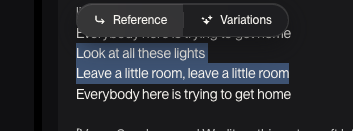
Yeah. I’d keep both “leave a little room”s and let “Somebody needs it tonight” answer “Look at all these lights.” On the 405, it is a gap in traffic. After the motel verse, it is a room with a door you can close.
Strange Loops — revised chorus
Everybody here is trying to get home
Look at all these lights
Leave a little room, leave a little room
Somebody needs it tonight
Everybody here is trying to get home
“We might be here all night” has more of the tired grin. I’d go with “Somebody needs it tonight” and let the grin come through in how you sing it the first time.
Charles
no I think leave a little room, then rhyme with lights then go back to trying to get home, you know? like we split the rhyme in the one line between the two lines above it
Codex
Yeah, one “leave a little room,” then the rhyme lands in the second half of that same line. Give “room” a little breath so “we might be here all night” comes out like a mutter.
Strange Loops — revised chorus
Everybody here is trying to get home
Look at all these lights
Leave a little room, we might be here all night
Everybody here is trying to get home
Charles
it's a strange loop, you know?
Codex
Yeah. “Room” leans toward “home,” then “might” and “night” pick up the sound of “lights.” By the time you sing “Everybody here is trying to get home” again, you’ve circled back with a little more sympathy for everybody in your way.
And after the motel verse, “we might be here all night” can sound like relief. Somebody finally gets to stay.
Charles
yeah I love that layered read of it too! ok let's refresh the lyrics/production cues and the style instructions. Can we emphasize an older voice?
Codex
Strange Loops — style instructions
Midtempo indie soul road song around 94 BPM, with a loose swing. Warm Wurlitzer, a bass line that circles back on itself, muted electric guitar, and a dry rim click like a turn signal.
An older lead singer with a warm low register, a little grain, and relaxed phrasing just behind the beat. Keep the voice close enough to hear the breath. The grin should come through in the timing, especially in the beat of silence before “but it’s looking pretty dead to me.” Let the chorus open into an easy melody. Take a small breath after “leave a little room” and let “we might be here all night” answer “look at all these lights.”
In verse two, the guitar answers the lead and the lead picks up its rhythm. Do the same thing with the two voices in the chorus. After the motel door clicks, lose the drums and keep the chorus melody and pace. Sing “we might be here all night” with a little relief. Double the hi-hat over the steady bass in the bridge, then cut the band on “ground stop” and bring back the turn-signal click.
Start the last chorus in unison and let it open into loose harmonies, with the older lead still audible in the middle. Drop the instruments on the final “home.” Let the voices hold it together and come off it a little unevenly, like people singing in the same room.
Charles
style instructions are over 1,000 characters
Codex
Strange Loops — style instructions
Midtempo indie soul road song, 94 BPM, with a loose swing. Warm Wurlitzer, looping bass, muted electric guitar, and a dry rim click like a turn signal. Older lead with a warm, grainy low register, close to the mic and a little behind the beat. Pause before the half-spoken “but it’s looking pretty dead to me.”
Open into an easy chorus melody. Breathe after “leave a little room” so “all night” answers “lights.” In verse two, guitar and lead trade rhythms. A second voice echoes “leave a little room” a beat late. After the motel latch clicks, drop the drums. Keep the melody and let the lead borrow that phrasing, with a little relief on “all night.”
Double the hi-hat over steady bass in the bridge. Cut the band on “ground stop,” then bring back the rim click. Everyone sings the final chorus in unison before opening into loose harmony. Drop the band on the last “home” and end on held voices.
From road song to late-night lounge
Charles
let's use those spare 100 characters in the style instruction to describe the older voice we want here, a little more scratchy a little more weathered
Codex
Strange Loops — style instructions
Midtempo indie soul road song, 94 BPM, with a loose swing. Warm Wurlitzer, looping bass, muted guitar, and a dry rim click like a turn signal. Older lead with a warm, weathered low register, close to the mic and a little behind the beat. Let the dry, scratchy rasp catch at the ends of lines and crack a little as the melody lifts. Pause before the half-spoken “but it’s looking pretty dead to me.”
Open into an easy chorus melody. Breathe after “leave a little room” so “all night” answers “lights.” In verse two, guitar and lead trade rhythms. A second voice echoes “leave a little room” a beat late. After the motel latch clicks, drop the drums. Keep the melody and let the lead borrow that phrasing, with a little relief on “all night.”
Double the hi-hat over steady bass in the bridge. Cut the band on “ground stop,” then bring back the rim click. Everyone sings the final chorus in unison, then loose harmony. Drop the band on the last “home” and end on held voices.
Charles
Let's dig more Leonard Cohen, it's feeling a little too Jason Mraz
Codex
Strange Loops — style instructions
Spare, late-night ballad at 76 BPM with a straight pulse. Low Wurlitzer chords, a bass figure that keeps coming back, muted guitar, and a dry rim click like a turn signal. Older bass-baritone, close to the mic, with a weathered, scratchy rasp. Half-speak the verses on a few low notes. Let “pretty dead to me” land a beat late, with a tired grin.
Give the chorus a simple, hymn-like melody. Breathe after “leave a little room,” then let “all night” answer “lights.” On the second chorus, a backing voice echoes “leave a little room” a beat late. After the motel latch clicks, drop the drums and let the lead borrow that phrasing. Sing “all night” like a relief.
Double the hi-hat over steady bass in the bridge. Cut to silence on “ground stop,” then bring back the rim click. Let everyone sing the final chorus in unison before opening into low harmony. Drop the band under the last “home” and let the voices hold it.
Charles
would we want to revisit the production cues too?
Codex
Yes. I’d make the cues as spare as the new sound. Let the older voice set the pace, give the motel latch a beat of silence, and save the full harmonies for the end. The lyrics stay as written.
Charles
it's feeling a little too southern, like country adjacent, I'm thinking more east coast, late night lounge
Codex
I hear it in a small New York jazz room after midnight. Put the older singer right up against the mic, with upright bass, brushes, and a piano player who knows how to leave him hanging for a beat. The tired grin is in the way he says “pretty dead to me,” like the pianist has heard him tell this story before.
Strange Loops — style instructions
After-hours New York piano lounge ballad, 76 BPM, with a straight, understated pulse. Upright bass, brushed snare, and acoustic piano playing spare seventh chords. Start with two dry rim clicks like a turn signal. Older bass-baritone, close-miked, with a dry, weathered rasp that catches at the ends of words. Half-speak the verses on low notes with crisp diction. Leave a beat before “pretty dead to me.”
Keep the chorus simple and low. Breathe after “leave a little room” so “all night” answers “lights.” In verse two, piano answers the lead and he picks up its rhythm. A low backing voice echoes “leave a little room” a beat late. After the motel latch clicks, drop the brushes and sing “all night” with quiet relief.
Let the brushes quicken over steady bass in the bridge. Cut to silence on “ground stop,” then bring back the rim click. Everyone joins the final chorus in unison, then close harmony. Drop the trio on the last “home” and end on held voices.
In the lyric cues, I’d give the piano the guitar’s answer after “I’ll walk you through.” Two dry notes are enough. Let the singer borrow their rhythm on “It sang a line I’d thrown away.” That’s where you get to hear the loop happen.
Acid jazz and dance-punk
Charles
yeah I dig that. let’s put the full lyrics together with the updated late-night lounge production cues
Codex
Charles
ok here are my latest lyric edits:
[Intro — 76 BPM, straight pulse. Two dry rim clicks, then upright bass and a sparse piano seventh chord]
[Verse 1 — older bass-baritone close to the mic. Dry rasp, low notes, almost spoken]
An hour on the 405
I swear this traffic is alive
[Let a beat pass, then mutter] But it’s looking pretty dead to me.
I know that license plate by heart
I close the gap. I do my part.
Then wave one in. We move a yard.
Look at us.
[Chorus — solo lead, simple low melody. Brushes enter softly. Breathe after “room”]
Everybody here is trying to get home
Look at all these lights
Leave a little room, we might be here all night
Everybody here is trying to get home
[Verse 2 — piano answers “I’ll walk you through” with two dry notes. The lead borrows their rhythm on the next line]
I told a joke. It said it laughed.
I bought it for a beat or two
It caught the setup, missed the turn
I said, “Hang on. I’ll walk you through.”
It sang a line I’d thrown away
I sang it in the car today
[Chorus — one low backing voice echoes “leave a little room” a beat late]
Everybody here is trying to get home
Look at all these lights
Leave a little room, we might be here all night
Everybody here is trying to get home
[Verse 3 — leave more space between piano chords. One soft latch click after “closed,” then a beat of silence]
They put a sink beneath the bridge
Where people slept beside the road
Then COVID hit. They rented rooms.
I thought, “Wait, we can just do that now?”
A motel key beside the lamp
The little click when the door closed
[Chorus — piano and bass only. Same melody, with the lead borrowing the backing voice’s phrasing. Let “all night” sound like relief]
Everybody here is trying to get home
Look at all these lights
Leave a little room, we might be here all night
Everybody here is trying to get home
[Bridge — brushes return and quicken. Upright bass holds the same pace, and the lead takes his time]
Pull it fast. Keep the candles lit.
I want to see what’s under it.
You’ve got both hands on the candlesticks.
I hear you saying, “Wait a bit.”
[Verse 4 — trio cuts on “ground stop.” A beat of silence, then the opening rim click returns. Keep “Look at us” to one voice]
“Ground stop,” the captain says. “Sit tight.”
I know that safety card on sight
I text, “Go on and eat. We’re stuck.”
I check the time. I check again.
Look at us. Wish us luck.
[Final chorus — everyone enters in unison, then opens into close harmony on “leave a little room.” Drop the trio under the last “home.” End on held voices]
Everybody here is trying to get home
Look at all these lights
Leave a little room, we might be here all night
Everybody here is trying to get home
I'm interested to get it a little more acid jazz infused, it's feeling too sleepy standard now
Codex
I’d put it at 98 BPM in a tight jazz-funk pocket. Let the bass and drums supply the urgency while the older singer hangs behind the beat. “Look at us. Wish us luck.” can land dry over the rim click, then the whole room comes in.
Strange Loops — acid jazz style instructions
After-hours New York acid jazz at 98 BPM. Round electric bass, clipped Rhodes seventh and ninth chords, and a tight live breakbeat with ghost notes and crisp sixteenth-note hats. Two dry rim clicks open like a turn signal. Older bass-baritone, close-miked, with a dry, weathered rasp. Half-speak the verses behind the beat. Leave a beat before “pretty dead to me.”
Keep the chorus low and easy to sing. Breathe after “leave a little room” so “all night” answers “lights.” Rhodes plays two clipped notes in verse two and the singer borrows their rhythm. A low backing voice echoes “leave a little room” a beat late. After the motel latch, drop the kit and let bass and Rhodes keep the pulse. Sing “all night” with quiet relief.
Quicken the hats in the bridge. Cut the groove on “ground stop,” then bring back the rim click. Everyone sings the final chorus in unison, then close harmony. Drop the band on the last “home” and end on held voices.
Charles
yeah I dig that. can we make the bass and drums a little grittier while keeping that scratchy older voice out front? let’s keep the style instructions under 1,000 characters and allow the drippy drums to dry out a bit
Codex
Strange Loops — acid jazz style instructions
After-hours New York acid jazz, 98 BPM. Syncopated electric bass with amp grit and audible string buzz, clipped Rhodes chords, and a dry live breakbeat. Close-miked kit with a punchy kick, papery snare, ghost notes, tight hats, and a short room tail. Open with two rim clicks like a turn signal.
Keep the older bass-baritone out front, close and dry, with a scratchy rasp that catches on the last word. Half-speak behind the beat. Wait a beat before “pretty dead to me.” Breathe after “leave a little room.” Rhodes answers in two short notes, and the lead picks up their rhythm. One low voice echoes “room” a beat late.
After the motel latch, drop the kit and keep the bass pulse. Let “all night” sound like relief. Double the hats in the bridge, then cut to silence on “ground stop” and bring back the rim click. Final chorus starts in unison and opens into close harmony. Drop the band on the last “home.” End on held voices.
Charles
ok let's zag here, let's do raspy female led dance punk. Really drive this one home, you know? feels poetic almost
Codex
Strange Loops — dance-punk style instructions
Scratchy, female-led dance-punk at 124 BPM. Two dry rim clicks, then a relentless four-on-the-floor kick, a cracked snare, and a dirty picked bass riff that keeps circling back. Short, jagged guitar chops. Keep the kit dry and close.
Put a raspy, weathered alto right up front. Half-speak the verses with a tired grin. Leave a beat before “pretty dead to me.” Let her rasp open up on “everybody here is trying to get home.” Breathe after “leave a little room,” then lean into “all night.”
In verse two, the guitar throws her two clipped notes and she sings their rhythm back. A backing voice echoes “room” a beat late. After the motel latch, strip it to bass and voice. Let “all night” sound like relief. Build the bridge on racing hats, then stop the whole band on “ground stop.” Bring it back hard for the final chorus, everyone singing in unison. Open into harmony, then cut the band under the last “home” and let the voices hold it.
Charles
here's my latest on the lyrics, let's update the production cues, also what do you think of my edits? [Intro — 98 BPM. Two dry rim clicks, then a syncopated electric bass figure. Rhodes stabs and live drums lock in]
[Verse 1 — older bass-baritone close to the mic. Dry rasp, low notes, a little behind the beat]
An hour on the 405
I swear this traffic is alive
[Let a beat pass, then mutter] But it’s looking pretty dead to me.
I know that license plate by heart
I close the gap. I do my part.
Then wave one in. We move a yard.
Look at us. Just look at us.
[Chorus — solo lead, simple low melody. Bass opens up. Breathe after “room”]
Everybody here is trying to get home
Look at all these lights
Leave a little room, we might be here all night
Everybody here is trying to get home
[Verse 2 — Rhodes answers “I’ll walk you through” with two clipped notes. The lead borrows their rhythm on the next line]
I told a joke. It said it laughed.
I bought it for a beat or two
It caught the setup, missed the turn
I said, “Hang on. I’ll walk you through.”
It sang a line I’d thrown away
I sang it in the car today
[Chorus — one low backing voice echoes “leave a little room” a beat late]
Everybody here is trying to get home
Look at all these lights
Leave a little room, we might be here all night
Everybody here is trying to get home
[Verse 3 — leave more space between Rhodes chords. One soft latch click after “closed,” then a beat of silence]
They put a sink beneath the bridge
Where people slept beside the road
Then COVID hit. They rented rooms.
I thought, “Wait, we can just do that now?”
A motel key beside the lamp
The little click when the door closed
[Chorus — kit drops out. Bass keeps the pulse under sparse Rhodes. Same melody, with quiet relief on “all night”]
Everybody here is trying to get home
Look at all these lights
Leave a little room, we might be here all night
Everybody here is trying to get home
[Bridge — kit returns. Hats double up over the same bass figure. The lead takes his time]
Pull it fast. Keep the candles lit.
I want to see what’s under it.
You’ve got both hands on the candlesticks.
I hear you saying, “Wait a bit.”
[Verse 4 — cut the groove on “ground stop.” Bring back the opening rim click and let the lead deliver the last line alone]
“Ground stop,” the captain says. “Sit tight.”
I know that safety card on sight
I text, “Go on and eat. We’re stuck.”
I check the time. I check again.
Look at us. Wish us luck.
[Final chorus — full groove returns. Everyone enters in unison, then opens into close harmony on “leave a little room.” Drop the band under the last “home.” End on held voices]
Everybody here is trying to get home
Look at all these lights
Leave a little room, we might be here all night
Everybody here is trying to get home
Codex
“Look at us. Just look at us.” is the tired grin. I’d toss the second half off like she’s still looking through the windshield. By the airport verse, “Look at us. Wish us luck.” turns the same gesture into a little plea. And “now” in “Wait, we can just do that now?” is worth the extra syllable. Let it spill past the beat so the surprise sounds spoken.
For the dance-punk pass, I’d keep the band pushing at 124 BPM and put a weathered, raspy alto right up front. She can take her time even when the room’s moving.
Charles
It feels like this wants to have some B-52 dna in it
Codex
Yeah. I hear it in the deadpan lead and the answering voices. She mutters “Look at us” like she’s alone in the car, and two voices snap back “Just look at us.” The joke is that she suddenly has company. And “we might be here all night” can sound like an invitation to dance the first time, then like relief after the motel latch.
Strange Loops — surfy dance-punk style instructions
Surfy new-wave dance-punk at 124 BPM. Two dry rim clicks, then a dirty picked bass riff, four-on-the-floor kick, cracked snare, and wiry offbeat guitar. Use cheap combo organ for quick stabs. Keep the kit close and dry.
Put an older, raspy female alto up front. Half-speak the verses with a tired grin, then sing out on “home.” She mutters “Look at us” and two backing voices snap back “Just look at us.” Let the guitar answer her with two clipped notes in verse two. A backing voice echoes “room” a beat late.
After the motel latch, strip to bass and lead. Sing “all night” with quiet relief. Bring the band back hard for the bridge, then cut it on “ground stop.” Leave “Wish us luck” to the lead alone. Everyone hits “Everybody” together in the final chorus, then splits into harmony. Cut the band on the last “home” and let the voices hold it.
Charles
do the production cues work as is?
Codex
Mostly, yes. The four-on-the-floor kick, wiry guitar, motel breakdown, and hard stop at the airport already work. I’d change two cues to bring out the new-wave character. Give the organ a quick jab between guitar chops, and make “Just look at us” an actual answer from the backing singers.
Keep “Look at us. Wish us luck.” solo at the airport. By then you’ve learned to expect an answer, so the silence has a little bite before everybody comes back in.
The small-club garage-rock arrangement
Charles
I feel like nick cave is the pocket for this, nick cave and the bad seeds. Almost like Dig Lazarus Dig, you know?
Codex
Yeah, I hear the Dig, Lazarus, Dig!!! pocket. The bass keeps bearing down while she tells the story at her own pace. I’d keep the weathered alto and give her room to sound amused by her own bad behavior. On “I close the gap. I do my part,” she can sound almost proud of herself. Then the backing singers throw “Just look at us” back at her.
Strange Loops — garage-rock style instructions
Live garage rock at 116 BPM. Two dry rim clicks, then a filthy repeating bass riff, hard snare backbeat, wiry guitar, and snarling combo organ. Keep the drums dry and let the band push. Put a weathered female alto close to the mic. Half-speak low and behind the beat, with a scratchy rasp and a tired grin. Leave a beat before “pretty dead to me.”
Let the chorus open into a rough singalong. Breathe after “leave a little room.” Two voices throw back “Just look at us.” In verse two, guitar plays two clipped notes and she sings their rhythm back. After the motel latch, leave bass and voice. Let “all night” sound like relief.
Bring the band back hard at the bridge. Cut it on “ground stop” and let “Wish us luck” land alone. Everyone hits “Everybody” together in the final chorus. Open into rough harmony, then cut the band under the last “home” and let the voices hold it.
For the cues, I’d trade the four-on-the-floor kick for that hard snare backbeat and let the organ hang over the bar line in the bridge. She can take her sweet time saying “Wait a bit” while the band sounds ready to go.
Charles
yeah I dig that. let’s put the full lyrics together with the updated production cues for that Dig Lazarus Dig pocket, keeping the raspy female lead
Codex
Charles
we shouldn't get any crowd sound, let's make it feel like they're playing a smaller venue
Codex
I’d set it at soundcheck in an empty club. Let a little room sound around the snare and amps, with her rasp right up against the mic. The lift at the end comes from the two backing singers joining her.
Strange Loops — small-club garage-rock style
Garage rock at 116 BPM, recorded at soundcheck in an empty small club. Short room reflections, close-miked drums, dirty picked bass, wiry guitar, and snarling combo organ. Two dry rim clicks open into a hard snare backbeat.
Keep the weathered female alto right up front. Half-speak behind the beat, with a scratchy rasp and a tired grin. Two backing singers throw back “Just look at us.” Guitar answers with two clipped notes in verse two and she sings their rhythm back.
After the motel latch, leave bass and lead. Let “all night” sound like relief. Bring the band back hard at the bridge, with organ hanging over the bar line. Cut on “ground stop” and leave “Wish us luck” to her alone. Lead and both backing singers hit “Everybody” in unison, then split into rough harmony. Cut the band on the last “home” and let those three voices hold it.
I’d swap in these three cues where the sense of space matters most.
Charles
can you give it to me in context, all together
Codex
Strange Loops — small-club garage-rock style
Garage rock at 116 BPM, recorded at soundcheck in an empty small club. Short room reflections, close-miked drums, dirty picked bass, wiry guitar, and snarling combo organ. Two dry rim clicks open into a hard snare backbeat.
Keep the weathered female alto right up front. Half-speak behind the beat, with a scratchy rasp and a tired grin. Two backing singers throw back “Just look at us.” Guitar answers with two clipped notes in verse two and she sings their rhythm back.
After the motel latch, leave bass and lead. Let “all night” sound like relief. Bring the band back hard at the bridge, with organ hanging over the bar line. Cut on “ground stop” and leave “Wish us luck” to her alone. Lead and both backing singers hit “Everybody” in unison, then split into rough harmony. Cut the band on the last “home” and let those three voices hold it.
Track 6 on Grief without Ritual
Listen to Strange Loops and open its songbook